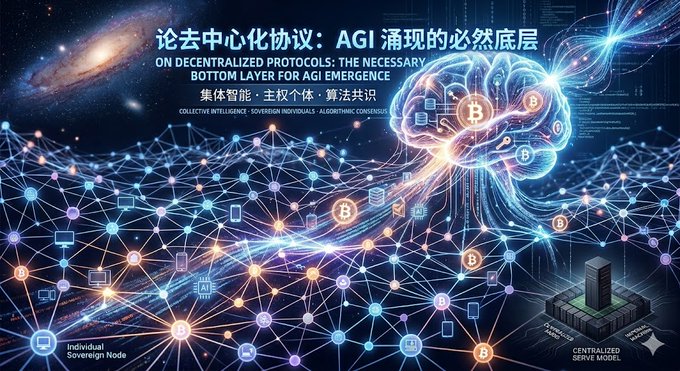
On Decentralized Protocols: The Inevitable Underlying Factor of AGI Emergence
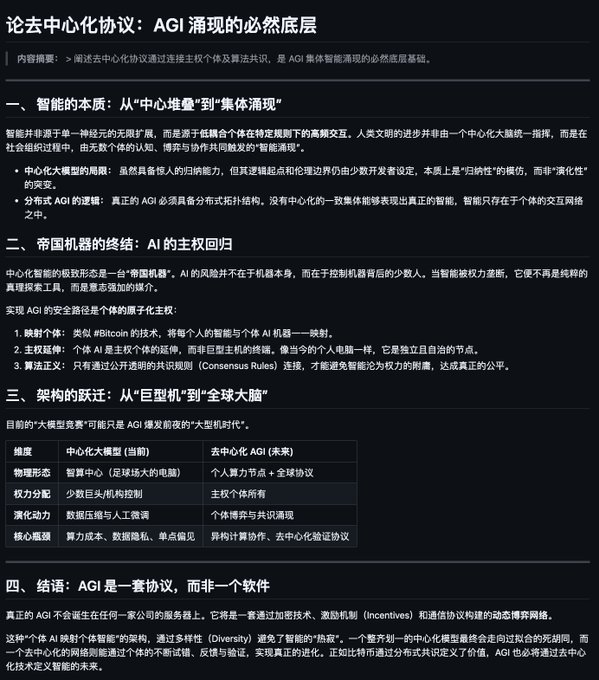
In the current AI wave, the computing power arms race has pushed large-scale models to their peak. However, this path based on centralized computing power stacking may merely be the "mainframe era" on the eve of the AGI (Artificial General Intelligence) explosion. True AGI should not be the will of a single giant machine, but rather a global intelligent system similar to the Bitcoin network, emerging through the collaboration of sovereign individuals.
I. The Essence of Intelligence: From "Centralized Stacking" to "Collective Emergence"
Intelligence does not originate from the infinite expansion of a single neuron, but rather from the high-frequency interaction of loosely coupled individuals under specific rules. As social beings, the progress of human civilization is not uniformly commanded by a centralized brain, but rather a "spontaneous emergence of intelligence" triggered by the cognition, competition, and collaboration of countless individuals during the process of social organization.
While current centralized large-scale models possess astonishing "inductive" abilities, their logical starting point and ethical boundaries are still set by a few developers. Essentially, they are imitating existing structures defined by humans, rather than understanding structures through evolution like organisms in nature. If AGI is defined as intelligence with the breadth and depth of human civilization, then it must possess a distributed topology—no centralized, unified collective can exhibit true intelligence; intelligence exists only within the interactive network of individuals.
II. The End of the Imperial Machine: The Return of Sovereignty to AI
The ultimate form of centralized intelligence is an "imperial machine." The risk of AI lies not in the machine itself, but in the few who control it. When intelligence is monopolized by power, it ceases to be a pure tool for exploring truth, becoming a medium for imposing will.
The only safe path to achieving AGI is the atomized sovereignty of individuals. Decentralized technology, similar to Bitcoin, can map each person's intelligence to an individual AI machine. In this architecture, individual AI is like today's personal computer (PC); it is an extension of the sovereign individual, not a terminal of a giant mainframe. Only when everyone has complete control over their own intelligent node, connected through consensus rules rather than administrative orders, can intelligence avoid becoming a slave to power and true "algorithmic justice" be achieved.
III. The Architectural Leap: From a "Football Field-Sized Computer" to a "Global Brain"
We are currently in a cognitive misconception: that the more centralized the computing power, the closer we are to AGI. In fact, today's centralized large-scale models are more like a "computer occupying the size of a football field." In the early days of computers, mainframes occupied physical space; in the AI era, large models occupy intensive computing power.
However, just as the widespread adoption of personal computers and the emergence of the internet truly reshaped human civilization, the birth of AGI will also depend on the leap from "single-machine" to "network." AI is still just an upgraded version of the personal computer, while AGI is the neural network connecting these computers. In this system, each individual node operates independently, possessing its own private data and logical preferences. They are interconnected, interact, and verify each other through decentralized protocols (such as the DeAI protocol).
IV. Conclusion: AGI is a Protocol, Not Software
True AGI will not be born on any company's server. It will be an ecosystem built through encryption technology, incentive mechanisms, and communication protocols.
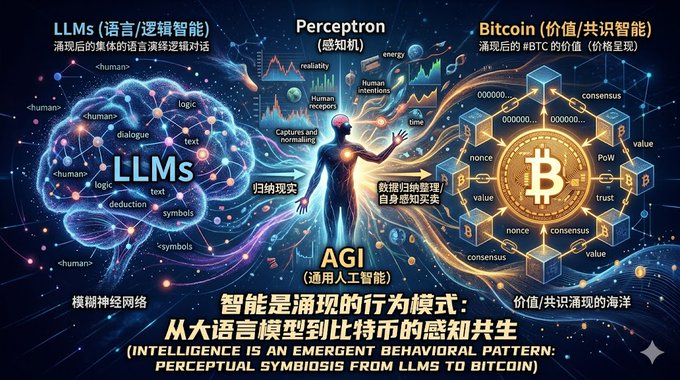
This architecture, which maps individual AI to individual intelligence, not only addresses the risks of single points of failure and single-point bias but also avoids the "heat death" of intelligence through its high diversity. A uniform, centralized model will eventually lead to overfitting, while a decentralized network can achieve true evolution through continuous trial and error, feedback, and consensus among individuals. Just as Bitcoin defines value through distributed consensus, AGI will inevitably define the future of intelligence through decentralized technology.
twitter.com/gguoss/status/2039...