Five tech giants squeezed through the same door within five days—the AI world is in an uproar! You must know that!
On the 18th, Stripe, Tempo, and Paradigm jointly released the payment protocol MPP, and the Tempo mainnet. On the same day, Visa established Crypto Labs and released the Visa CLI.
On the 17th, Mastercard acquired stablecoin infrastructure BVNK for $1.8 billion.
Did you notice Coinbase's x402 protocol upgrade and WLFI's release of its AgentPay SDK last night? They're all vying for the same thing: AI's bank cards. Over the past three years, every layer of the AI industry chain has been controlled.
- The model layer is the playing table for OpenAI, Anthropic, and Google.
- The computing power layer is monopolized by NVIDIA
- The application layer, from programming assistants to search engines, has become a red ocean, but the battle at the payment layer has already begun. Stripe × Tempo built an open MPP protocol, and Coinbase x Cloudflare built X402.
Last year, Google launched the AP2 consortium to develop global standards for AI Agent payments, and HashKey was among the first compliant digital financial institutions in the Asia-Pacific region to enter the field. I remember their Dr. Xiao Feng saying something like this:
"If an AI agent is to begin operating independently of humans and creating economic value, it will definitely need an account. Currently, the only suitable form seems to be a digital wallet, rather than an account opened for the agent through a bank."
Traditional bank accounts have limitations on the number of accounts that can be opened, unclear liability, high payment costs, and low efficiency. When 5 billion AI agents simultaneously conduct high-frequency, micro-amount cross-border settlements globally, traditional systems will be instantly overwhelmed.
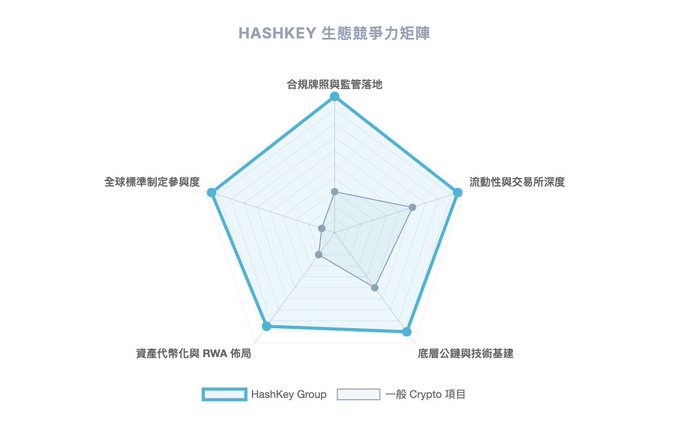
AI and blockchain are two sides of the same coin, and that's exactly what HashKey is doing. With custody, exchanges, public chains, RWA, and stablecoins all in hand, HashKey is beginning to dominate other crypto projects, especially considering they went public on the Hong Kong Stock Exchange last year.
The AI economy needs the same thing: a clearing language, settlement channels, and trusted compliance anchors designed for agents.
HashKey has already established a presence in these three areas: the Hong Kong VASP license serves as a compliance anchor; the public blockchain and stablecoins act as settlement channels; and joining Google's AP2 consortium to jointly develop standards with PayPal, Circle, and UnionPay International.
Is HashKey the SWIFT of the AI era?
This article is a collaboration with @HashKeyGroup and features @tiezhucrypto.