Today
Intel
Market
Earn
Settings
Account
Theme Selection
Light
Dark
Language
English
简体中文
繁體中文
Tiếng Việt
한국어
Followin APP
Mine Web3 Possibilities
App Store
Google Play
Log in
ZC |BlueBird
4,521 Twitter followers
Follow
Posts
ZC |BlueBird
05-22
Thread
#Thread#
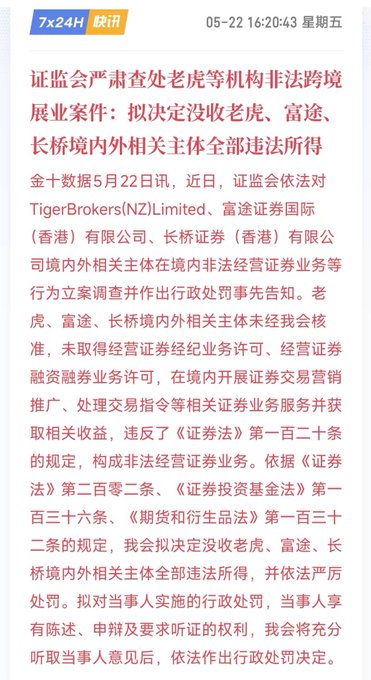
Okay, now it's completely blocked. Ordinary people can forget about directly buying US stocks. Tiger and Futu have to give back all the money they've made over the years. From now on, they'll just have to put US stocks on the blockchain. That's the only thing that's hard to regulate, like cryptocurrencies. They've been regulated for so many years, but people can still play around with them. 😂😂😂😂😂😂 Remember this: anything that's off-limits or restricts your access to is definitely a good thing. For example, previously, it was houses/household registration/school districts in big cities; now it's going to include US stocks. Anything that encourages your participation is likely to result in losses, like starting a business/studying/owning a house. So do you know why you should buy US stocks? twitter.com/ZhanweiC/status/20...
ONDO
6.6%
ZC |BlueBird
05-07
Thread
#Thread#
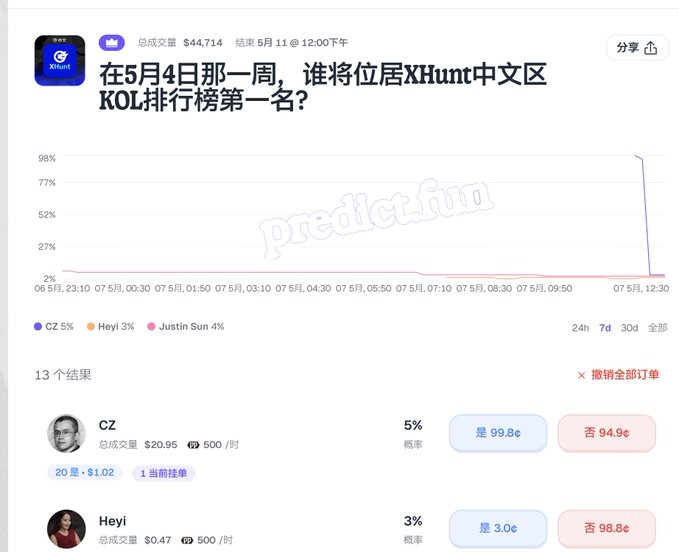
Latest Predict Point-Gaining Tips: Testing 20,000 Points with Under 50U Predict has been launching new markets recently, and these new markets usually offer high point rewards. Often, scripts can't be updated in time, so manual settings can be used to gain a significant number of points during the initial mining phase. For example: Who will be number one on the XHunt Chinese KOL rankings during the week of May 4th? In this market, CZ is almost certainly the winner. After all, CZ has consistently topped the rankings, and his popularity is high enough. But the key isn't predicting the outcome, but rather the point pool. This market currently offers approximately 6,500 points per hour, totaling 156,000 points per day. If I can capture 5% of that, that's 7,800 points per day. If I can maintain similar efficiency throughout the week, 20,000 points isn't difficult. The specific strategy is as follows: When a new market first launches, there's usually no liquidity available, especially for the YES direction where liquidity is very thin. For example, with the CZ option, I initially placed 10 buy orders with a 95% YES probability. Then I placed 10,000 sell orders with a 0.3 NO probability, effectively consuming all the available points. Similarly, the other options can be played this way. Currently, the probability of others winning is around 1%, so I place buy orders of 1000-2000 units, usually capturing about 20% of the entire points pool, a very comfortable experience. Of course, I know these options have a high probability of losing. But the key is: as long as the orders don't fill, I can continuously earn points. Even if they do fill, it's not entirely hopeless. Just sell quickly as soon as possible, minimizing losses to reduce risk. This method is still in testing. My goal is to keep costs below 50U and aim for 20,000 points. Overall, manual liquidity strategies in the early stages of a new market are definitely worth paying close attention to. @dingalingts @predictdotfun
ZC |BlueBird
03-29
Thread
#Thread#
Next, I'll be transferring funds to US stocks. These are good bloggers to bookmark; I suggest all crypto KOLs bookmark them too, because stock tokenization is the only thing that hasn't been disproven, and the US stock market is the only place with real people involved. The main battleground for this is YouTube, so we can do some research there. twitter.com/ZhanweiC/status/20...
ZC |BlueBird
03-13
Thread
#Thread#
Teacher Jia Yi clearly identified the problem, but I personally believe that the solution he provided did not address the core issue. The core problem with current AI+crypto, RWA, and other similar projects is that their market operations are all centered around the crypto community. Whether it's project teams, KOLs, or agencies, the metrics they set for themselves are generally centered around market share, traffic, and token price. However, their target audience is basically the crypto community. I don't know the specifics, but the project team and marketing company allocate the vast majority of their budget to crypto KOLs and marketing teams. But are the native users of the crypto community truly the customers of these projects? Is it possible that the biggest problem with Web3 is that project teams have mistaken speculators for users? Let me give you an example. The founder of Xiaolongxia (a cryptocurrency platform) wasn't originally from the crypto, but he was constantly being exploited by people in the crypto community, and now he intensely dislikes the crypto and blockchain. I think the core reason is that native crypto users only care about arbitrage and trading. What's even more frightening is that crypto people don't care about the product at all; they're not users. If you have to say, they're just early-stage testers. Once the project launches its token, these people have essentially fulfilled their mission. They won't use the product long-term, nor will they become true customers. So the question is clear: if a project really wants to find users, the order should be: 1️⃣ First, discover the real needs. 2️⃣ Find real users 3️⃣ Finally comes market outreach, but many Web3 projects now do it the other way around: Marketing comes first, then narrative, and only then do they remember they have a product. So a lot of agency work essentially boils down to one thing: creating a false sense of prosperity. Lots of traffic, lots of KOLs, impressive data, but where are the real users? Nobody knows. twitter.com/ZhanweiC/status/20...
ZC |BlueBird
03-03
Thread
#Thread#
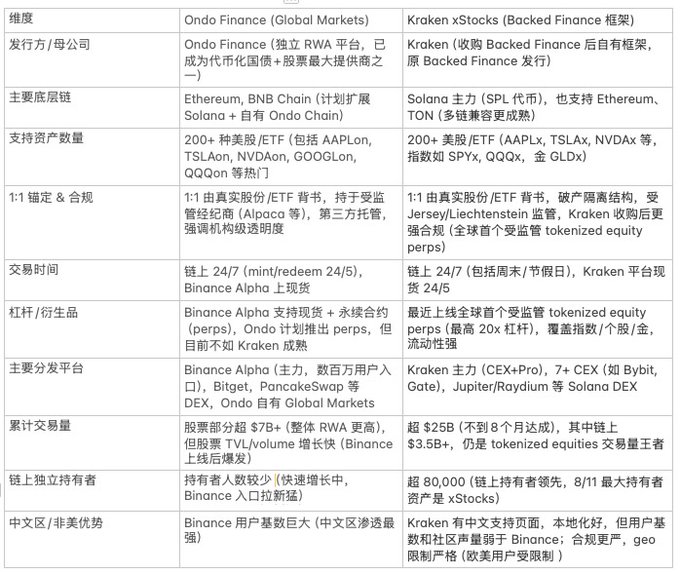
I'm guessing Xstocks is run by Chinese people, haha. Guys, you can go "collect your eggs"—they've prepared some USDC stocks to issue. Now, both Xstocks (a Kraken subsidiary) and Kraken are entering the Chinese market. The biggest reason is probably the still active user base in the Chinese-speaking region; there are too few users from other countries. And coincidentally—the on-chain stock market has exploded. Whether it's CEXs or DEXs, they're all rushing towards "on-chain US stocks." Something many haven't fully explained: The Chinese-speaking region has a huge characteristic: Buying US stocks has extremely high barriers to entry; obtaining a Hong Kong bank card is difficult. Opening accounts with overseas brokers is troublesome, the fund compliance path is complex, and there are many risk control restrictions. European and American users buying US stocks? Two minutes. Mainland users? Layer upon layer of hurdles. Therefore, if the on-chain stock market succeeds—its biggest potential market will definitely be mainland China. Not because it has the most money, but because there is demand that hasn't been met, coupled with a huge population base, there's still room for growth. Currently, this market is actually being fought between ONDO (supported by Binance) and Xstocks (a Kraken subsidiary), and the outcome in the Chinese-speaking region is crucial. Here's a key point: ONDO and xStocks' stock tokens are not interchangeable. To swap them, you can only do so through a DEX. This means—whoever controls the access controls the liquidity. I've compared the characteristics of the two projects in detail. Comparing the two camps: 🔵 Kraken + xStocks: Stronger compliance, has a segregation mechanism, and is directly affiliated with Kraken. Theoretically, if problems arise, you can find the main body to seek redress. Realistically speaking: If xStocks encounters risks, I can still seek redress from Kraken. If ONDO has problems, Binance won't cover it. If I had to choose? I would choose xStocks. Binance + ONDO: Binance has better Chinese user traffic. But ONDO itself is not a Binance subsidiary. If ONDO has problems, there might be no way to seek redress. Finally, my experience of over ten years tells me: The best benchmark in the US stock market is: The Nasdaq 100 Index (QQQx) Long-term annualized return is close to 10%+ @xStocksFi_zh twitter.com/ZhanweiC/status/20...
ONDO
6.6%
Loading..