At Devconnect in Argentina in November 2025, Ethereum Foundation researcher Justin Drake demonstrated a different block verification process. His verification node used the zkLighthouse client and relied solely on zero-knowledge proofs from protocols such as Brevis's Pico zkVM to determine the validity of blocks. This could very well foreshadow the future direction of Ethereum's scaling. It proves that the blockchain doesn't need to repeat all computations; it only needs to be able to verify externally generated proofs.
What is Brevis: A verifiable computation layer being used by protocols and the Ethereum core.
Brevis is positioned not just as a specific application, but as a verifiable computation layer. As an Infinite Compute Layer, it allows complex computations to be performed off-chain and the results brought back on-chain via zero-knowledge proofs, where smart contracts can verify them at extremely low cost. This is crucial because Ethereum's default security model essentially relies on network-wide recalculation. Each validating node, upon receiving a new block, often has to rerun all the transactions in the block to confirm its correctness. While this ensures correctness, it also means that computational power and resource consumption continuously increase with the workload. Brevis rewrites this repetitive recalculation into a single computation with network-wide verification. The computation and proof are generated off-chain, and the on-chain nodes only need to verify a small proof.
Unlike many ZooKeeper applications that focus solely on privacy or scalability, Brevis addresses a fundamental structural problem in the Web3 industry: as on-chain computations become increasingly complex and frequent, must the system rely on repeated execution by each node to maintain trust? Brevis's approach is to off-chain computation, with the zkVM executing and generating proofs. On-chain contracts only need to verify these proofs, allowing contracts to reliably utilize historical data, cross-chain states, or complex algorithm results without introducing additional trust assumptions. In achieving this goal, ZK Data Coprocessor, Pico zkVM, and ProverNet constitute its three core technologies.
Pushing the boundaries of smart contracts: The superpowers of ZK Data Coprocessor
Brevis's initial technological breakthrough was the ZK Data Coprocessor. It enables smart contracts to query arbitrary on-chain historical data, perform off-chain computations, and generate zero-knowledge proofs, providing the computation results as trusted input to the contract. The ZK Data Coprocessor can query and compute historical on-chain transaction volumes or user behavior, generating zero-knowledge proofs for contract verification. This allows contracts that previously could only access the current block to utilize long-term window data and cross-chain state.
After Brevis created the Coprocessor prototype in 2023, it iterated all the way to the release of v2 in January 2025, which was then launched on the mainnet. The key changes in v2, without getting bogged down in the specific name of the proof system, can be abstracted into three points: faster (the same task can be completed with fewer resources and in less time), more versatile (able to cover more types of data and computing needs), and easier to use (simplifying the process and encapsulating the complexity).
Looking back at Brevis's technical roadmap before 2025, there was essentially one main thread: first, clarify the performance boundaries of the proof system; then, develop the off-chain computation and on-chain verification into usable Coprocessors and continuously iterate them through engineering; and finally, explore more systematic operating models. What's even more commendable is the team's inherent strength: they understand both cryptography and large-scale systems engineering, they don't rely on theoretical derivations, they identified industry pain points early on, and they are committed to the large-scale adoption of the technology.
When proving capabilities enter the system layer: Pico zkVM and ProverNet
In 2025, Brevis completed the other two parts of the three-pronged approach: Pico zkVM, a more general-purpose and production-oriented proof execution engine, and ProverNet, which makes proof generation capabilities open and available, moving from being provable to being able to continuously and scalably provide proofs.
Pico zkVM can be understood as Brevis's general-purpose proof engine. It advances zero-knowledge proof from dedicated circuits and manual adaptation to a more software engineering-like approach—developers write logic using familiar development methods, and the underlying layer transforms it into verifiable proof results. More importantly, Pico has been designed from the outset with real-world business throughput and cost in mind. Under the same benchmark, Brevis's comparison shows that Pico has a significant performance advantage over mainstream zkVMs, while also enabling more efficient execution of specific types of computation through pluggable components/coprocessors.
In June 2025, Brevis released Pico-GPU, pushing real-time proof generation speed to a critical inflection point, not only for the protocol but also for the entire industry. Pico-GPU systematically moved the core proof generation process to GPU parallelism, with an official performance improvement of 10–20 times, representing a qualitative leap compared to previous solutions.
Released in October, Pico Prism pushed this direction to a very tangible level. With a configuration of 64 consumer-grade GPUs, it achieved a 99.6% proof completion time within 12 seconds and a 96.8% proof completion time within 10 seconds for Ethereum's 45M gas blocks, with an average proof time of approximately 6.9 seconds—closely approaching the Ethereum Foundation's goal. For the first time, real-time proof generation speed nearly perfectly matched Ethereum's block generation speed, and compared to competitors, it used fewer resources.
These developments have also received direct responses from the Ethereum core community. Vitalik directly mentioned in a tweet that Pico Prism's entry into the ZK-EVM proof race is an important step in proof speed and diversity. Justin Drake, in an earlier tweet, very clearly praised the extraordinary progress of real-time proof Pico Prism. It's worth noting that in May of this year, the SP1 Hypercube required 160 RTX 4090s to prove approximately 94% of L1 blocks within 12 seconds. This precipitous lead in real-time proof speed makes Brevis's Pico Prism the most watched solution.
After successfully developing general-purpose zkVM and real-time proof technology, Brevis began addressing the proof supply issue. In November 2025, Brevis announced the ProverNet vision, which would marketize proof capabilities, allowing any application to submit proof tasks and be matched with prover nodes in the market through an auction mechanism. The mainnet Beta, launched in December, further solidified this into a usable product, with a continuously operating market, direct submission of proof requests, and prover registration and bidding for orders, eliminating the need for applications to build their own proof infrastructure.
Through its three pillars, Brevis transforms proof capabilities from a tool into infrastructure: a scalable proof engine and an open proof supply network, enabling applications to obtain verifiable computation on demand. Its significance extends beyond Ethereum—this off-chain computation, on-chain verification paradigm will spill over into the entire Web3 ecosystem and even other industries such as AI and gaming.
Agreements don't lie: they only count when they're used.
Brevis's technological value is ultimately reflected in real-world applications. It's not a concept showcased in promotional materials, but rather integrated into the daily operation of the protocol. How data is collected, metrics are calculated, rewards are distributed, and fees are adjusted—things that were previously either impossible to do or could only be brute-forced using centralized scripts—are now finding a more protocol-driven path. In this process, Brevis has generated over 280 million proofs for users, distributed over $230 million in rewards, and securely driven $2.5 billion in TVL growth.
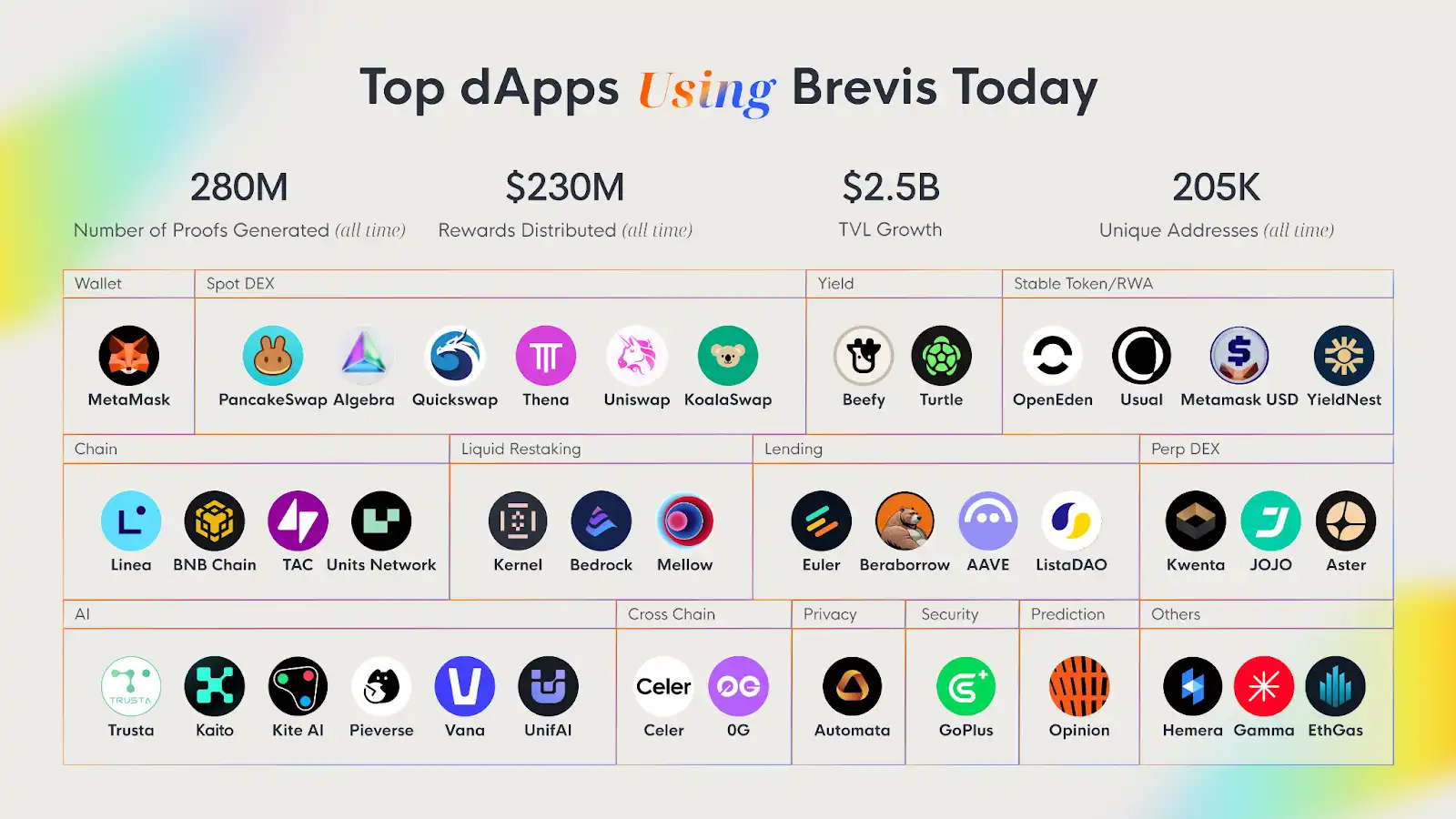
To understand Brevis, the most intuitive entry point is to start with trading, which is something users are most familiar with. Brevis can give DEXs the functionality of CEXs while ensuring data privacy and authenticity, thereby improving the trading experience for DEX users. PancakeSwap Infinity makes tiered fees possible through hooks, where historical behavior such as token holdings and trading volume affects the fee rate for a particular transaction. However, these judgments rely on historical data aggregation, which is too expensive to store on-chain and introduces trust issues if stored off-chain. What Brevis does is calculate historical behavior off-chain and then use proofs to bring the data back on-chain, allowing differentiated fees to be written into the contract, rather than being written into the background script like in CEXs.
If PancakeSwap offers a more personalized experience similar to a centralized exchange (CEX), Usual showcases a longer-term growth mechanism, transforming incentives from one-off airdrops into a continuously running CPI (Cost Per Income). Rewards are tied to long-term behaviors such as holding and interaction, and Brevis makes these metrics verifiable inputs, automating and auditing the distribution process without requiring the community to trust any operational spreadsheet or centralized distributor. Incentra standardizes reward issuance capabilities; protocols can issue LP, lending, or holding rewards based on off-chain metrics and on-chain settlement using proofs. Euler's activities at Arbitrum exemplify this—rewards are not distributed through manual statistics and multi-signature methods, but rather through continuous distribution supported by rules and proofs.
When the scenario expands to the ecosystem level, Linea's Ignition Program better illustrates the point. The challenge isn't issuing incentives, but how to issue them. Brevis enables large-scale incentive calculations to be completed off-chain and brings the credibility back on-chain for verification, thus shifting incentives from centralized operational actions to reusable system capabilities. Similarly system-oriented is Uniswap v4's Routing Rebate Program. Whether routing occurs, how gas consumption is statistically analyzed, and how the return amount is calculated are all part of the data-computation-settlement chain. Brevis handles off-chain computation and proof generation here, allowing the return system to be based on rules and verification, rather than relying on a single statistical provider.
Looking at these cases together, Brevis's data acquisition, metric calculation, and proof generation allow the protocol to write more logic that could only be implemented through a centralized backend back onto the chain without sacrificing decentralization. This enables the protocols in the entire crypto industry to do more, and the design space is thus reopened.
Who is supporting long-term technology?
Brevis's core team comprises researchers from top universities and frontline systems engineers. They possess distinct strengths: the ability to undertake long-term research into proof systems and algorithms, and the capacity to rigorously refine complex technologies in real-world production environments until performance, stability, and cost meet scalable deployment standards. More importantly, they are not merely a tech-savvy lab team—they are also intimately familiar with how the crypto industry operates: understanding the real needs of protocol stakeholders, the pace of ecosystem collaboration, and possessing long-term capital and community experience. This allows them to translate engineering projects into sustainable partnerships and developer momentum.
This is evident in the long-term support Brevis has received from capital and the community. Brevis completed its seed round of financing in November 2024, led by leading institutions such as Polychain and Yzi Labs, providing financial support for its continued advancements in zkVM, the proof network, and productization. Meanwhile, Brevis's community saw significant growth in 2025, with its Proving Grounds, role system, and task mechanism attracting continued participation from developers and users. Coupled with Vitalik's public affirmation and Justin Drake's attention to related progress in experiments and discussions at the Ethereum Foundation, these factors together constitute external endorsement and trust capital for Brevis's continued expansion as infrastructure.
From Ethereum to the wider world
Ethereum scaling has long been stuck in a structural dilemma: either all nodes perform repetitive computations in exchange for security and trustlessness, but throughput and cost are constrained by network-wide recomputation; or outsource computations to improve efficiency, but this requires additional trust in a particular computation provider. Brevis attempts to provide a third way—performing complex computations off-chain and then using proofs to bring trustworthiness back on-chain for verification, thus shifting the system from repetitive computation to a division of labor model that verifies results. Its value therefore lies not in a single product feature, but in establishing a complete, verifiable computation chain.
Brevis is not the only solution to Ethereum's scaling problem, but it demonstrates the significant value of a verifiable computation layer. By decoupling computation from verification, it ensures both security and decentralization while relieving pressure on on-chain execution. More importantly, the benefits of an infinite computation layer extend beyond Ethereum. For the entire crypto industry, it means more on-chain applications can achieve near-Web2 complexity and user experience without sacrificing security. In the broader traditional world, verifiable computation, where computation precedes verification, also provides a new collaborative approach—proofs can become a new universal language when multiple parties need to share results but cannot share trust. As open proof networks like ProverNet mature, Brevis will build not just a capability enhancement for a single chain, but a trusted computation supply that can be invoked across ecosystems and industries.