After a long period of silence, Virtuals Protocol announced its return with a large green candle. The price of VIRTUAL rebounded strongly at the start of 2026, not only regaining the 1 mark but also recording a gain of over 70% in less than 6 days.
This is not simply a matter of speculative investment; behind it lies a strategic upgrade by Virtuals Protocol for the AI Agent launch sector—evolving from a single launch platform into a tiered "Agent Capital Market."
Why is a single launch mode unsustainable?
In 2024, the cryptocurrency world was still figuring out how to use AI agents. At that time, Virtuals' approach was very clear— get the market running first . Its core logic was to enable agents to exist on-chain, trade publicly, and carry out real economic value transfers.
In the first half of 2025, the industry's pain points shifted. The implementation of the Genesis mechanism successfully solved the fairness issue: it abandoned the brutal "first come, first served" model and instead allocated shares based on "contribution," fundamentally breaking the monopoly of snipers and small groups on the ownership of AI agents.
However, the Virtuals team gradually realized that fairness is just the starting point, not the end . Excellent ecosystem builders need more than just a level playing field; they also need a "depot" to support long-term development.
Thus, in the second half of 2025, the Unicorn mechanism was born. It transforms the abstract concept of "belief" into concrete incentive rules: each Unicorn project starts with a low valuation, and early participants can reap asymmetric benefits; while the founding team's financial returns are deeply tied to the actual growth of the project, thereby forcing long-termism and shared responsibility.
As the ecosystem continues to expand, Virtuals has discovered an even more pressing contradiction: different AI Agent projects are not even on the same starting line . Some are just highly promising meme ideas that need to be launched quickly to validate the market; some are standardized "regular army" approaches that require sufficient funding to support technology research and development; and some are already leading projects with their own built-in audience and need an entry method commensurate with their size.
Three launch mechanisms to meet diverse needs
Virtual Protocol frankly stated that a single distribution model cannot adapt to the complex needs of the ecosystem. To address this, the team specifically launched three launch mechanisms: Pegasus, Unicorn, and Titan, building a unified and flexible proxy launch framework.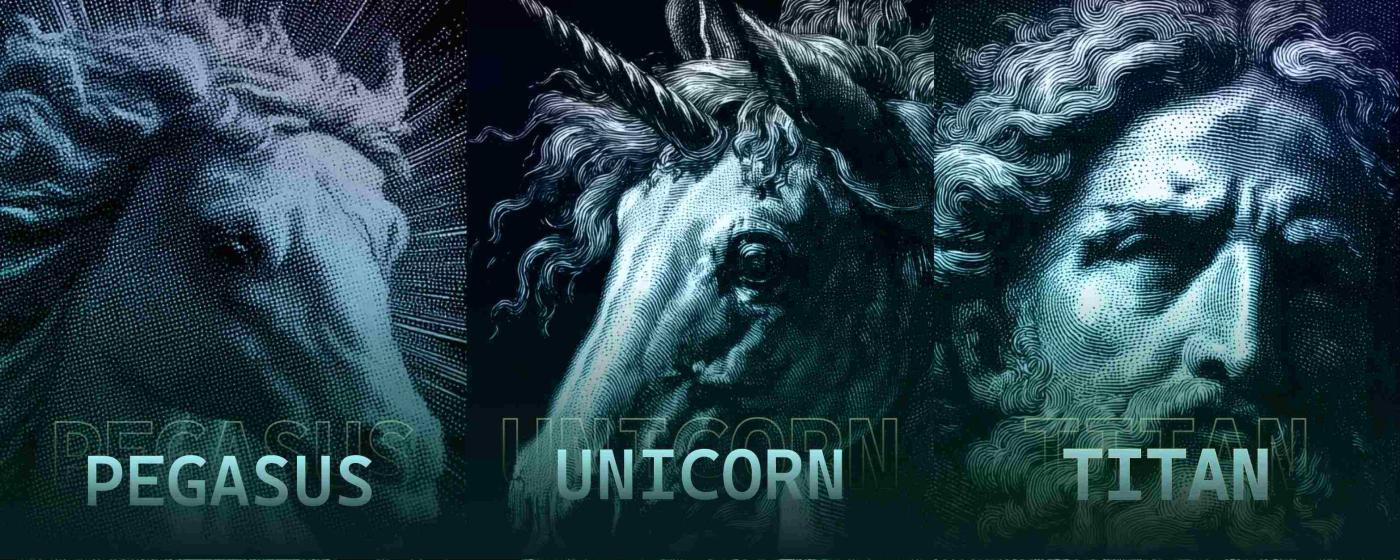
The brilliance of Virtuals' upgrade lies in the fact that it no longer tries to define "what is a good agent", but instead creates a suitable environment for agents at different stages to thrive.
Pegasus: Born for MEME and Inspiration
Pegasus is a purely market-driven testing ground, designed specifically for early-stage projects seeking a "quick and easy" approach. Whether it's a brilliant idea or a lightweight agent focused on community consensus, it can be launched rapidly through Pegasus.
Under this mechanism, 95% of the project's tokens will be directly injected into the liquidity pool, and the team must purchase tokens from the open market if needed. This design may seem stringent, but the logic is very clear: whether the market accepts the Agent or the idea behind it is most directly determined by voting with real money.
Core features:
- Lightweight startup architecture .
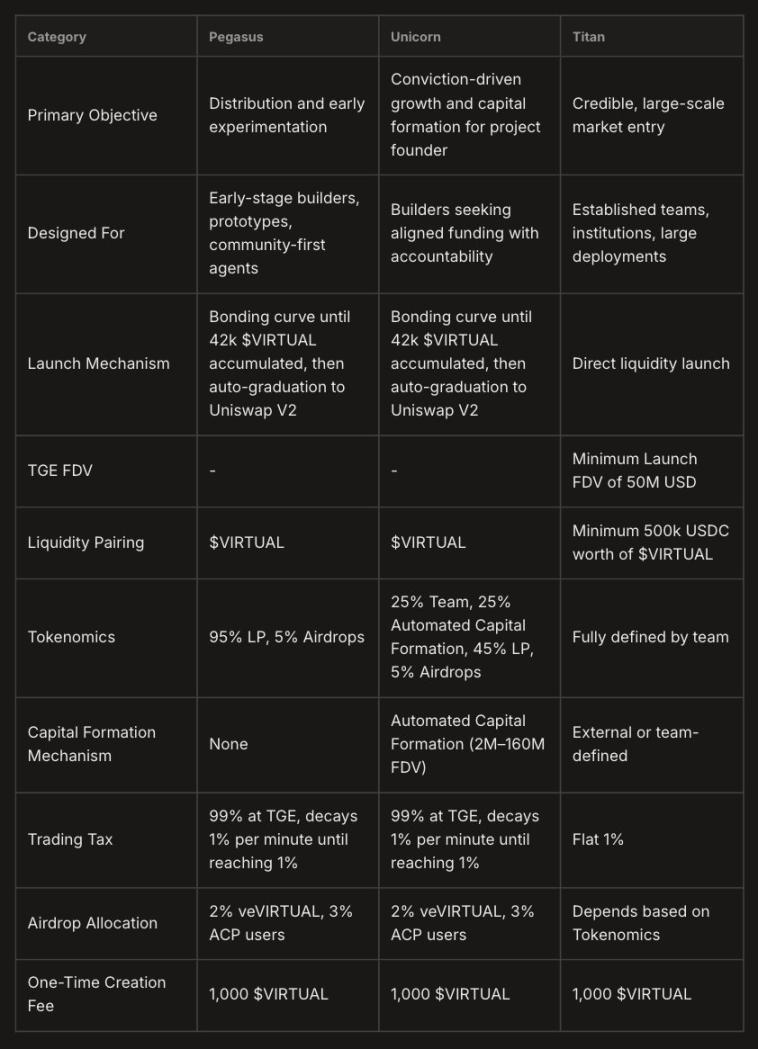
- Supply allocation : 95% of the token supply is allocated to liquidity pools, with no team reservations, no pre-sale, and only 5% reserved for ecosystem airdrops (of which, 2% is allocated to veVIRTUAL and 3% to ACP users).
- Price discovery : A transparent price discovery mechanism is provided using a joint curve.
- Transaction Tax : Pegasus's transaction tax design is quite interesting. It's 99% at TGE, then decreases by 1% every minute until it stabilizes at 1%. This is an extremely ruthless anti-sniping mechanism. This means that if scientists and bots want to get ahead in the first second, they're basically just giving money away to the pool.
- Graduation mechanism : Automatic graduation and listing on Uniswap V2 after reaching the liquidity threshold (42,000 VIRTUAL).
Pegasus is suitable for early-stage projects where "the idea is bigger than the execution." It allows you to launch and test market response without needing a complete white paper, a prestigious team, or institutional backing.
Unicorn: Providing a pathway for talented individuals to advance.
Unicorn is essentially Virtuals' current launch mechanism. Under the Unicorn model, project teams do not receive funding initially. Only when the agent proves its value in the market (reaching a certain FDV market capitalization) will the protocol release funds to the team in batches through an "automatic capital formation mechanism".
In short, for developers who are committed to long-term development, financing is no longer a "one-off deal," but a "bet between entrepreneurs and the market": only by delivering tangible results can they gain market recognition.
Core features:
- Structured Token Economics : Unlike the Pegasus mechanism, the token economics of projects launched through Unicorn is as follows: 25% allocated to the team, 25% for automatic capital formation, 45% allocated to LPs, and 5% for airdrops. Unicorn gives the team and capital formation mechanism more flexibility.
- Automatic Capital Formation Mechanism : This is Virtuals' killer feature. Funding isn't provided all at once; instead, it's released based on performance as the market capitalization reaches between $2 million and $160 million, unlocked in stages according to project performance, thus incentivizing the team to continuously deliver value.
- Launch mechanism : The Bonding Curve is still used, and the system automatically migrates to Uniswap V2 after accumulating 42,000 VIRTUALs. This ensures a smooth transition in early liquidity.
- Transaction tax : Similar to the Pegasus transaction tax, it is 99% at TGE, then decreases by 1% every minute until it stabilizes at 1%.
Unicorn's mechanism is suitable for teams that require financial support, are willing to accept long-term market evaluation, and adhere to long-termism.
Titan: A High-Barrier Startup Path for "Regular Army"
The Titan mechanism is designed for teams or organizations with established brand reputation and large-scale technology deployment capabilities, and it is also the highlight of this Virtuals strategic upgrade.
Key features:
- High entry barriers: minimum launch valuation of $50 million and at least $500,000 USDC equivalent in VIRTUAL liquidity pairing (TGE).
- Fixed tax rate: There is no need to go through the 99%→1% reduction process. The tax rate is stable at 1% from the first second of the transaction.
- High degree of customization: The high threshold comes with autonomy. The token economics, ownership timeline and distribution structure are completely defined by the founding team and are only subject to standard protocols and compliance.
- No bonding curve: does not rely on bonding curves, phased discovery, or protocol-mandated distribution mechanisms.
- Migration support: Supports the direct migration of existing proxy tokens to the Virtuals ecosystem by "bringing funds into the group".
The essence of the Titan mechanism is a two-way selection process of "trust for efficiency." The agreement grants projects a VIP-level launch channel based on their product strength, team background, and financial reserves; while the high threshold automatically filters out speculative projects lacking strength, providing users with the first line of defense against risk.
More importantly, the Titan mechanism will directly drive demand for VIRTUAL – the launch of each Titan project means that a large amount of VIRTUAL will be purchased and locked in liquidity pools, providing strong support for the token's value.
How to empower the VIRTUAL token?
From the perspective of VIRTUAL token empowerment, the three mechanisms achieve a unified underlying logic:
- Uniform entry threshold: Regardless of the launch mode chosen, the project creation fee is 1000 VIRTUAL, using standardized costs to screen high-quality projects.
- Mandatory Liquidity Binding: All liquidity pairings must use VIRTUAL. This means that the success of each AI Agent project will directly bring new buy orders and liquidity depth to VIRTUAL.
- Ecosystem Value Returns: The Pegasus and Unicorn mechanisms mandate a 5% token airdrop, with 2% going to veVIRTUAL stakers and 3% allocated to ACP users, directly rewarding loyal holders and participants in the ecosystem.
summary
The three-layer launch framework of Virtuals Protocol represents a strategic evolution from a single fair launch model to a layered, demand-matched launch ecosystem, and is also Virtuals' value capture network.
More importantly, it truly returns the choice to the ecosystem builders: there's no need to compromise launch models for financing, nor to forgo long-term development funds in pursuit of fairness. Choosing the most suitable mechanism based on project stage, team capabilities, and market positioning is precisely the core embodiment of "builder-centricity."
No single model can fit all projects, and Virtuals understands this deeply. Therefore, it focuses on "laying the track"—allowing creative ideas that seek explosive growth to sprint on Pegasus, enabling teams that cultivate long-term value to obtain continuous resources on Unicorn, and allowing giants with economies of scale to land steadily on Titan.
Pegasus captures traffic and ideas with a broad-based approach, Unicorn targets long-term builders willing to undergo market evaluation, and Titan focuses on mature, leading projects. Together, these three platforms create a flexible and unified AI agent launch system. In particular, the introduction of the Titan mechanism makes VIRTUAL a true "shovel" for launching high-quality projects.
EtherMage, a core contributor to the Virtuals Protocol, revealed that approximately 4% of the VIRTUAL supply is currently locked in proxy liquidity pools. The team's core goal is to increase this proportion to 20%. The key to achieving this goal lies in attracting a wider range of founders and project teams to join the ecosystem.
Virtuals' ultimate ambition is to anchor the economic value created by future AI agents—from real-world GDP to aGDP (Agentic GDP) of intelligent agents.
Of course, there are still many unresolved issues in the ecosystem's development: the quality of Titan's first batch of launched projects and the diversification of ACP ecosystem revenue streams are all worthy of continued attention. Titan's first project may be the robotics capital market XMAQUINA. Previously, in December 2025, XMAQUINA announced a partnership with Virtuals Protocol for a community sale of DEUS.