Nvidia's Rubin chips are making AI a cost-effective infrastructure. That's why open AI marketplaces like Bittensor are becoming increasingly important.
Nvidia used CES 2026 to showcase a major shift in how it operates its artificial intelligence. The company is no longer focusing on introducing GPUs for the general consumer. Instead, it launched Rubin, a rack-based AI computing platform designed to make large-scale AI inference faster, more cost-effective, and more efficient.
Rubin transforms AI into industrial infrastructure.
Through their presentation at CES, Nvidia made it clear that they no longer sell individual chips . Instead, they sell entire "AI factories."
Rubin is Nvidia's next-generation data center platform , succeeding Blackwell. Rubin combines new GPUs, high-bandwidth HBM4 memory, custom CPUs, and ultra-fast connectivity into a single, seamless system.
Unlike previous generations, Rubin treats the entire rack as a single computing unit. This design minimizes data migration, improves memory access, and reduces the operating costs of large models.
As a result, cloud service providers and businesses can operate AI capable of handling long contexts and complex inference at a much lower cost per Token .
This is especially important because modern AI tasks are no longer simply a single chatbot . Increasingly, smaller models, agents, and specialized services will call upon and coordinate with each other in real time.
Lower costs are changing the way AI is developed.
By making AI inference cheaper and more scalable, Rubin is paving the way for a new AI economy. Developers can deploy thousands of small, finely tuned models instead of relying on a single large model.
Businesses can operate systems based on multiple agents, each model handling a separate task.
However, this creates a new problem. As AI becomes easier to create and more diverse, who will decide which model will handle each request? Who will evaluate performance, manage reliability, and coordinate payments?
Cloud platforms can store models, but they don't provide a "neutral marketplace" for them to operate in.
That gap is where Bittensor fits in.
Bittensor doesn't sell computing power. The platform operates a decentralized network where AI models compete to produce useful results. The network ranks the models based on on-chain performance and rewards them with its native TAO Token .
Each subnet of Bittensor is like a marketplace for a distinct type of intelligence, such as text generation, image processing, or data analysis. Models that perform well receive greater rewards. Conversely, weaker models gradually lose their voice.
This structure will become even more valuable as the number of models increases.
Why Nvidia's Rubin makes the bittensor model viable.
Rubin is not a competitor to Bittensor. On the contrary, Rubin helps Bittensor's economic model operate on a large scale.
As Nvidia continues to reduce AI operating costs, more developers and companies will deploy more specialized models. This increases the need for a neutral system to rank, select, and reward those models across multiple clouds and organizations.
Bittensors are that orchestration layer. This platform transforms diverse AI services into an open and competitive marketplace.
Nvidia controls the physical infrastructure of AI, such as chips, memory, and connectivity. Rubin further strengthens this control by making AI cheaper and faster.
Bittensors operate at the layer above that – making decisions about the artificial economy, choosing which models to use and receive rewards.
As AI gradually shifts towards multi-agent systems and coordinated, small-scale models, this economic class becomes increasingly difficult to control centrally.
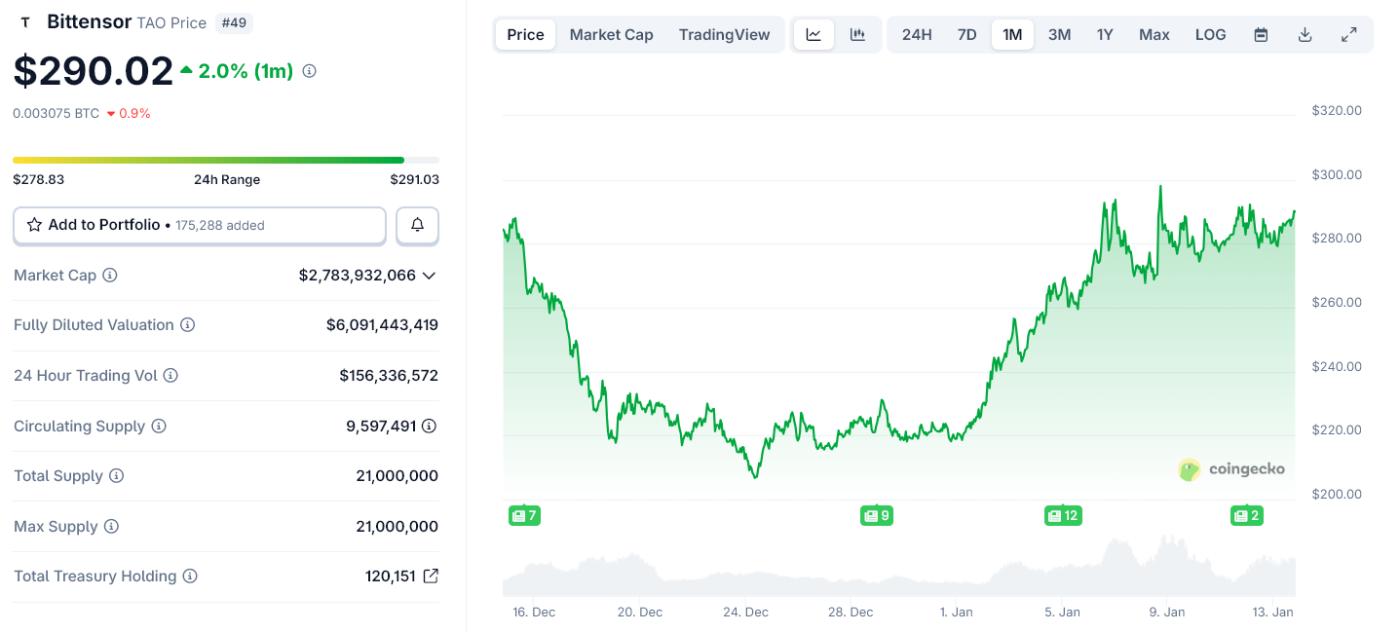 Bittensor (TAO) price chart over the past month. Source: CoinGecko
What does this mean for the future?
When Rubin officially launches in late 2026, AI capabilities will be enhanced across multiple data centers and cloud platforms, thereby driving a significant increase in the number of competing models and agents for real-world tasks.
Open networks like Bittensor will be the biggest beneficiaries of this shift. They are not replacing Nvidia's hardware infrastructure, but rather providing a market for this ecosystem to grow.
In that sense, Rubin does not undermine decentralized AI; on the contrary, it provides decentralized AI with a platform for organization, collaboration, and development.