When Bitwise released its 2026 outlook report, one of its conclusions immediately sparked heated debate: cryptocurrency-native stocks like Coinbase and MicroStrategy, as well as listed mining companies, are likely to significantly outperform traditional Nasdaq tech stocks. The reasoning is simple yet highly controversial. Bitwise argues that these companies possess an inherent leverage effect related to the cryptocurrency cycle that traditional tech companies lack.
MicroStrategy is a prime example of this polarization. In private discussions, it's often described as a time bomb—an over-leveraged Bitcoin alternative destined to collapse once prices remain depressed for an extended period. However, it's precisely this widespread skepticism that makes the case so compelling. Historically, excess returns rarely stem from consensus; they tend to emerge where opinions diverge most sharply.
Before judging whether MicroStrategy represents systemic vulnerability or financial complexity, it is necessary to go beyond superficial comparisons and carefully examine how its strategy actually works.
MicroStrategy's Bitcoin leverage is not traditional debt financing.
At first glance, this criticism seems reasonable. MicroStrategy borrows money to buy Bitcoin, and if the price falls below its average acquisition cost, it faces downside risk. From this perspective, failure seems inevitable in a prolonged bear market.
However, this framework implicitly assumes a traditional leverage model—short-term loans, high interest rates, and forced liquidation. MicroStrategy's balance sheet structure is quite different.
The company primarily funds its Bitcoin purchases through convertible bonds and senior unsecured bonds. Most of these bonds offer zero or extremely low interest rates and the majority will mature between 2027 and 2032. Crucially, these bonds do not involve margin calls or price-based forced liquidation. As long as the company can pay the minimum interest, it will not be forced to sell its Bitcoin holdings at a low price.
This distinction is crucial. Leverage with the risk of forced liquidation behaves very differently from leverage designed around time and options.
MicroStrategy's cash flow supports long-term Bitcoin investment.
Another common misconception is that MicroStrategy has abandoned its operational business and now relies entirely on the appreciation of Bitcoin. In reality, however, the company remains a profitable enterprise software provider.
Its core analytics and software business generates approximately $120 million in revenue each quarter, providing a stable cash flow that helps cover interest expenses. While this business represents only a small fraction of the company's total market capitalization, it plays a crucial role from a credit perspective. It provides the liquidity needed to maintain the capital structure during periods of prolonged market stress.
Time is the second structural advantage. With its debt maturing in several years, MicroStrategy doesn't need an immediate surge in its stock price. The company will only face real pressure if the price of Bitcoin crashes significantly below its average and remains so for years.
As of December 30, 2025, MicroStrategy held approximately 672,500 Bitcoins, with an average purchase cost of nearly $74,997. This figure is often cited as evidence for bearish arguments, but focusing solely on the spot price ignores the asymmetric returns inherent in the company's debt.
MicroStrategy convertible bonds create asymmetric options for Bitcoin.
Convertible bonds introduce a repayment structure that is often misunderstood. If MicroStrategy's stock price rises significantly—often due to a rise in the price of Bitcoin—bondholders can choose to convert their bonds into equity instead of demanding repayment of the principal.
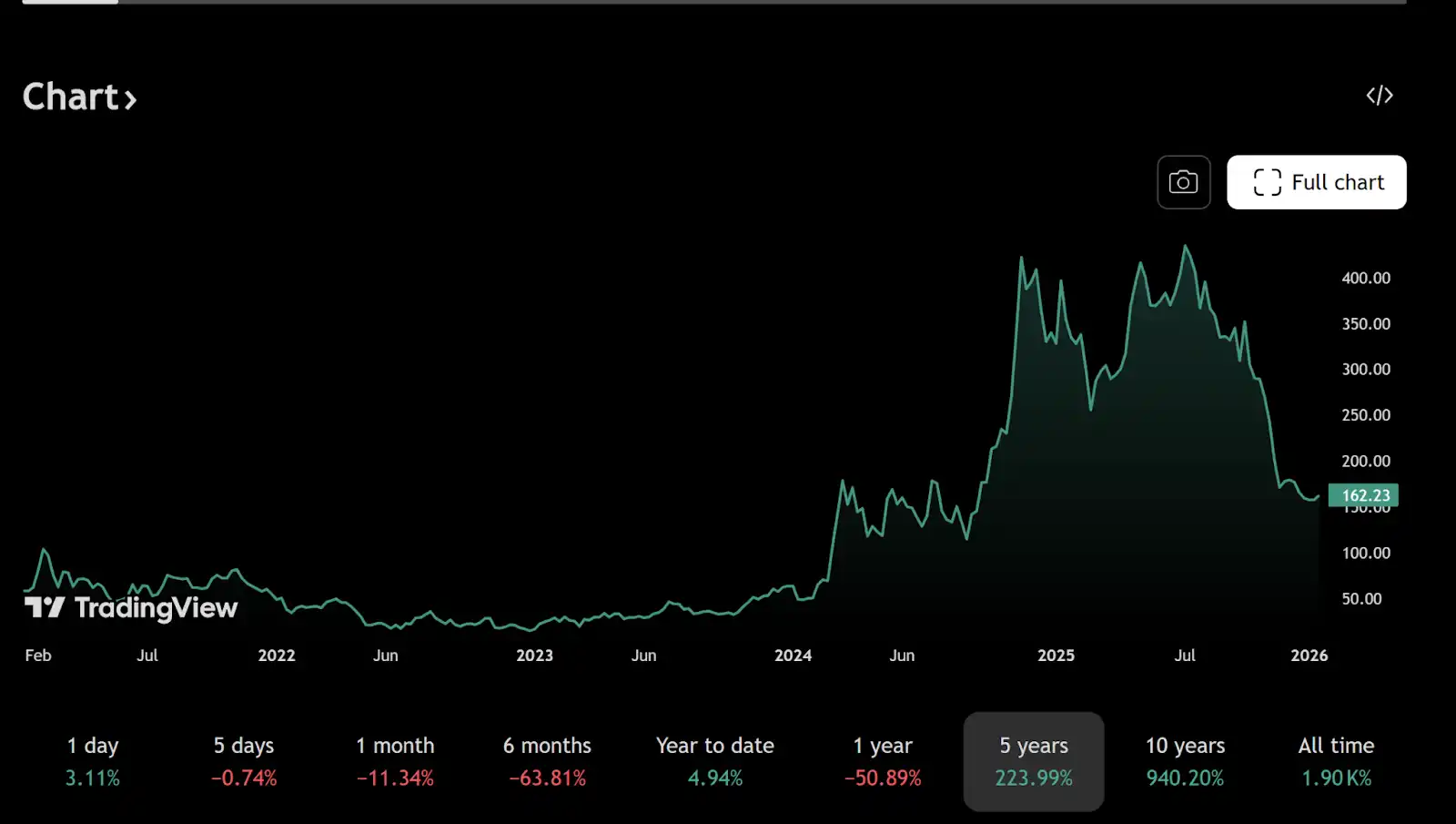
For example, the conversion price for some of the bonds issued in 2025 that mature in 2030 is approximately $433 per share, significantly higher than the current trading price of approximately $155. At the current price, conversion is not justified, therefore the company will only pay the minimum interest.
If Bitcoin surges, equity value will increase accordingly, and some debt can be effectively eliminated through conversion. If Bitcoin prices stagnate but don't crash, MicroStrategy can continue operating with very low actual interest payments. Forced deleveraging will only become a concern if Bitcoin prices fall to around $30,000 and remain there until the late 2020s.
This is a possibility, but it is far more extreme than many casual comments suggest.
MicroStrategy Bitcoin Strategy is a macro-currency game strategy.
At a deeper level, MicroStrategy is not merely speculating on Bitcoin's price. It is expressing its views on the future of the global monetary system, particularly the long-term purchasing power of the US dollar.
By issuing long-term, low-interest bonds denominated in US dollars, the company effectively short fiat currency. If monetary expansion continues and inflation remains high, the real value of its liabilities will shrink over time. Bitcoin, with a fixed supply of 21 million, serves as the hedging asset in this transaction.
This is why comparing MicroStrategy to reckless leveraged trading is a misunderstanding. The strategy is more like long-term macro investing than short-term speculation. Borrowing depreciated currencies to acquire scarce digital assets is a classic practice in an environment where debt can be hedged against inflation.
In short, if the value of the dollar in the future is lower than its value today, then repaying nominal debt becomes easier over time. This effect is more pronounced the longer the debt maturity and the lower the interest rate.
Why do retail investors misinterpret MicroStrategy's Bitcoin leverage strategy?
Individual investors typically assess leverage from a personal finance perspective. Loans must be repaid, losses can materialize quickly, and leverage itself carries risk. Large-scale corporate financing, however, follows a different set of rules.
MicroStrategies can refinance, roll over debt, issue stock, or restructure debt in ways that individuals cannot. As long as capital markets remain open and the company's creditworthiness is maintained, time will become an asset rather than a liability.
This difference in perspective explains why Michael Thaler's strategy often appears reckless to outsiders. In reality, as long as its core assumptions—long-term currency depreciation and the continued existence of Bitcoin as a global store of value—are accepted, the strategy is internally consistent.
Bitwise, crypto stocks, and Bitcoin leveraged upside potential
From this perspective, Bitwise's optimism towards cryptocurrency stocks becomes easier to understand. Companies like MicroStrategy and Coinbase are not merely participants in the cryptocurrency ecosystem; they are structurally intertwined with it.
When cryptocurrency cycles turn bullish, their profitability, balance sheets, and equity valuations can expand faster than those of traditional tech companies. This leverage amplifies downside risk, but during periods of speculative expansion, the market rarely rewards linear exposure; instead, it rewards convexity.
Conclusion: MicroStrategy is more like a Bitcoin call option than a time bomb.
MicroStrategy is neither a sure thing nor on the verge of collapse. Comparing it to a time bomb is an oversimplification, ignoring both its capital structure and strategic intent. In reality, it's more like a large, publicly traded Bitcoin call option—financed with long-term, low-cost debt and backed by an operating company capable of generating cash flow.
Whether this is ultimately visionary or disastrous depends on Bitcoin's long-term trajectory and the credibility of the fiat currency system over the next decade. However, it is clear that this is not a naive gamble, but a carefully orchestrated macro investment utilizing institutional tools.
In financial markets, it is often these unsettling and questionable structures that produce the most asymmetrical results.
Recommended reading: