A hardcore AI hands-on course
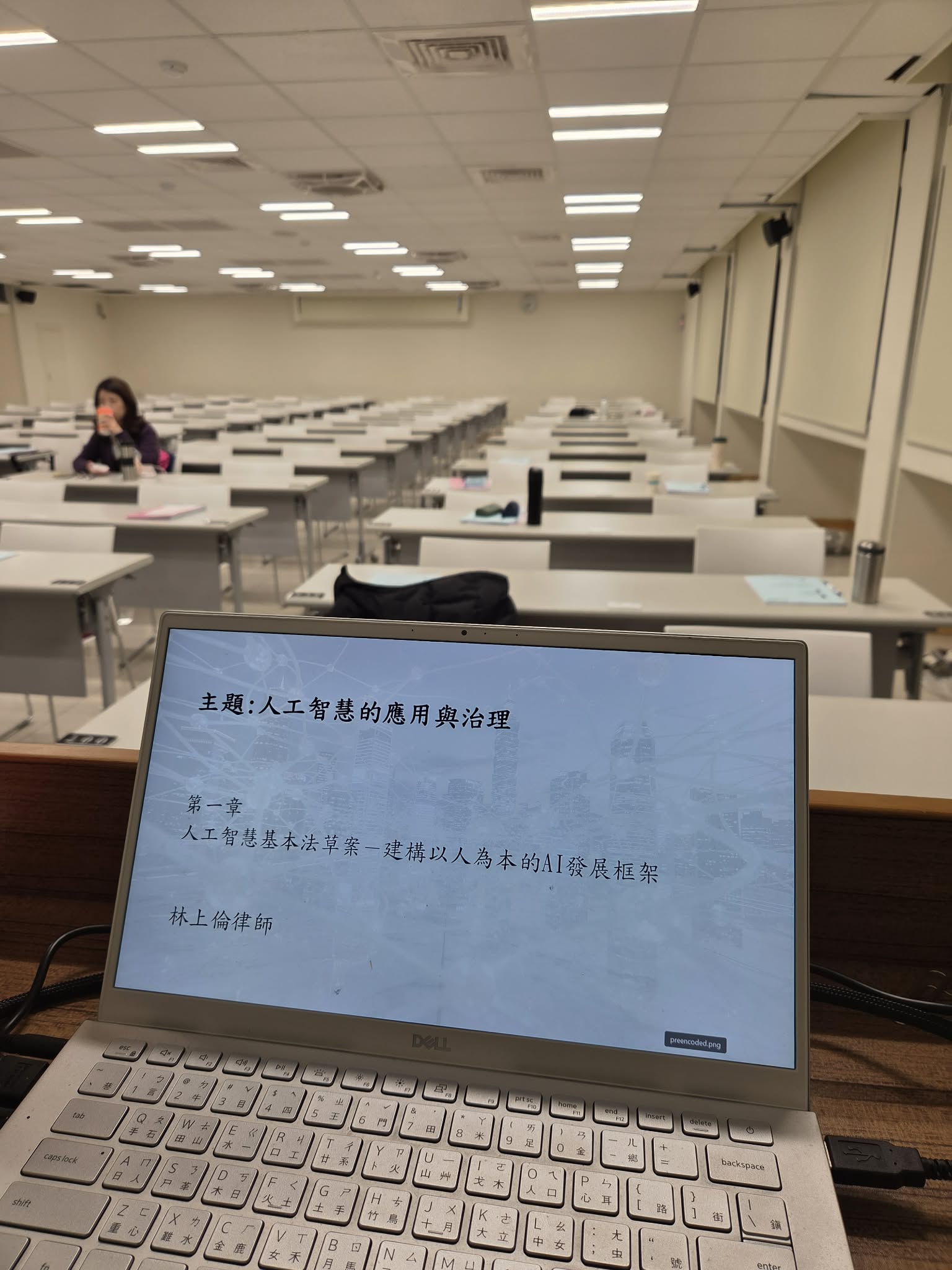
I was fortunate to be invited to Hua Nan Bank to conduct a course on AI application and governance for a group of financial professionals. It was a full three hours of hardcore, hands-on training. We started with the draft AI Basic Law, rigorously defining what AI is, thereby eliminating those automated programs that are misunderstood by the public; we talked about privacy, and why people often feel powerless when using GPT or Gemini.
I also explained why some customer service robots are often laughably "weak." This isn't because AI is incompetent, but because they use low-end models, lack RAG (Retrieval Augmentation) to supplement the database, and don't even differentiate between different agents for different application scenarios.

When the "fortress of expertise" is breached by AI
But the highlight of the entire course happened when I switched back to my "lawyer" identity and tested the AI operation on the spot.
I demonstrated live how to use AI to perform legal tasks such as drafting pleadings, preparing evidence-based letters, and revising contracts.
The financial professionals in the audience initially looked at the audience with polite focus, but their expressions shifted to utter shock. Why the shock? Because in the past, this was a highly specialized task that required hands-on instruction of interns and employed lawyers.
But when they saw with their own eyes that these processes, which were considered "professional strongholds," could be executed so smoothly and automatically by AI, the impact was enormous.
Misconceptions in AI applications in Taiwan: Treating tools like toys
Taiwan's hardware technology is always at the forefront of the world, but our software thinking and applications often lag behind international mainstream by five to ten years. What AI news does the algorithm push to you on Facebook?
"Gemini edited my photos so beautifully!" "I wrote a data classification bot using Vibe Coding!" "I created a customer service chat room with more realistic responses!"
Sounds cool, right? But frankly, this was already old news when Cursor was released two years ago. If you're still training AI to "respond more naturally" and "not look like a robot," that's a real shame, because that's not the current focus of AI development.
The greatest power of AI lies not in enabling ordinary people to create small tools, but in enabling professionals with domain knowledge to unleash ten times, or even dozens of times, more energy.
I didn't demonstrate how AI can perform tasks in the financial industry during this financial presentation because I lack the domain knowledge required for current finance or accounting, and therefore I'm not qualified to showcase AI applications in that field.
But what I want to say is: "When a professional lawyer, accountant, or doctor knows how to combine their expertise with AI to transform tedious, hard-to-scale tasks into efficient automated processes, that's the real game-changer."
The harsh reality in Silicon Valley: Without AI collaboration, you don't even qualify to submit your paper.
To illustrate just how massive this efficiency gap is, I'll share a stark reality of Silicon Valley. Many of Silicon Valley's top tech companies now have two policies that shock me:
- First, the initial drafts of all tasks should never be completed by humans from scratch. No matter how complex the task, AI is capable of producing at least 40-50% of the foundation. Its direction is usually correct, and employees must iterate on this AI-completed draft, rather than wasting time reinventing the wheel.
- Secondly, when you are refining and iterating on the initial draft, the backend software will monitor in real time to see the proportion of AI you are using. If you don't reach that proportion, your work cannot be sent to your superiors for review or proceed to the next stage.
The logic behind this is simple: bosses value cost and efficiency. In coding or document processing, if you don't use AI to complete a certain percentage of your work, you're not even eligible to submit your assignment. That's the reality.
When the world's brightest minds are already mandating "human-machine collaboration" and implementing data-driven monitoring, it would be truly arrogant for us to blindly believe that "humans are special" or that "professions cannot be replaced."
Silent professional restructuring
In my personal opinion, the most important thing for most people right now isn't learning how to program (unless you want to change careers), but rather clearly defining: "What are my professional strengths?" and "Which parts of my workflow can be delegated to AI?"
If you don't do this, you will definitely not be given a chance to breathe in the future, because under the new workflow, the required manpower may only be one-tenth of what it used to be, and "you and I" are very likely to be excluded from the future workplace.