Author|Azuma ( @azuma_eth )

On January 27th, US time, Soccer United Marketing (SUM), the commercial arm of Major League Soccer (MLS), announced a multi-year partnership with prediction market platform Polymarket. Under the agreement, Polymarket will become the official exclusive prediction market partner for the MLS league, the MLS All-Star Game, the MLS Cup, and the North American League Cup. MLS will require Polymarket to use official league data and third-party integrity monitoring systems, and will refrain from offering predictions that the league deems susceptible to manipulation or involving insider information.
This is not the first time a sports league has partnered with a prediction market. Back in October of last year, the National Hockey League (NHL) reached multi-year licensing agreements with Kalshi and Polymarket respectively; later, in November of last year, Polymarket also reached an agreement with the Ultimate Fighting Championship (UFC) to become the UFC's official exclusive prediction market partner.
What does the so-called "official exclusive prediction market" mean? Does this mean that other unauthorized platforms will be unable to open related betting platforms in the future? What impact will this have on future competition in the industry? Although there are currently limited mature cases of prediction markets partnering with sports events and a small number of observable samples, we can find similar answers to these questions in the sports betting market, which has a very similar service effect.
- Odaily Note: For information on the similarities in services and the differences in regulation between prediction markets and sports betting, as well as the regulatory battles surrounding prediction markets, please refer to our article from two weeks ago, "Prediction Markets, which have touched the betting industry's multi-billion dollar pie, are being chased by the old order."
Exclusive authorization ≠ betting license
First, let's answer the most crucial question: Does the existence of exclusive authorization mean that other unauthorized platforms will be unable to open related betting platforms in the future?
The current state of sports betting is that since the U.S. Supreme Court overturned the Professional and Amateur Athletic Protection Act (PASPA), a federal law that previously prohibited commercial sports betting, on May 14, 2018, individual states in the U.S. have gained the authority to decide whether to legalize sports betting within their jurisdictions. In other words, the legality of betting services depends on state-level licensing, not commercial authorization from leagues— in reality, betting companies do not need commercial authorization from league operators to open betting markets or provide betting services for various legal sporting events.
However, in a few states like Tennessee, state sports betting regulators require betting companies to use official league data when offering in-play betting services, unless they can prove that the data is inapplicable or unavailable. This effectively limits the scope of services offered by betting companies – only those with data authorization can provide the most comprehensive betting service.
However, this logic does not currently apply directly to prediction markets. Given the current unclear (and objectively more lenient) regulatory framework for prediction markets, Polymarket and Kalshi are not obligated to comply with similar requirements in gambling regulations until the final rulings of the appellate courts or even the Supreme Court are determined.
Therefore, although Polymarket has obtained exclusive authorization for MLS, at least at this stage, it does not mean that other platforms such as Kalshi are prohibited from opening MLS-related betting platforms.
If it's not necessary, what's the point of authorizing it?
While it's not a "mandatory authorization" requirement to operate betting platforms, in actual commercial operations, there are indeed numerous business collaborations and licensing agreements between major sports leagues and betting companies. For example, the NFL has signed a long-term cooperation agreement with Genius Sports, authorizing betting companies to access real-time game data, including rosters, game reports, and statistics, through Genius as the sole official data provider.
For betting companies, the main significance of licensing lies in the fact that they can directly obtain official data and brand authorization from the operators of sports events through commercial agreements, thereby improving their service quality and user experience. Exclusive licensing adds another layer of exclusivity.
The core significance of this lies in the quality and completeness of the data. Compared to data scraping through third-party channels, official data obtained through licensing agreements is bound to be more accurate, timely, and comprehensive. This has a direct impact on improving the accuracy of odds in betting services, accelerating settlement efficiency, and expanding betting categories. As for brand and trademark licensing, it allows betting companies greater flexibility in promoting related betting odds—they can use league, team, and player logos while avoiding the risk of infringement.
Conversely, for sporting events, direct licensing agreements with betting companies can also help reduce the possibility of market manipulation (this may sound a bit abstract...). Both parties can regulate the scope of betting and share abnormal betting data to promptly detect potential manipulation. For example, in the cooperation between Polymarket and MLS, both parties have clearly stipulated that they cannot offer betting odds that are easily manipulated by individuals, such as red and yellow card decisions, or those involving insider information such as manager dismissals and player transfers.
Given the high degree of overlap between prediction markets and sports betting in terms of service effectiveness, the significance of licensing agreements for the sports betting market will also apply to the prediction market.
The leading team in direct confrontation, and the second tier that takes an unconventional approach.
Sports betting has long been proven to be a large-scale business with certain growth, and in the prediction market, sports events have gradually become the category with the highest trading volume.
Dovey Wan ( @DoveyWan ), founder of Primitive Ventures, posted yesterday the revenue share of various event types on several major prediction markets. On Kalshi, sports events account for over 90% of the betting volume, and on Polymarket, they account for 43% —clearly, sporting events have become the core source of traffic for these two leading prediction markets.
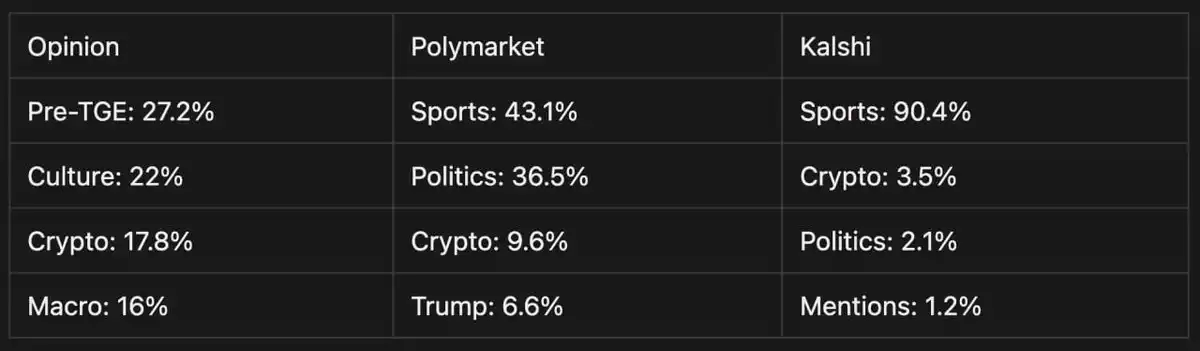
Given the massive existing market size and the clearly visible potential for growth, market competition is inevitable. Currently, among the four major US sports leagues, only the NHL has signed licensing agreements with Kalshi and Polymarket respectively, while the NFL, NBA, and MLB are still in the observation phase. It is anticipated that after Polymarket secured exclusive licenses for the UFC and MLS, Kalshi and Polymarket, the two leading players with advantages in compliance and funding, will likely engage in even fiercer competition for licenses of various top-tier sporting events, inevitably leading to more exclusive agreements.
However, the data also reveals another interesting phenomenon—perhaps due to cultural differences and user habits, emerging prediction markets on the other side of the world are taking drastically different paths. As shown in the previous chart, the percentage of transaction volume related to events in the cryptocurrency-native market on Opinion is far higher than that on Kalshi and Polymarket. While the leading players are directly competing for this huge pie of sports events, choosing a different approach might be an opportunity for second-tier projects to catch up.