This issue provides an overview of the legal framework and practical recommendations for real-world asset tokenization in Dubai, for your reference.
Article author: Yi He
Source: Digital New Financial Report
Global Report on Digital Development, Volume 4, Issue 5 (January 26, 2026 - February 1, 2026)
This issue provides an overview of the legal framework and practical recommendations for real-world asset tokenization in Dubai, for your reference.
This article aims to systematically review the legal environment and regulatory framework for RWA tokenization in Dubai, providing compliance guidance for companies intending to conduct RWA tokenization business in Dubai.
This article mainly introduces the legal framework for real-world asset tokenization in Dubai, including the core legal framework, licensing and registration requirements, compliance obligations for anti-money laundering and counter-terrorist financing, investor participation, common business and operating models, global comparative analysis, and corporate compliance recommendations.
This article primarily references the following laws and regulations: Dubai Law No. 4 of 2022, the Virtual Asset Regulation Law; the VARA Virtual Asset Issuance Rulebook (May 2025); the DFSA Tokenization Regulatory Sandbox Framework; and the UAE Federal Anti-Money Laundering Law.
The key regulatory bodies discussed in this article include the Virtual Asset Regulatory Authority (VARA) - Dubai Mainland and Free Zone (excluding DIFC) and the Dubai Financial Services Authority (DFSA) - DIFC Free Zone.
The tokenization of real-world assets (RWAs) is reshaping global financial markets, transforming traditional assets such as real estate, bonds, equities, and commodities into digital tokens that can be traded on the blockchain, and potentially even reshaping the entire economic landscape in the future. Dubai, by establishing a comprehensive regulatory framework, has become one of the leading jurisdictions in the global RWA tokenization field.
In 2022, Dubai enacted Law No. 4, the Virtual Asset Regulation Law, establishing the Virtual Asset Regulatory Authority (VARA), which provides a clear legal basis for activities such as the issuance, distribution, trading, and custody of virtual assets. In May 2025, VARA released an updated Virtual Asset Issuance Rulebook, explicitly including Asset Reference Virtual Assets (ARVAs)—that is, tokenized real-world assets—within its regulatory scope.
I. Core Legal Framework
1.1 Virtual Asset Regulatory Authority (VARA) – Mainland and Free Zone of the UAE (excluding DIFC (Dubai International Financial Centre))
According to Dubai Law No. 4 of 2022, the Virtual Asset Regulatory Authority (VARA) is the main regulatory body for virtual assets in Dubai, responsible for overseeing the issuance, distribution, trading, custody and related activities of virtual assets in most jurisdictions of Dubai.
The May 2025 rulebook is very important. The updated Virtual Asset Issuance Rulebook released by VARA explicitly covers Asset Reference Virtual Assets (ARVAs), the regulatory category for tokenized real-world assets. The core content of this rulebook includes the following points.
First, the definition of ARVAs : These include tokens representing direct or indirect ownership of real-world assets, or rights to the cash flows from those assets. This definition encompasses a wide range of RWA tokenizations, including but not limited to real estate tokens, bond and fixed-income instrument tokens, equity tokens, commodity tokens, and art and collectible tokens.
Secondly, regarding the classification of ARVAs as Category 1 Virtual Asset (VA) issuances, ARVAs are categorized as Category 1 VA issuances, meaning that a full VARA license must be obtained before issuance. This is the highest level of regulatory requirement, reflecting the importance that regulators place on RWA tokenization activities.
Third, it provides detailed requirements. The rulebook specifies the details of licensing categories, white paper requirements, risk disclosure, and ongoing monitoring. This is not merely a sandbox or pilot project, but a comprehensive and legally binding regulatory framework.
Fourthly, regulatory powers: the rulebook defines licensing requirements, disclosure systems, oversight powers, and enforcement mechanisms for virtual asset issuers, including the power to suspend issuance when non-compliance is found.
1.2 Dubai Financial Services Authority (DFSA) – DIFC Free Zone
The DIFC holds a unique status. The Dubai International Financial Centre (DIFC) is Dubai's financial free zone, possessing its own independent legal and regulatory framework. Within the DIFC, the Dubai Financial Services Authority (DFSA) is responsible for regulating financial services and digital investment products, including tokenized assets through its "Tokenized Regulatory Sandbox" program.
The key characteristics of DFSA regulation include the following.
The first is the Innovation Test License (ITL). DFSA provides a sandbox environment for RWA tokenization projects, allowing companies to use the Innovation Test License to test tokenized business models and obtain customized compliance support.
Secondly, the scope of sandbox participants includes enterprises involved in the issuance, trading, holding, or settlement of tokenized investments, such as the tokenization of stocks, bonds, Islamic bonds (sukuk), and funds.
Thirdly, there is a transition path: successful sandbox participants can transition to a full DFSA license after demonstrating their governance and risk control capabilities.
Fourth, the framework is unique. The DFSA framework differs from VARA and is specifically tailored to the financial services priorities of the DIFC. This provides companies with a choice: to choose either the VARA or DFSA regulatory path based on the nature of their business.
1.3 The significance of the dual-track regulatory system
Dubai's dual regulatory framework (VARA + DFSA) provides flexibility for RWA tokenization. The VARA path is suitable for tokenization projects targeting a broader market, covering the Dubai mainland and most of the free zones; while the DFSA path is suitable for institutions wishing to operate in an international financial center environment, particularly traditional financial institutions looking to test tokenized business models.
This dual-track system puts Dubai ahead of many jurisdictions in providing legal certainty and structured innovation for RWA tokenization.
II. Licensing and Registration Requirements
2.1 VARA Licensing Framework
According to the VARA 2025 rulebook, the licensing requirements for RWA tokenization are as follows:
Type 1 VA Issuance Permit (Required for ARVAs/RWA Token Issuance) :
It is a mandatory requirement that any entity issuing ARVAs or other Type 1 tokens must obtain a VARA license. This is an absolute requirement; there are no exemptions or simplifications.
The general requirements are that the issuer must meet the general requirements regarding integrity, governance and operating structure, including an appropriate corporate governance structure, a qualified management team and board of directors, sufficient financial resources and an effective internal control system.
White paper and risk disclosure requirements stipulate that issuers must produce a formal white paper and risk disclosure statement, which need to be updated and maintained throughout the asset's lifecycle. The white paper must include a detailed description of the tokenized asset, the nature and value of the underlying asset, the rights and obligations of token holders, risk factors, issuer information, and details of the technical architecture and smart contracts.
Continuous oversight means that VARA possesses broad enforcement powers, including the ability to suspend issuance upon discovery of non-compliance. This implies that licensing is not a one-time event but requires ongoing compliance.
2.2 Other VARA Compliance Requirements
In addition to the initial license, ARVA issuers shall also assume related ongoing obligations.
First, there is a comprehensive requirement for the publication of white papers and risk disclosures, meaning that white papers and risk disclosure documents must be publicly released and updated regularly to ensure that investors always have access to the latest information.
Second, capital adequacy and governance requirements, which are consistent with other VARA rulebooks (corporation, compliance, and risk management), including minimum capital requirements, liquidity management, and best practices for corporate governance.
Thirdly, there are oversight and auditing obligations, including document retention and reporting obligations. Issuers must maintain complete transaction records, submit compliance reports to VARA regularly, accept on-site and off-site inspections by VARA, and appoint external auditors.
2.3 DFSA Sandbox and Licensing
Within DIFC, tokenized projects follow different paths.
The participation process within the DIFC includes the following main steps. First, an expression of intent is submitted, whereby companies first submit an expression of intent to participate in the DFSA tokenization regulatory sandbox. Second, there is the Innovation Test License (ITL) stage, where , upon approval, controlled testing is conducted under the ITL. Third, there is the transition to a full license, where, after successful testing, a full DFSA license can be applied for.
The DIFC offers the advantage of a sandbox environment. Sandbox participation allows for controlled testing under regulatory oversight before entering the full market. This provides innovative companies with a "learn-by-doing" opportunity while ensuring regulatory compliance.
III. Anti-Money Laundering/Know Your Customer (AML/KYC) and Compliance Obligations
3.1 AML/KYC Framework Requirements
Both VARA and DFSA licenses require businesses to implement robust anti-money laundering (AML) and know-your-customer (KYC) frameworks that are consistent with UAE federal AML laws and international standards.
First, there are identity verification requirements, meaning that issuers and exchanges must adopt AML/KYC procedures, including verifying investor identities, monitoring trading activities, reporting suspicious activities, and maintaining customer due diligence records.
These requirements stem from the general AML obligations in the VARA licensing requirements and the specific provisions in the rulebook.
Second, transaction monitoring, which requires the establishment of a system to monitor abnormal transaction patterns in real time, identify potential money laundering or terrorist financing activities, set transaction limits and abnormal alerts, and maintain a complete transaction audit trail.
3.2 Custody and Client Asset Protection
Regulatory authorities are enforcing custody and client asset protection measures.
The first requirement is customer asset segregation, meaning that tokenized platforms must separate customer assets from their own assets to ensure that customer assets are protected in the event of platform bankruptcy or liquidation.
The second is the proof-of-reserves check, which means that the platform must be able to prove that the tokens it holds match the rights of its customers through regular proof-of-reserves audits.
Thirdly, compliance reporting, meaning that regulators will also enforce AML/KYC as part of the broader compliance reporting and risk management obligations of Virtual Asset Service Providers (VASPs) under the VARA rulebook.
IV. Investor Participation (Institutional and Retail)
4.1 Retail Investor Participation
Dubai's framework does not prohibit retail investors from participating in the RWA tokenization market, but regulatory requirements and marketing rules emphasize investor protection, mainly focusing on risk disclosure and marketing restrictions.
Risk disclosure requirements mandate that issuers include appropriate risk disclaimers and disclosures, particularly when targeting retail investors. These disclosures should include a detailed description of investment risks, warnings about liquidity risks, technological risks (smart contracts, blockchain), regulatory and legal risks, and market risks.
Marketing restrictions include that marketing materials for retail investors must be clear, fair and non-misleading, include all important risk factors, avoid exaggerating returns or minimizing risks, and comply with VARA's marketing and promotion rules.
4.2 Secondary Market Trading
Secondary market trading of ARVAs is permitted on licensed platforms that must include AML/KYC requirements to ensure compliance for all types of investors.
The licensing requirement stipulates that only brokers and exchanges licensed by VARA can provide secondary market trading services for ARVAs.
Investor classifications, namely institutional and high-net-worth investors, may face additional disclosure or suitability requirements, depending on the product structure and license category, particularly within the DFSA Sandbox and DIFC regimes.
V. Common Business and Operating Models
5.1 Special Purpose Vehicle (SPV) Issuance Model
The common model for RWA token issuance involves the SPV model.
How can the SPV structure be combined with RWA issuance? This is mainly achieved through the following aspects: real-world assets (such as real estate or debt) are incorporated into the SPV; the SPV issues tokens representing economic rights; these tokens are issued through a licensed VARA platform; and smart contracts execute compliance logic (such as revenue distribution).
SPVs offer unique legal advantages in RWA issuance. These include risk isolation, meaning the underlying assets are separated from the issuer's other assets; a clear legal structure, meaning token holders' rights are clearly defined; tax optimization, meaning tax efficiency can be achieved under a specific structure; and bankruptcy protection, meaning the SPV structure can provide additional creditor protection.
Typical applications currently reported by the market include real estate project tokenization, infrastructure project financing, bonds and fixed-income products, and private equity and venture capital fund shares.
5.2 Licensed Trading and Secondary Market
From a regulatory perspective, secondary trading is authorized by VARA-licensed brokers and exchanges, providing liquidity for ARVAs in a regulated environment.
Market infrastructure includes licensed trading platforms that provide order matching and settlement services, custody service providers that ensure asset security, market makers that provide liquidity, and clearing and settlement infrastructure that ensures transaction finality.
However, there are requirements for investor access, including that all participants must pass KYC/AML verification. The platform may set different access thresholds for different investor categories, and transaction limits may vary depending on the investor classification.
5.3 Sandbox Testing and Innovation Path
Under the DFSA sandbox model, fintech startups and traditional institutions are allowed to test the RWA business model under regulatory supervision before obtaining full authorization.
Sandboxes also offer unique advantages, including reduced initial compliance costs, testing product market fit in a controlled environment, access to direct guidance from regulators, and identification and resolution of compliance issues before transitioning to full licensing.
According to publicly available information, there have been some success stories. Several companies have successfully tested tokenized securities, real estate, and fund products through the DFSA sandbox and transitioned to full operating licenses.
VI. Global Comparative Analysis
The following is a brief comparison of RWA tokenization regulations in Dubai and other major jurisdictions.
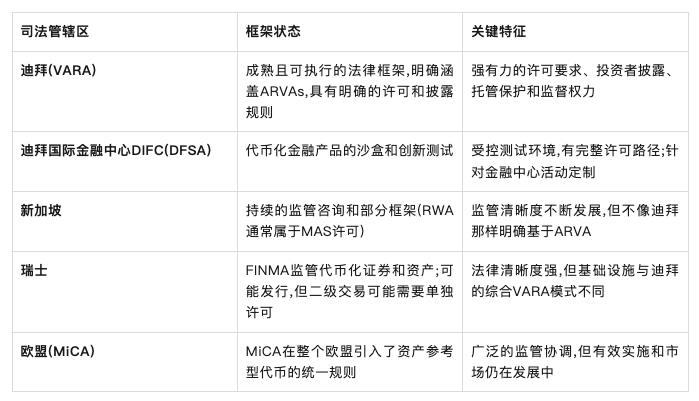
In comparison, Dubai's competitive advantages include the following aspects.
First, there is a clear legal classification. VARA explicitly defines ARVAs as a regulatory category, while many jurisdictions are still developing similar frameworks.
Secondly, the dual-track system, combining VARA (market-oriented) and DFSA (DIFC-oriented), provides flexibility, allowing companies to choose the most suitable regulatory path based on their business model.
Third, it has a mature law enforcement framework, which includes not only rules, but also clear enforcement mechanisms and oversight powers.
Fourth, it is innovation-friendly. The DFSA sandbox provides a structured path for innovation while maintaining regulatory oversight.
Fifth, international recognition: Dubai's status as a global financial center enhances the credibility of its regulatory framework.
VII. Compliance Recommendations for Enterprises
7.1 Choosing an appropriate regulatory path
The VARA pathway is suitable for projects targeting a broader market (mainland UAE and most free zones), and is suitable for companies planning large-scale issuances and secondary market trading, while requiring a full Type 1 license and ongoing compliance.
The DFSA path is suitable for financial institutions that want to operate in the DIFC, and for startups that want to test their business models through a sandbox, providing a clear transition path from testing to full licensing.
7.2 Preparation of License Application
The key steps include the following aspects.
The first step is business planning and feasibility studies, which mainly involve clarifying the type of tokenized assets and target market, assessing the regulatory path (VARA vs DFSA), and developing detailed business plans and financial forecasts.
Second, the legal and technical architecture, including designing the SPV structure (if applicable), developing or selecting a smart contract platform, and ensuring that the technology complies with VARA technical standards.
Thirdly, the construction of a compliance framework, including establishing AML/KYC procedures, formulating internal control and risk management policies, and preparing white papers and risk disclosure documents.
Fourthly, capital and human resources, including ensuring that minimum capital requirements are met, recruiting or appointing a qualified management team and compliance officer, and establishing an appropriate corporate governance structure.
7.3 Continuous Compliance Management
Key obligations during the operational phase.
First, regular reporting, including submitting quarterly and annual compliance reports to VARA, promptly reporting any significant changes or events, and keeping the white paper and risk disclosures up-to-date.
Second, auditing and inspection, including cooperating with VARA's on-site and off-site inspections, appointing qualified external auditors, and conducting regular internal audits and risk assessments.
Thirdly, investor communication, including maintaining transparent investor relations, timely disclosure of important information, and handling investor complaints and inquiries.
Fourthly, technology and security, including regularly reviewing and updating smart contracts, maintaining cybersecurity measures, and conducting reserve verification and asset reconciliation.
7.4 Common Traps and Avoidance
Trap 1: Underestimating licensing time and cost
The licensing application process can take several months and involves extensive documentation and communication with regulatory agencies. Businesses should begin preparations at least 6-9 months in advance, allocate sufficient legal and consulting budgets, and consider hiring a local consultant familiar with the VARA process.
Trap Two: Insufficient White Paper and Disclosure
Regulators have high standards for the quality of white papers and risk disclosures. Common issues include overly general or incomplete risk disclosures, unclear technical descriptions, ambiguous rights for token holders, and a lack of adequate description of the underlying assets.
Trap 3: Inadequate implementation of AML/KYC
Many businesses underestimate the complexity of establishing a regulatory-compliant AML/KYC system. It is recommended to use a verified third-party KYC service provider, establish a robust transaction monitoring system, regularly train employees to identify suspicious activity, and maintain detailed due diligence records.
Trap 4: Neglecting Continuous Compliance
Obtaining a license is just the beginning; ongoing compliance is equally important. This includes establishing a compliance calendar to track all reporting deadlines, designating a dedicated compliance officer to handle regulatory relationships, regularly reviewing and updating internal policies, and maintaining proactive communication with regulatory agencies.
Dubai's regulatory framework for RWA tokenization, established through VARA, is one of the most specific and comprehensive legal frameworks globally. By explicitly classifying ARVAs as Category 1 virtual asset issuances and establishing detailed licensing, disclosure, and oversight requirements, Dubai provides legal certainty and a structured, innovative path for RWA tokenization.
Key takeaways.
First, it has a solid legal foundation. VARA’s ARVAs framework provides clear legal definitions and regulatory categories, which are still under development in many jurisdictions.
Secondly, licensing is mandatory; issuers must obtain a Type 1 VARA license, provide full disclosure, and comply with ongoing monitoring.
Third, compliance is comprehensive; AML/KYC, risk management, and customer asset protection are integral parts of the licensing and operational system.
Fourth, market access is open, allowing secondary trading of tokenized assets on regulated platforms to provide liquidity for investors.
Fifth, the innovation path is clear. The DFSA Sandbox provides a supplementary compliance path for companies within the DIFC, making it particularly suitable for companies seeking DIFC financial licenses.
Sixth, Dubai holds a leading competitive position. Its dual framework (VARA + DFSA) puts it ahead of many jurisdictions in providing legal certainty and structured innovation for the tokenization of real-world assets.
For companies intending to conduct RWA tokenization business in Dubai, the key to success lies in a deep understanding of the differences and applicability of the VARA and DFSA frameworks; planning license applications in advance and reserving sufficient time and resources; establishing a comprehensive compliance management system that not only meets initial license requirements but also ensures ongoing compliance; leveraging Dubai's dual-track system to choose the regulatory path most suitable for the business model; and closely monitoring regulatory developments, as the framework is constantly being improved and evolved.
With the continued growth of the global RWA tokenization market, Dubai, with its clear legal framework, strategic geographical location, and open business environment, has become one of the most attractive jurisdictions in this field. For well-prepared and compliant companies, Dubai offers an ideal platform to tokenize traditional assets and enter the global digital asset market.