Author: David Hoffman
Compiled by: TechFlow TechFlow
TechFlow Dive: Are Most Tokens Garbage? David Hoffman, co-founder of Bankless, points out that historically, teams have treated tokens far less seriously than equity, and the market has responded to this with its prices.
But a turning point came in 2026:
MegaETH has locked 53% of its tokens in a KPI program, which will only be unlocked once growth targets are met.
The Cap protocol replaces governance tokens with stablecoin airdrops, allowing genuine investors to acquire CAP through token sales.
These innovative strategies are ending the era of "spray-and-drip" token distribution and moving towards a more precise, conditional allocation mechanism.
The full text is as follows:
The crypto industry has a "good coins problem".
Most tokens are junk.
Most tokens are not treated like equity by the team, both legally and strategically. Because the team has historically not given tokens the same respect as equity companies, this is reflected in the token prices.
Today I want to share two sets of data that make me optimistic about the state of tokens in 2026 and beyond:
- MegaETH's KPI Plan
- Cap's stablecoin airdrop
Conditionalize token supply
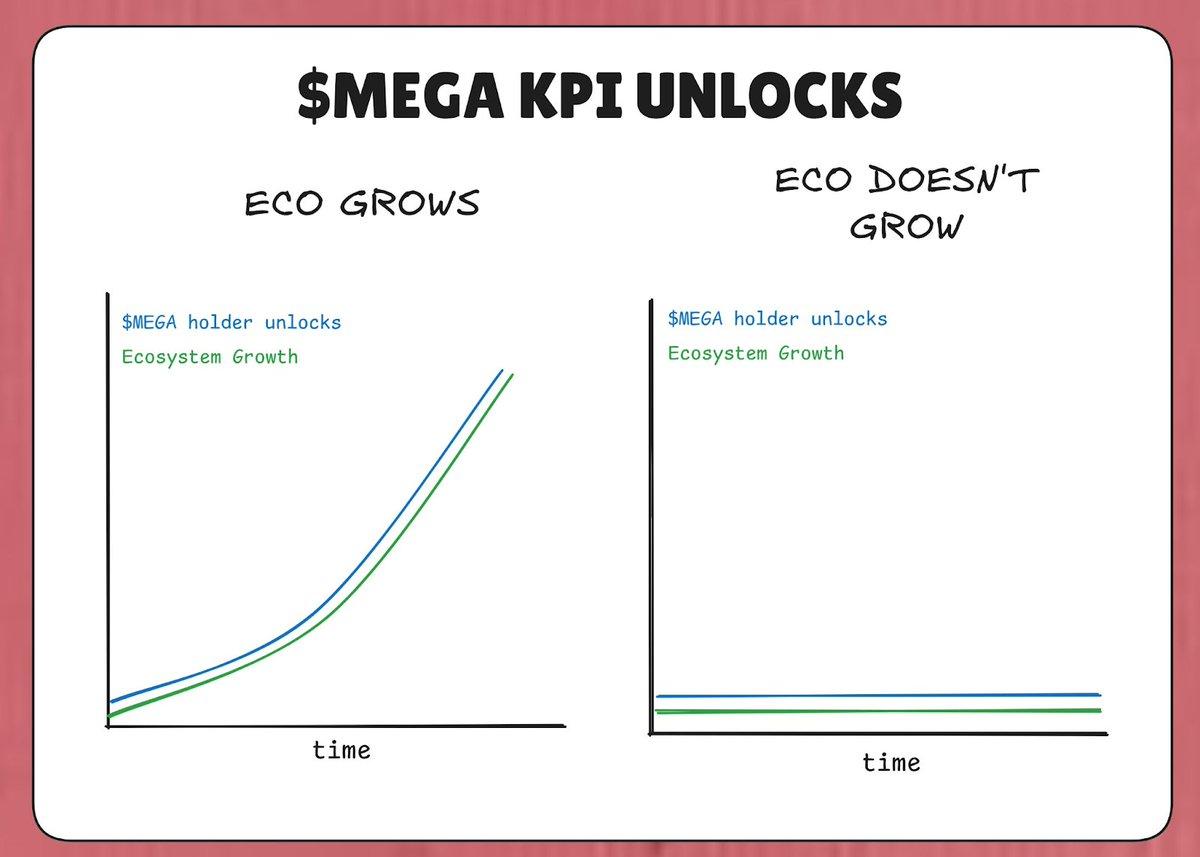
MegaETH has locked 53% of its total supply of MEGA tokens in a "KPI program." The logic is: if MegaETH does not meet its KPIs (Key Performance Indicators), these tokens will not be unlocked.
Therefore, in a pessimistic scenario, even if the ecosystem doesn't grow, at least there won't be a flood of more tokens entering the market and diluting holders. MEGA tokens will only enter the market when the MegaETH ecosystem truly grows (as defined by KPIs).
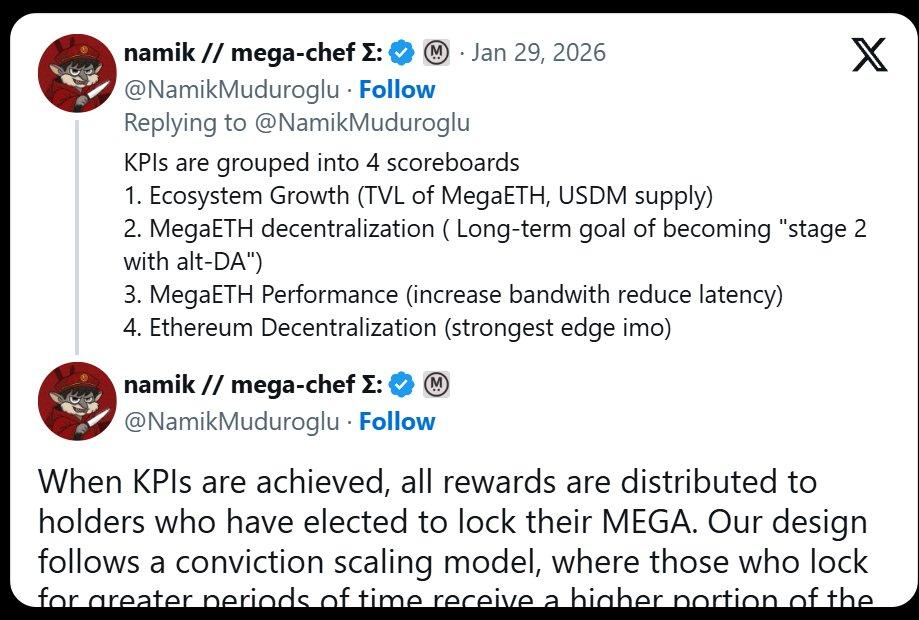
The plan's KPIs are divided into 4 scoreboards:
- Ecosystem growth (TVL, USDM supply)
- MegaETH Decentralization (L2Beat Phase Progress)
- MegaETH Performance (IBRL)
- Ethereum Decentralization
Therefore, in theory, as MegaETH achieves its KPI targets, its value should increase accordingly, thereby mitigating the negative impact of MEGA dilution on market prices.
This strategy is very similar to Tesla's "pay-as-you-go" compensation philosophy for Elon Musk. In 2018, Tesla granted Musk an equity compensation plan, vesting in installments, which would only be realized if Tesla simultaneously achieved increasing market capitalization and revenue targets. Elon Musk would only receive compensation if Tesla's revenue and market capitalization grew.
MegaETH is attempting to transplant the same logic into its token economics. "More supply" is not a given—it is something the protocol must earn by accumulating real points on a meaningful scoreboard.
Unlike Musk's Tesla benchmark, I don't see anything about using MEGA market capitalization as a KPI target in Namik's KPIs—perhaps for legal reasons. But as a publicly traded MEGA investor, this KPI is indeed very interesting to me. 👀
The person who unlocks it is very important.
Another interesting aspect of this KPI plan is who gets the MEGA when the KPI is achieved. According to Namik's tweet, those who stake MEGA in the lock-up contract are the ones who unlock it.
Those who lock up more MEGA tokens for a longer period will receive 53% of the MEGA tokens that enter the market.
The logic behind this is simple: dilute MEGA and allocate it to those who have already proven themselves to be MEGA holders and are interested in holding more MEGA—those who are least likely to become MEGA sellers.
Alignment and Trade-offs
It's worth emphasizing that this also brings risks. We have already seen historical cases of similar structures experiencing serious problems. Consider this excerpt from Cobie's article: "(Content)"
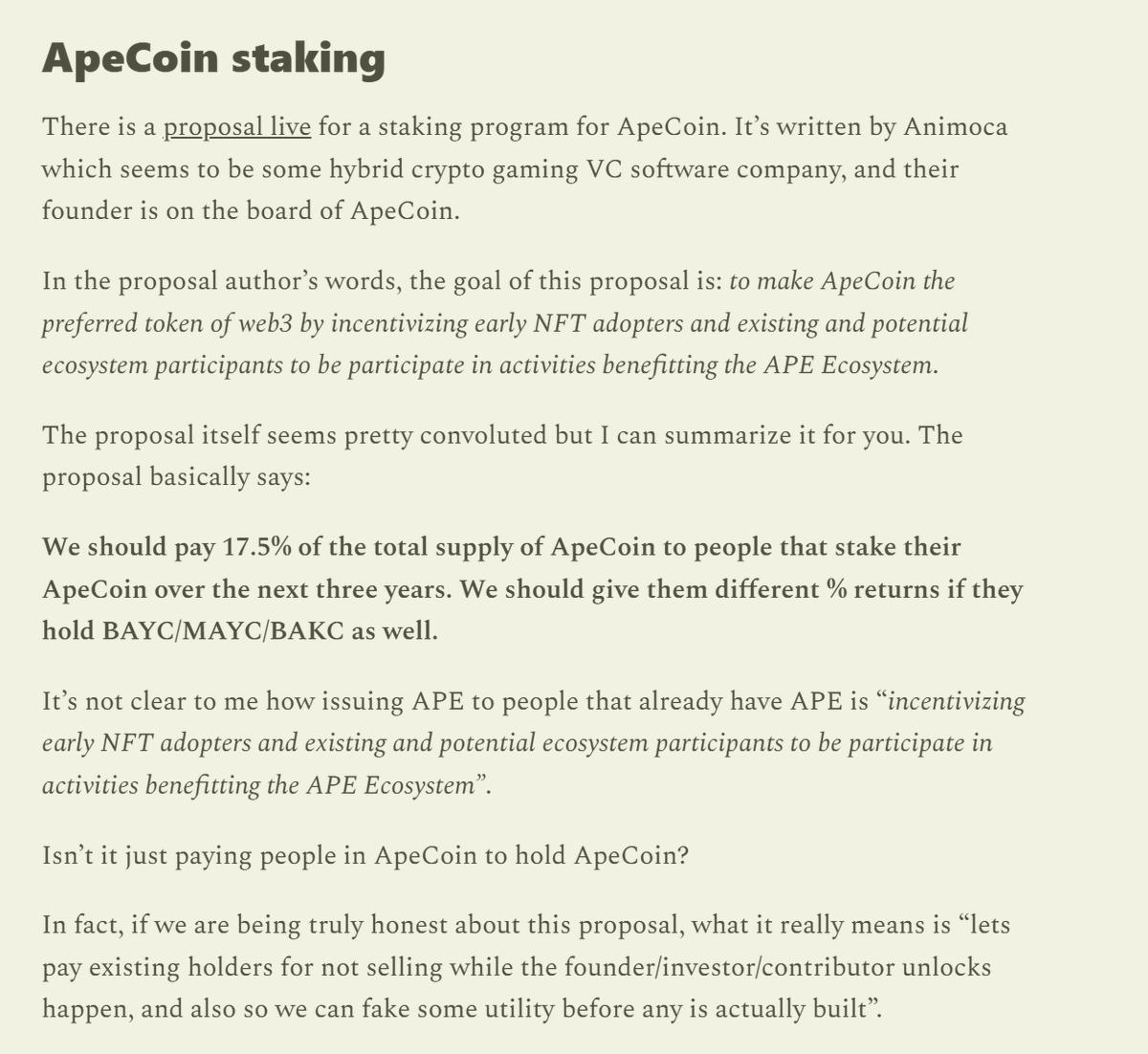
If you're a token pessimist, a crypto nihilist, or simply bearish, this alignment issue is what you're worried about.
Alternatively, looking at the same article: "Staking mechanisms should be designed to support the goals of the ecosystem."
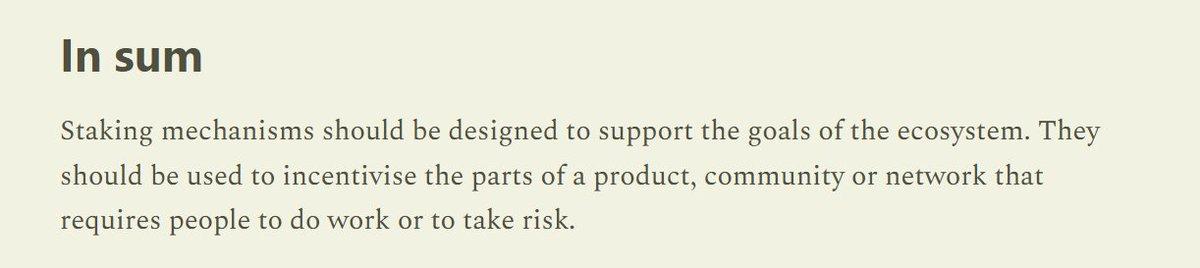
Locking tokens in a way that actually reflects the value growth of the MegaETH ecosystem is a far better mechanism than any typical staking mechanism we saw during the liquidity mining era of 2020-2022, when tokens were being issued regardless of the team's basic progress or ecosystem growth.
Therefore, the net effect is MEGA dilution:
- Constrained by the growth of the MegaETH ecosystem
- Dilute it to the hands of the least likely person to sell MEGA.
This does not guarantee that MEGA's value will increase as a result—the market will do what it wants. But it is an effective and honest attempt to address a core underlying problem that seems to affect the entire crypto token industry complex.
Treating tokens as equity
Historically, the team has been "spraying and praying" their tokens throughout the ecosystem—airdrops, mining rewards, grants, etc.—but the team wouldn't participate in these activities if they were distributing something of real value.
Because the team distributed the tokens as if they were worthless governance tokens, the market priced them as worthless governance tokens.
After Binance launched MEGA token futures on its platform (a strategy Binance has historically used to blackmail the team), you can see the same philosophy in MegaETH's CEX listing approach:
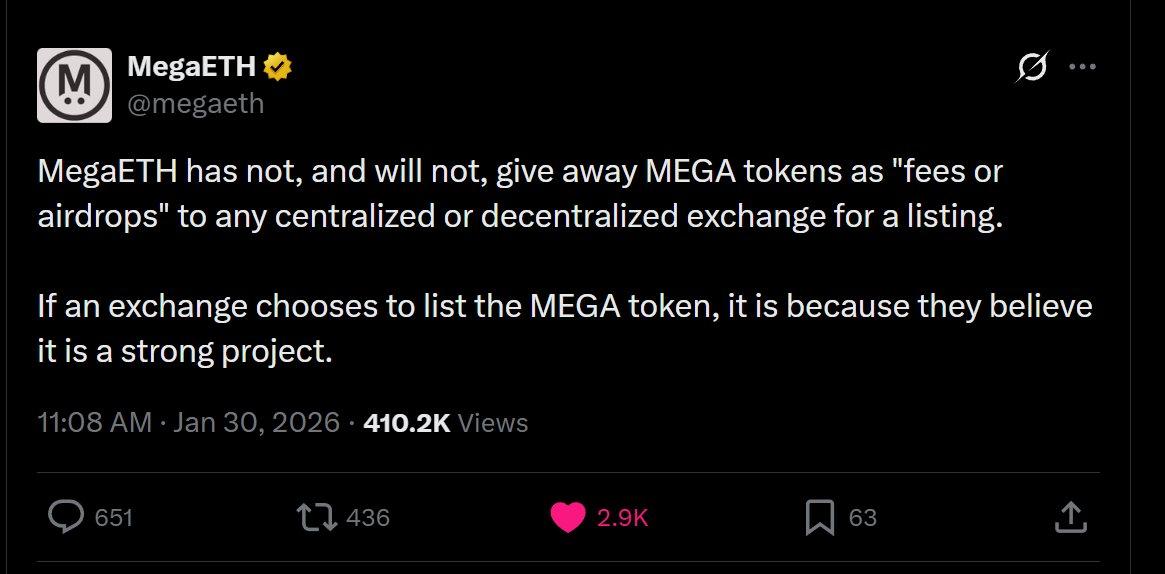
Hopefully, the team will start to be more selective about their token distribution. If the team begins to treat their tokens as valuable, perhaps the market will respond in the same way.
Cap's stable airdrop
The stablecoin protocol Cap introduced a "stabledrop" instead of a traditional airdrop. Instead of airdropping the native governance token CAP, they distributed the native stablecoin cUSD to users who earned Cap points.
This method rewards farmers with real value, thus fulfilling the social contract. Users who deposit USDC into the Cap supply side accept the risks and opportunity costs of the smart contract, which are compensated accordingly by the stablecoin airdrop.
For those who want CAP itself, Cap is conducting a token sale through Uniswap CCA. Anyone seeking CAP tokens must become a genuine investor and commit real capital.
Filter loyal holders
The combination of stablecoin airdrops and token sales filters out committed holders. Traditional CAP airdrops tend to flow to speculative farmers who might sell immediately. By requiring capital investment through token sales, CAP ensures that it flows to participants willing to accept all downside risk for upside potential—a group more likely to hold for the long term.
The theory is that this structure gives CAP a higher probability of success by creating a centralized holder base that aligns with the protocol’s long-term vision, rather than a less precise airdrop mechanism that puts tokens into the hands of those who are only focused on short-term profits.
Watch this video:
https://x.com/DeFiDave22/status/2013641379038081113
Token design is evolving
The protocol has become smarter and more precise in its token distribution mechanism. It's no longer a shotgun-like, spiel-like issuance of tokens—MegaETH and Cap select highly selective individuals to receive their tokens.
"Optimizing distribution" is no longer the same thing—perhaps a toxic hangover from the Gensler era. Instead, the two teams are optimizing concentration to provide a stronger base of fundamental holders.
I hope that as more applications launch in 2026, they can observe and learn from these strategies, and even improve them, so that the "quality token problem" will no longer be a problem, and we will only have "quality tokens" left.