Bitcoin's price briefly touched $60,000 last week. Under a diminishing returns model, this is far from simple noise. The market is touching the most vulnerable point in the entire four-year cycle and logarithmic growth framework.
With the gains at the top of the Bitcoin cycle already significantly compressed, a further historically deep correction would completely negate the appeal of its classic cycles.
This is not a prediction; it is a mathematical law.
The upward movement at the top of the cycle is being compressed.
Bitcoin's historical tops across various cycles:
• 2013: ~1,242 USD
• 2017: ~$19,700
• 2021: ~$69,000
· 2025: ~126,000 USD
The multiple of price increases between cycle peaks:
· 1,242 → 19,700 = 15.9 times
· 19,700 → 69,000 = 3.5 times
• 69,000 → 126,000 = 1.8 times (weakest ever)
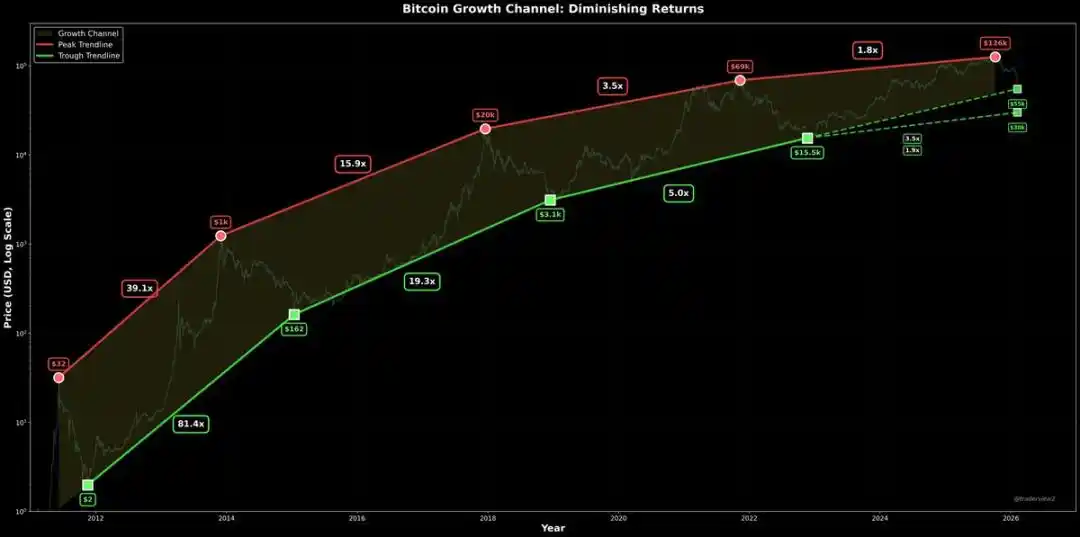
This 1.8x increase speaks volumes. Compared to historical levels, the upside potential in this cycle is negligible. This pattern cannot withstand a significant drop; otherwise, Bitcoin's growth would plateau completely.
This 1.8-fold increase reveals the core truth of the current market: compared to historical levels, Bitcoin's upside potential is now extremely limited. This cyclical pattern can no longer withstand significant pullbacks; otherwise, Bitcoin's long-term growth momentum would come to a complete standstill.
Pure mathematical constraint formula
definition:
• m = Multiple of the cycle peak value = Current cycle peak value ÷ Previous historical high value
• d = the percentage of retracement from the peak (in decimal form)

Therefore, the relative level of the bottom of the next cycle is equal to the multiple of the peak increase in this cycle multiplied by the remaining price percentage after the pullback.
For the bottom of the next cycle to be no lower than the historical high of the previous cycle, the following conditions must be met:
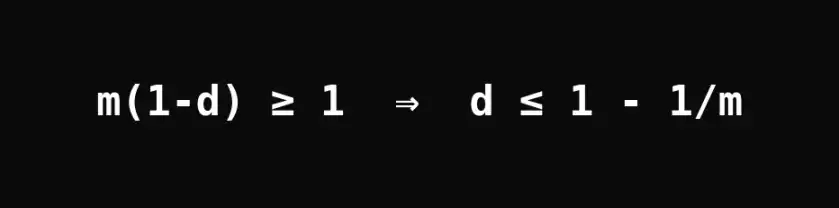
Substituting the current cycle data into the calculations, the previous historical high was approximately $69,000, and the current cycle peak was approximately $126,000. Therefore, we can conclude that:
The peak multiple of this round is approximately 1.8 times. In order to maintain the integrity of the bull market structure, the maximum allowable drawdown is about 44%. Currently, Bitcoin's drawdown has exceeded this critical value.
Bitcoin's price has fallen from approximately $126,000 to $60,000, exceeding the aforementioned "safety cap" of 44%.

This means that if the previous historical high should have served as a structural bottom support, the market is now forcibly breaking through this support, forcing the market to reach a final conclusion.
$55,000 is the critical lifeline.
If Bitcoin falls to $55,000, two key signals will emerge:
• The drawdown reached 56%, far exceeding the allowable limit of 44%.
The bottom price will be 20% lower than the previous all-time high ($69,000).
Once the price remains below $55,000, it signifies market acceptance that in this weak cycle with only a 1.8-fold increase, the cycle bottom could be significantly lower than the previous historical high.
The subsequent impact will be that if the next cycle maintains a 1.8x growth rate, the price of Bitcoin will rise from $55,000 to $99,000, and the long-term growth momentum will stagnate. This is essentially a structural failure of the growth model, and the market must change.
This is the core contradiction: Bitcoin's profit potential has been significantly compressed, but volatility has not decreased accordingly. The market remains highly volatile, but the peak gains have shrunk considerably; this cyclical pattern is simply unsustainable.
Technical support around $55,000
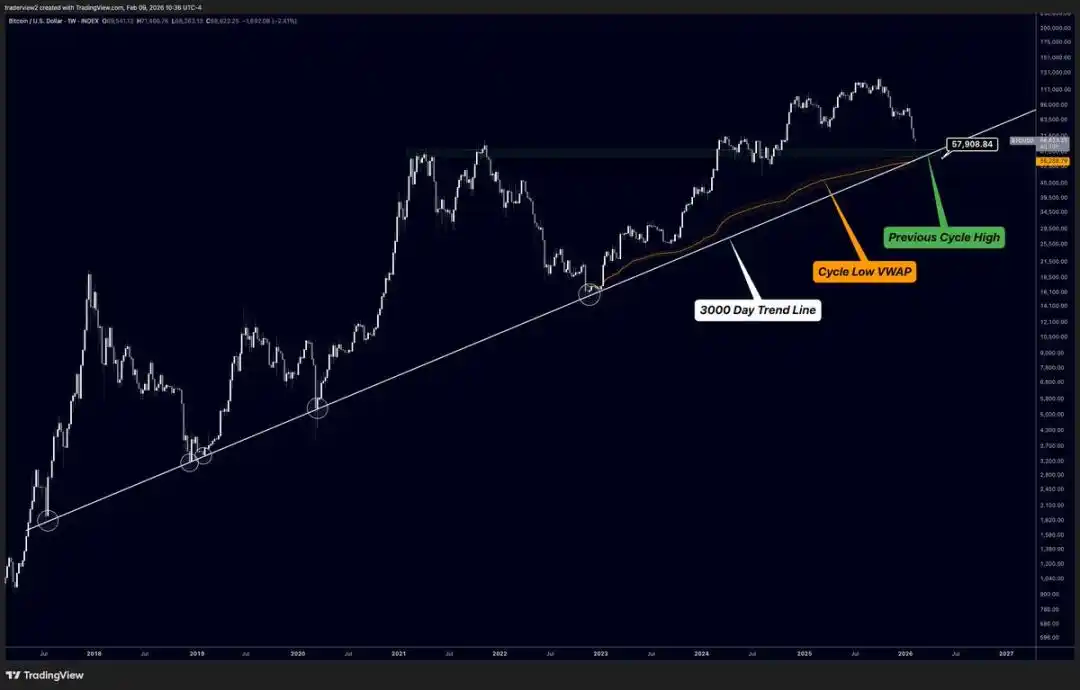
From a technical perspective, the $55,000 mid-range price level has very strong structural support, mainly including:
• 3000-day trend line (spanning over 8 years)
• Volume-weighted average price (VWAP) at the 2022 cycle low
• Support extended from the previous cycle's all-time high ($69,000)
Let's consider this: Why would an asset whose core belief is "long-term ultra-high returns" fall below the triple structural support accumulated over many years? Especially given the official launch of convenient investment channels such as ETFs, this trend is completely contrary to the long-term growth trend.
Risk-adjusted return cliff
This contradiction makes the entire cyclical logic of Bitcoin black and white: if the peak multiple of the cycle continues to shrink, while the drawdown does not shrink proportionally, Bitcoin's risk-reward ratio will deteriorate drastically.
• The potential upside for the four-year cycle is only 20% to 50%.
• Downside potential could still reach 50%.
• Cyclical trading will become completely meaningless.
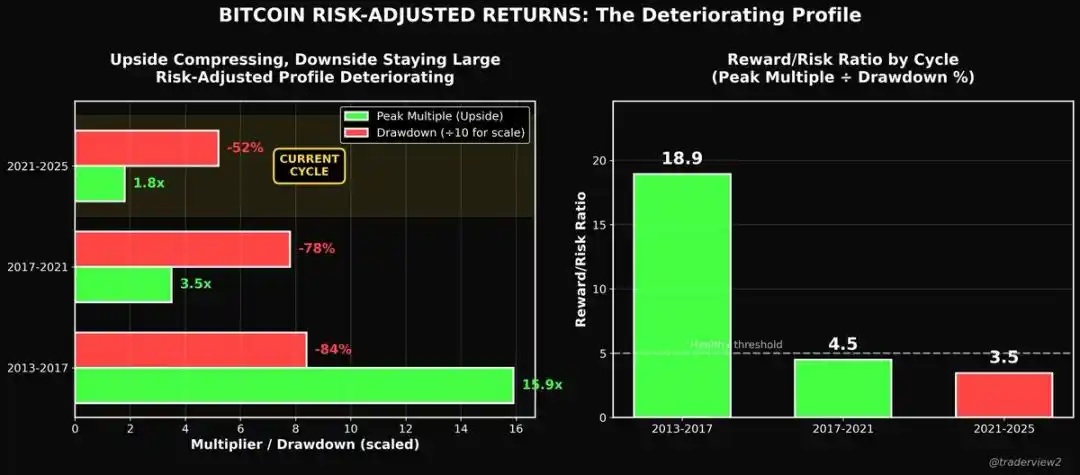
Faced with this predicament, the market has only three ways out:
Volatility contracted significantly (moving towards glory)
• The four-year cycle framework has completely failed (leading to destruction).
• A completely new demand driver has emerged, resetting the growth curve and ending the trend of continuously declining growth rates.
ETFs are the most frequently mentioned potential driver in the market, but in reality, ETFs have already been officially launched. To truly reset the growth curve, three more forces are needed: large-scale structural fund allocation, adoption at the sovereign nation level, or sustained and price-insensitive rigid demand.
The harsh reality: Why this cycle is so different
When I entered the crypto market in 2017, the entire industry was full of hope and innovation, and people firmly believed that these blockchain networks could bring real solutions to the world.
Nearly nine years have passed, and it is difficult to say whether any large crypto ecosystem has truly achieved the sustainable mainstream utility that it promised.
This cycle has wiped out countless participants, with the vast majority of tokens showing almost no performance. More and more people are beginning to recognize the truth of the market: for the vast majority of crypto assets, this is essentially a PvP game where participants rely on leverage, liquidation, and fund rotation to profit from other participants, rather than relying on the value growth of the asset itself.
The market's selection mechanism has never failed: in the long run, the vast majority of cryptocurrencies will eventually go to zero. Bitcoin, along with a few other high-quality assets in the crypto space, still has the opportunity to defy this fate and achieve a true breakthrough in value.
The choice between glory and destruction
Road to Glory
Bitcoin has achieved a "breakthrough upgrade": volatility has contracted significantly, drawdowns are far below historical levels, and the previous historical high area has once again become a solid structural support. Although the cyclical peak multiple has shrunk, the asset's stability has significantly improved, the risk-reward ratio has been greatly optimized, and it has truly become a sustainable long-term investment target.
Path of Destruction
The four-year cycle framework has completely failed. It's not that Bitcoin itself has died, but rather that the cyclical logic that sustained it for so many years no longer holds true. Volatility remains historically high, but profit potential continues to shrink. The previous historical high no longer serves as a support level, and the past growth channels have become relics of the past. Bitcoin may still experience periodic price increases in the future, and it may continue to find practical applications, but the cyclical patterns of the past will no longer be the dominant rules governing the market.
The Road to Reset
A new and powerful demand driver has emerged, completely breaking the model of diminishing returns and reshaping Bitcoin's growth curve. This could stem from large-scale structural fund allocation, widespread adoption by sovereign nations, or long-term support from passive buying by institutional funds.
Another potential problem: the long-term challenges of the protocol layer.
This is not the core factor currently influencing the market, but it deserves long-term attention: In the long run, Bitcoin must prove its ability to evolve at the protocol layer, especially by acquiring quantum resistance. The core of the quantum problem concerns the security of Bitcoin ownership and the coordination of protocol upgrades, not mining itself. The security of early Bitcoin (such as Satoshi Nakamoto's holdings) is the real potential threat.
If Bitcoin hopes to become a long-term asset, it must ultimately pass the test of "completing a protocol upgrade without undermining market trust." This is like a background timer, which hasn't been triggered yet, but it remains a significant hidden danger for Bitcoin's long-term development.
Simple judgment criteria
If Bitcoin recovers and stabilizes above $69,000 after the shakeout, the cyclical structure will be preserved, and there is still a high probability of it returning to its former glory.
If the price of Bitcoin remains in the $55,000 to $69,000 range: the market is under maximum pressure, and the cyclical model is facing its final test.
If the price of Bitcoin remains below $55,000: In the context of a weak cycle with a peak multiple of 1.8x, a structural breakdown is likely to occur, and the market landscape will likely undergo a fundamental change.
in conclusion
Bitcoin cannot simultaneously possess both characteristics: a low-growth asset and a high-drawdown asset. If risk-adjusted returns still hold value, the two cannot coexist in the long run.
Bitcoin is currently hovering around $60,000, and the market is testing this critical boundary in real time. Once the price falls below $50,000, all debate will end, and the market will deliver its final verdict: either glory or destruction.
Click to learn about BlockBeats' job openings.
Welcome to the official BlockBeats community:
Telegram subscription group: https://t.me/theblockbeats
Telegram group: https://t.me/BlockBeats_App
Official Twitter account: https://twitter.com/BlockBeatsAsia