Bitcoin is currently caught in a high-stakes tug-of-war between technical gravity and a potential institutional "pain trade."
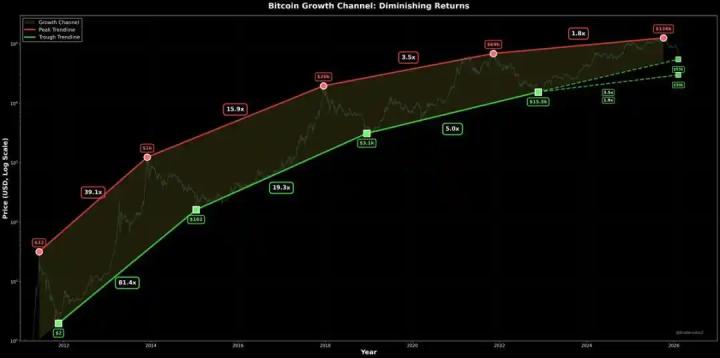
After a sharp slide from its October 2025 peak of $126,210, Bitcoin has shed nearly 45% of its value, stabilizing around $68,500, per CoinGecko data. For many, the question is no longer if the market has changed, but where the new floor resides as the asset matures into a macro-sensitive heavyweight.
Analysts are weighing two primary frameworks: a short-term technical rebound driven by trapped bearish bets, and a longer-term macroeconomic reality of tightening liquidity and high interest rates.
This divergence matters because it defines the investment horizon—whether traders should prepare for a sharp, counter-trend rally or brace for months of consolidation as the market digests last year’s excesses.
The debate is playing out in prediction markets. Users on Myriad, a prediction market owned by Decrypt's parent company Dastan, now assign a 44% probability that Bitcoin’s next major move will be a rally to $84,000 rather than a fall to $55,000—a significant increase from 24.8% just last Friday, signaling a notable shift toward near-term bullishness.
This contrasts with sentiment toward other major assets. On the same platform, users assign only a 30% chance that Ethereum’s next move will propel it to $3,000 instead of crashing to $1,500.
For Hyperliquid, whose token weathered the recent selloff relatively well, users give only a 25% chance it becomes a top-10 crypto by market cap before March, reflecting continued skepticism toward altcoins.
Some analysts see immediate fuel for a rebound in overcrowded bearish positioning.
“In the immediate future, we expect a violent, upside expansion driven by a mechanical short squeeze,” Nicholas Motz, CEO of ORQO Group and CIO of Soil, told Decrypt.
He argues that Bitcoin is decoupling from traditional macroeconomic headwinds and serving as a sovereign debt hedge.
“As price refuses to break down, we anticipate a 'pain trade' where trapped shorts are forced to cover, sending the market vertical in a volatility-fueled rip,” Motz said.
This aligns with the view that market structure itself may cushion further drastic falls, as noted in a previous Decrypt report, which highlighted whale accumulation, the extended nature of the spot CVD, and percent supply in profit among other on-chain metrics serving as indicators of a potential slowdown of the Bitcoin selloff.
“Market structure has matured significantly,” Rachel Lin, CEO of SynFutures, told Decrypt. “Institutional participation is deeper, derivatives markets are more liquid... This tends to dampen extreme moves while reinforcing directional trends driven by macro signals.”
Beyond positioning, analysts are watching where capital pauses on-chain.
“Rather than calling the next move, it’s more revealing to watch where on-chain capital pauses,” Denis Petrovcic, CEO of Blocksquare, told Decrypt.
He pointed to stablecoin supply as a key sentiment proxy. “Stablecoins have quietly become the macro buffer of crypto markets. Unlike earlier cycles, capital doesn’t automatically exit crypto during downturns, it parks on-chain.”
This introduces a new dynamic for Bitcoin’s price path. “What’s different about this cycle... is that on-chain capital now has more places to go than just major cryptos,” Petrovcic explained, noting the rise of tokenized real-world assets (RWAs) like Treasurys and private credit as alternative liquidity sinks.
“A market pullback doesn’t necessarily mean capital is leaving crypto, but it may simply be sitting in stablecoins, rotating toward yield and lower volatility,” the Blocksquare analyst said.
The counter-argument paints a picture of a more prolonged downturn, with several experts pointing to historical cycles and a hostile macro backdrop.
“We’re in the gravity phase of the cycle,” Connor Howe, CEO & Co-founder of Enso, told Decrypt.
He argued that Bitcoin will likely grind lower and spend time in the broad $45,000 to $55,000 range over the next six to twelve months, citing “ETF-driven excess… and trapped supply from the highs.”
In this case, investors can expect a drawn-out consolidation rather than a V-shaped recovery.
Motz also acknowledged this medium-term friction, noting that after any short squeeze, “the broader environment of widening credit spreads and a resilient dollar will likely create significant friction,” leading to a period of volatile consolidation.
Despite near-term disagreement, a consensus has emerged on the long-term structural thesis.
Motz framed it as an inevitable flight to quality as “we enter an era of ‘Fiscal Dominance’ where sovereign debt concerns override central bank policy.”
In this environment, the expert sees Bitcoin transitioning from a speculative tech proxy, risk-on asset into a highly anticipated non-sovereign store of value.