Abstract: By providing comprehensive EVM compatibility, Lumoz RaaS can help Ethereum projects seamlessly integrate into the Move ecosystem, such as Sui, Aptos, Movement, etc. The Lumoz RaaS solution not only promotes cross-chain collaboration and unlocks new growth potential, but also reduces transaction costs and optimizes the user experience, providing developers and enterprises with a seamless path to enter the Move ecosystem.
Introduction
Lumoz's Rollup-as-a-Service (RaaS) has supported the scalable second-layer network within the Move ecosystem. This solution fully utilizes the resource-oriented model of the Move programming language, enhancing security through a strict type system, and ensuring precise management of assets and data. The integration of Rollup technology further ensures high-speed transaction processing, lower Gas fees, and complete EVM compatibility, helping Ethereum projects seamlessly enter the Move ecosystem.
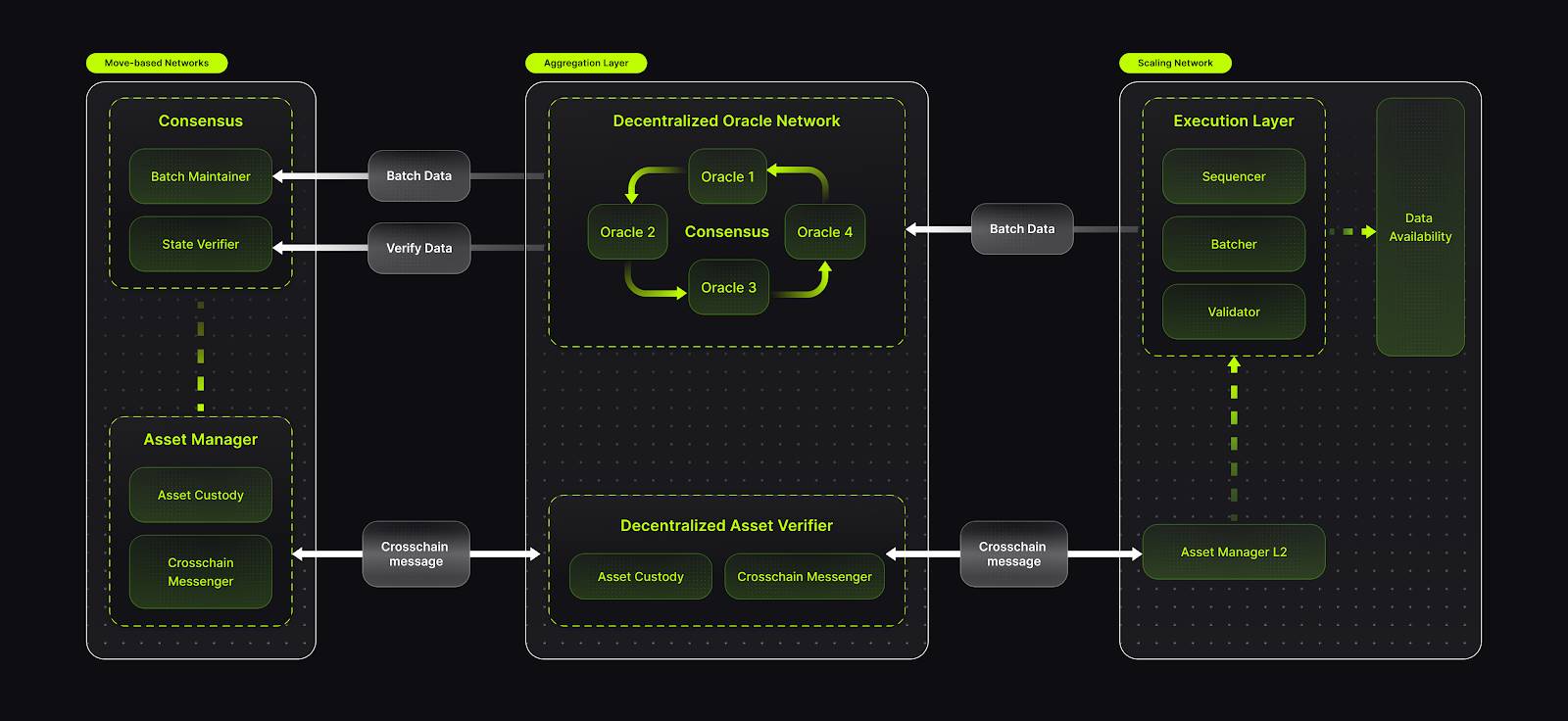
Lumoz RaaS's three-layer modular architecture covers the consensus contract, the data flow and verification of the aggregation layer, and the state management of the execution module. This design ensures smooth cross-chain communication and provides users with an efficient and friendly transaction environment. While ensuring high performance, Lumoz enhances the interoperability and security of the Move ecosystem, helping developers and enterprises explore more new opportunities in Web3.
Advantages of Lumoz Solution
As a second-layer network running on the Move ecosystem, this solution can first benefit from the inherent advantages of the Move language itself. Whether it's the MoveVM itself or the customized SuiVM or AptosVM based on it, they can leverage the resource-oriented programming model to provide higher flexibility and security for the data and asset management of the first-layer network. This feature ensures that the consensus contract on which the second-layer network runs can safely and conveniently manage the batch data and asset status of the second-layer network, greatly reducing the potential vulnerabilities during development.
The Rollup solution underlying the RaaS technology can also bring significant performance improvements to the second-layer network, including increased network throughput, faster transaction confirmation, lower on-chain interaction costs, and complete EVM compatibility. In addition, the Rollup consensus mechanism, which has been validated in a large number of scenarios, can seamlessly inherit the security of the first-layer network and provide strong security guarantees for the second-layer network.
Basic Architecture of the Solution
Move-based Scaling Network Architecture
Lumoz will adopt a three-layer structure to provide a scalability solution for Move-based first-layer networks, including the following main layers:
Consensus and Asset Manager contracts running on the first-layer network. This part will utilize the features provided by the Move language, using a resource-oriented modular design to ensure the security of the extended network's assets and data.
Consensus: The core module includes a Batch Maintainer that manages the second-layer batch data and a State Verifier that verifies the validity of the state. The contract will only consider the current second-layer state as valid and perform corresponding asset operations when the information stored in the Batch Maintainer is consistent with the state verification of the State Verifier.
Asset Manager: Composed of the actual Asset Custody and the Crosschain Messenger that handles cross-chain states. When the Crosschain Messenger detects a cross-chain event, it will verify the validity of the cross-chain request in the Consensus, and the Asset Custody will further process the asset state after the verification is passed.
Aggregation Layer: As the intermediate layer connecting the first-layer and second-layer networks, responsible for the interaction of bilateral data, information, and cross-chain communication, laying the foundation for the security and interoperability of the extended network.
Decentralized Oracle Network: As a bridge for data and information, this layer ensures the batch data and state submitted by the extended network can be confirmed by the first-layer network through independent network consensus, thereby enhancing the transparency and credibility of the system.
Decentralization Asset Verify Layer: Verifies the validity of cross-chain communication, including assets, flowing between the first and second-layer networks. Through proposal and review processes, it checks the validity of cross-chain requests and network states to enhance the security and liquidity of transactions.
Extended Network: Composed of the execution module, cross-chain module, and data availability module contained in the Rollup architecture, where:
Execution Layer: As the direct entry point for transactions on the extended network, responsible for executing, processing, and packaging the transaction data on the second-layer network, and maintaining the network state. The batch data will be finally submitted to the first-layer network after packaging and undergo state validity verification according to the Rollup consensus.
Asset Manager L2: As the counterpart of the first-layer network's Asset Manager, it will also initiate/process related cross-chain requests and update the asset state on the second-layer network based on the verification results.
Data Availability: Stores the full-chain data produced by the Execution Layer, providing transparency and reliability for the network's data.
Through this three-layer architecture, Lumoz not only ensures the high performance and security of the extended network, but also achieves tight integration with the Move first-layer network, bringing users a more efficient scaling solution.
Conclusion
In the increasingly competitive blockchain market, scalability has become a key factor. Lumoz's RaaS framework will become an important driving force within the Move ecosystem. With its high performance, security, and low-cost features, RaaS provides a strong reason for enterprises and developers to adopt Move second-layer solutions. By simplifying the transition between Ethereum and the Move ecosystem, and promoting a seamless cross-chain interaction experience, Lumoz is laying the foundation for the evolution of the decentralized ecosystem.
The successful launch of Lumoz RaaS services in the Move ecosystem marks its continuous progress in both technical breadth and depth. Currently, the service supports multiple mainstream blockchain ecosystems, including BTC, ETH, SUI, and TON. Through this innovation, Lumoz is leading the cross-chain interoperability and scaling of blockchain networks, providing enterprises and developers with more efficient and secure solutions. This not only enhances the application capabilities of the Move ecosystem, but also drives the development of the Web3 ecosystem and the future of multi-chain collaboration.