Author: Zoltan Vardai; Compiled by: Bai Shui, Jinse Finance
Due to increasingly clear regulations and soaring cryptocurrency valuations, the global cryptocurrency industry is expected to gain mainstream and institutional recognition again in 2025.
2024 set a new historical high, with Bitcoin price reaching a record high of $108,300 on December 17, more than a month after Donald Trump won the US presidential election, and the optimism of cryptocurrency investors is on the rise.
Industry experts point out that with the expectation of clearer regulation of the Trump administration, the cryptocurrency industry may usher in another milestone year, including more institutional adoption and a new high in the number of global cryptocurrency investors.
Regulatory Clarity Will Drive a Record High in the Number of Cryptocurrency Investors
In 2024, the cryptocurrency industry experienced significant regulatory developments in some of the largest jurisdictions.
In Europe, the Markets in Crypto-Assets (MiCA) regulation - the world's first comprehensive crypto regulatory framework - came into full effect on December 30, providing comprehensive guidelines for crypto service providers.
In Asia, Singapore is becoming the next crypto hub with its "risk-adjusted" regulation, which helped the country double the number of digital asset licenses issued annually in 2024.
Singapore has 1,600 blockchain patents, 2,433 industry-related jobs, and 81 cryptocurrency exchanges. These numbers are staggering for a country with a population of less than 6 million.
Chainalysis CEO Jonathan Levin said these global regulatory developments will lead to greater adoption by both retail and institutional investors.
Levin said: "We can expect adoption by institutions and retail investors to increase next year, especially as these regulations bring greater transparency to the industry."
He added that these new regulations will also enhance industry trust, market integrity, and consumer protection, "making the industry more attractive to retail."
Levin said, regulatory transparency will drive a record high in the number of daily cryptocurrency users and spur the growth of institutional products like exchange-traded funds (ETFs).
According to Triple-A's 2024 Cryptocurrency Ownership Report, as of July 12, an estimated 560 million people globally are cryptocurrency holders, representing 6.8% of the world's population.
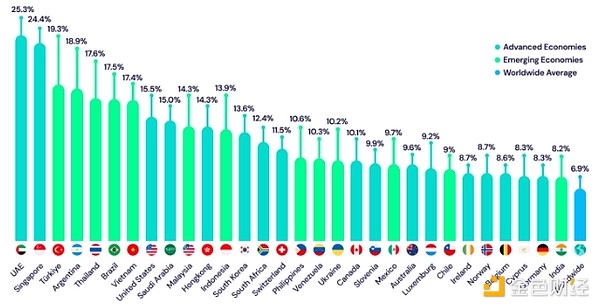
There are 560 million cryptocurrency holders globally. Source: triple-a
Pavlo Denysiuk, CEO of cryptocurrency payment company Lunu, said, based on the current user growth, the number of cryptocurrency holders could double in the next two years.
Denysiuk said in a panel discussion at NFT Fest 2024: "That's where we're getting more adoption in various places and in payments."
ETFs and Government BTC Reserve Plans Will Drive Institutional Adoption
The launch of spot Bitcoin ETFs in the US has brought more institutional adoption, making it easier for traditional financial institutions to gain BTC exposure.
Bitcoin ETFs have reached nearly $110 billion in assets under management in less than a year since their launch, supporting analysts' predictions of a $200,000 Bitcoin cycle peak in 2025.
Chainalysis CEO Levin said this dynamic will pave the way for increasing institutional acceptance of Bitcoin as an asset class:
"This is likely to translate into sustained institutional interest and efforts by financial institutions and crypto firms to build the infrastructure and resilience to support investor demand."
As an important milestone in Bitcoin's mainstream adoption, Bitcoin's status as a store of value is growing in the US, thanks to a bill advocated by Wyoming Senator Cynthia Lummis that proposes to establish a strategic Bitcoin reserve.

Lummis Bitcoin Bill. Source: Lummis.senate.gov
Anastasija Plotnikova, co-founder and CEO of Fideum, said the Bitcoin reserve proposal is gaining strong support due to the victory of former President Donald Trump in the November 2024 election and the Republican majority in the Senate.
Adam Back, co-founder and CEO of Blockstream, inventor of Hashcash, and one of the most renowned cryptographers in the industry, said that if the Bitcoin Bill is accepted by US lawmakers, the price of Bitcoin could ultimately exceed $1 million.
Cryptocurrency Adoption in Low-Income Countries Expected to Continue Growing
According to Chainalysis' October 2024 Crypto Geography Report, 2024 saw a peak in cryptocurrency activity, reaching the highs of the 2021 bull market.
The report said the Chainalysis Global Index, which measures the total value of global cryptocurrency activity, reached a new high above 0.75 in the first quarter of 2024.
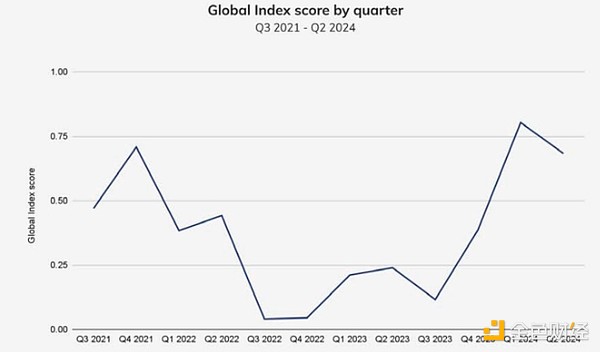
Global Index measuring the total value of global cryptocurrency activity. Source: Chainalysis
The report added that while cryptocurrency adoption in 2023 was primarily driven by low- and middle-income countries, the 2024 peak was attributed to increased cryptocurrency activity across all income levels, with a slight decrease in high-income countries in early 2024.
Levin pointed out that the increase in global activity is mainly attributed to the growing real-world use cases of stablecoins and the debut of the US Bitcoin ETF:
"There are many factors driving this trend, from the launch of the US Bitcoin ETF to the growing real-world use cases of stablecoins supporting low- and middle-income countries, as well as a significant increase in DeFi activity in Sub-Saharan Africa, Latin America, and Eastern Europe."
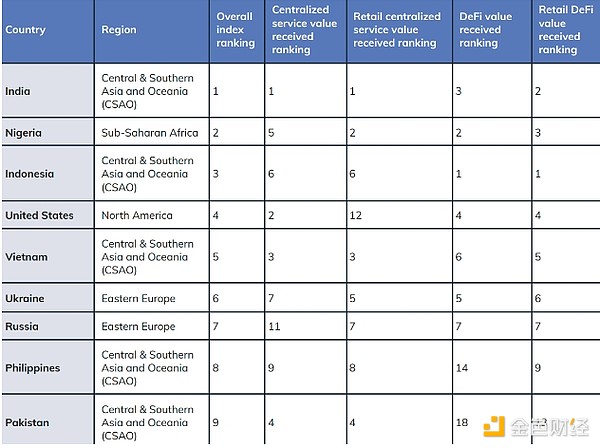
Global Cryptocurrency Adoption Index in 2024. Source: Chainalysis
Low- and middle-income countries like India, Nigeria, and Indonesia are leading the adoption, with India ranking first in the Chainalysis Global Cryptocurrency Adoption Index.
In Latin America, El Salvador adopted Bitcoin as legal tender in September 2021, generating over $31 million in profits for the country in the first three years.
Despite the $31 million in profits, the decision by President Nayib Bukele has been widely criticized after the collapse of the FTX exchange, as Bitcoin fell from its November 2021 all-time high of $69,000. During the bear market, Bitcoin fell to $16,000, and El Salvador's Bitcoin holdings declined significantly.
Author and inter-governmental blockchain expert Anndy Lian said El Salvador's decision to adopt Bitcoin is an important step in Bitcoin's increasing integration into the global financial system.
Lian said similar government initiatives may spur the adoption of Bitcoin in other countries:
"As more countries consider this path, we may see a gradual redefinition of 'safe' reserve assets. If Bitcoin becomes the primary currency for national reserves, it could fundamentally change the global financial landscape, driving a more decentralized and digitized approach to economic stability."
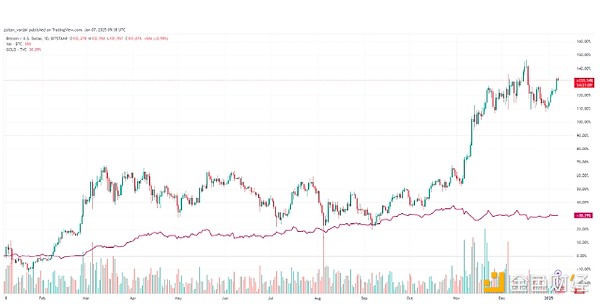
BTC and Gold, 1-year chart. Source: Cointelegraph/TradingView
Bitcoin may even become the next reserve asset after gold. TradingView data shows that Bitcoin has risen over 131% in the past year, while gold prices have risen about 30%.
Cryptocurrency investors remain highly optimistic about 2025, especially on January 6th, two weeks before Donald Trump's inauguration on January 20th, when Bitcoin regained $100,000 - as regulation becomes clearer, this is seen as a potential catalyst for cryptocurrency prices.
The expected rise of Bitcoin in 2025 is expected to attract more investors to the cryptocurrency industry, with price forecasts ranging from $160,000 to over $180,000.