Author: Zack Pokorny, Galaxy Research Analyst; Translated by: Jinse Finance
Original link: https://www.galaxy.com/insights/research/the-state-of-crypto-lending/
Preface
Lending is a use case for cryptocurrencies that has found strong product-market fit both on-chain and off-chain, with the entire category exceeding $64 billion at its peak. The lending market also plays an important role in building a financial ecosystem based on digital assets, enabling users to obtain liquidity for their holdings to deploy in DeFi and trade on-chain and off-chain.
This report explores the on-chain and off-chain cryptocurrency lending markets. The report is divided into two parts:
The first part covers the history of the cryptocurrency lending market, its participants, its historical size (on-chain and off-chain), and some key moments in the industry.
The second part of the report dives deeper into how some lending products and other sources of leverage work in both on-chain and off-chain environments, who uses them, and the risks of each.
The report provides a comprehensive overview of the cryptocurrency lending market, shedding light on one of the most widely used yet opaque sectors of the cryptoeconomy. Crucially, the report provides rare insight into the size of the off-chain lending market, which has historically been an opaque area of the industry.
Key Takeaways
• The overall size of the cryptocurrency lending market remains well below the highs reached at the end of the 2020-2021 cryptocurrency bull run. As of Q4 2024, the total size of the cryptocurrency lending market, including crypto-backed collateralized debt position (CDP) stablecoins, was $36.5 billion, 43% lower than the all-time high of $64.4 billion in Q4 2021. This decline can be attributed to a significant reduction in supply-side lenders, as well as a significant reduction in demand-side funds, individuals, and corporate entities.
• As of Q4 2024, the top three CeFi lenders include Tether, Galaxy, and Ledn, with a total loan amount of $9.9 billion as of the end of Q4 2024. Together, they account for 88.6% of the CeFi lending market and 27% of the entire crypto lending market, including crypto-backed CDP stablecoins.
• On-chain lending applications have experienced strong growth since the bear market bottom of $1.8 billion at the end of Q4 2022. As of Q4 2024, total open borrowings across 20 lending applications and 12 blockchains reached $19.1 billion. This means that DeFi open borrowings have grown 959% in eight quarters.
Lending market history and current status
Currently, there are two main channels that provide cryptocurrency-based lending services: DeFi and CeFi. These two channels have their own characteristics and provide different products. The following is a brief overview of CeFi and DeFi lending:
1. Centralized Finance (CeFi) - Centralized off-chain financial companies that provide lending services for cryptocurrencies and crypto-related assets. Some of these entities use on-chain infrastructure or build their entire business on-chain. CeFi lending is mainly divided into three categories:
• Over-the-Counter (OTC) – OTC transactions are provided by centralized institutions and offer a comprehensive range of customized lending solutions and products. OTC transactions are conducted on a bilateral basis, allowing for customized agreements between borrowers and lenders. The terms of the OTC agreement will be tailored to the specific needs of both parties, including interest rate, term and loan-to-value (LTV). Such products are typically only available to qualified investors and institutions.
• Prime Broker - An integrated trading platform that provides margin financing, trade execution, and custody services. Users can withdraw margin financing from a prime broker for other purposes or keep it on the platform for trading activities. Prime brokers typically provide financing for a limited number of crypto assets and crypto ETFs.
• On-chain private credit – allows users to pool funds on-chain and deploy them through off-chain protocols and accounts. In this case, the underlying blockchain effectively becomes a crowdsourcing and accounting platform for off-chain credit needs. Debt is often tokenized, either as a collateralized debt position (CDP) stablecoin or directly issued as a token representing a share of the debt pool. The use of proceeds is often narrow.
2. Decentralized Finance (DeFi) – Blockchain-based applications driven by smart contracts that allow users to borrow, lend, or gain leverage when trading with cryptocurrencies. DeFi lending is unique in that it operates 24 hours a day, 7 days a week, offers a wide variety of borrowable and collateralized assets, and is fully transparent and auditable by anyone. Lending applications, collateralized debt positions, stablecoins, and decentralized exchanges allow users to gain leverage on the chain.
• Lending apps – On-chain applications that allow users to deposit collateral assets (such as BTC and ETH) and borrow other cryptocurrencies against them. The loan terms are based on the collateral assets provided and the borrowed assets, and are pre-determined through risk assessment by the application. Lending through these applications is similar to traditional overcollateralized loans.
• Collateralized Debt Position Stablecoins — USD stablecoins that are overcollateralized by a single cryptocurrency or a basket of cryptocurrencies. The principle is similar to overcollateralized lending, but synthetic assets are issued based on the collateral deposited by users.
• Decentralized Exchanges - Some decentralized exchanges allow users to use leverage to expand their trading positions. While decentralized exchanges function differently, exchanges that offer margin trading play a similar role to CeFi prime brokers. However, earnings are generally not transferable from decentralized exchanges.
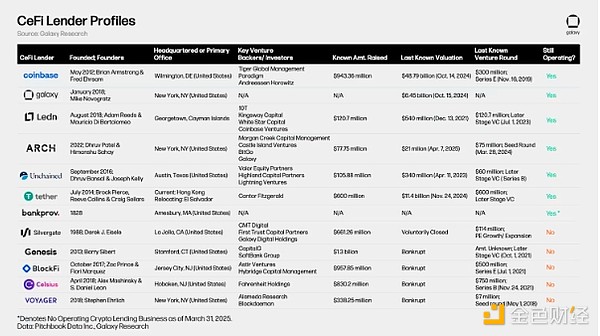
The market overview below highlights some of the major players in the CeFi and DeFi crypto lending markets, past and present. As crypto asset prices plummeted and market liquidity dried up, some of the largest CeFi lenders by loan book size collapsed in 2022 and 2023. Most notably, Genesis, Celsius Network, BlockFi, and Voyager filed for bankruptcy in the past two years. This caused the total size of the CeFi and DeFi lending markets to plummet by about 78% from the peak in 2022 to the bear market trough, and CeFi lending lost 82% of its open borrowings. More information about the history, evolution, and size of the crypto lending market will be introduced in the following sections.
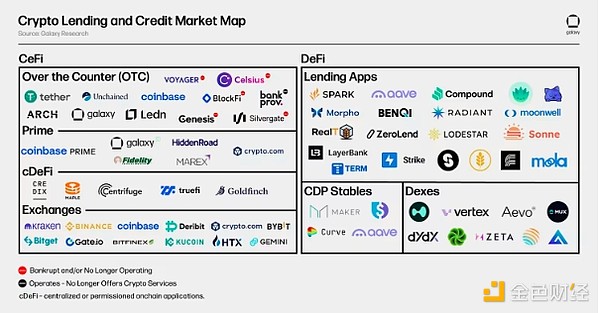
The table below compares some of the largest CeFi crypto lending institutions in history. Some of these companies offer multiple services to investors, such as Coinbase, which primarily operates as an exchange but also provides credit to investors through over-the-counter crypto loans and margin financing.
The History of Cryptocurrency Lending
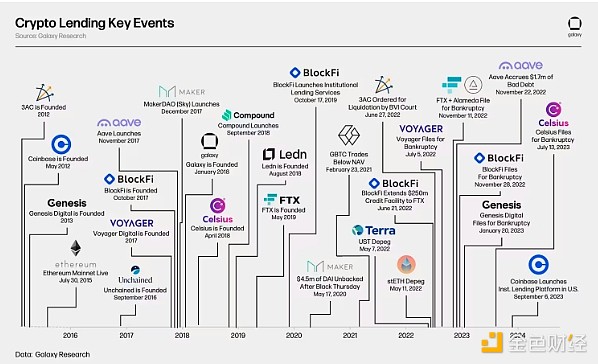
While on-chain and off-chain crypto lending did not become widely used until late 2019/early 2020, some current and historically important players were formed as early as 2012. Notably, Genesis was founded in 2013 and has loaned a whopping $14.6 billion. On-chain lending and CDP stablecoin giants such as Aave, Sky (formerly MakerDAO), and Compound Finance launched on Ethereum between 2017 and 2018. These on-chain lending solutions were only possible after the launch of Ethereum and smart contracts in July 2015.
The end of the 2020-2021 bull run marked the beginning of a turbulent 18 months for the crypto lending market, a period plagued by a wave of bankruptcies. Some of the key events during this period include: Terra’s stablecoin UST depegging, ultimately becoming worthless like LUNA; Ethereum’s largest liquid staking token (LST) stETH depegging; and Grayscale’s Bitcoin Trust GBTC trading at a discount to net asset value (NAV) after years of rising premiums.
Lending Market Size
Measured by the end-of-quarter snapshot data, the total size of the DeFi and CeFi crypto lending markets is still far below the highs reached in the first quarter of 2022. This is mainly due to the lack of recovery in CeFi lending after the 2022 bear market and the losses of the largest lenders and borrowers in the market. The following article will explore the size of the crypto lending market from the perspective of CeFi and on-chain platforms.
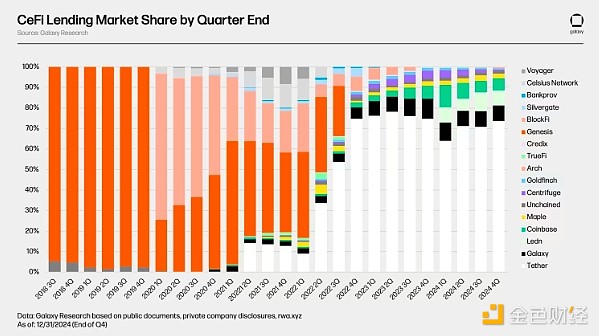
Galaxy Research estimates that at its peak, the total loan size of CeFi lenders for which data is available was $34.8 billion; at its trough, the estimated value of the CeFi loan market was $6.4 billion (down 82%). As of the end of the fourth quarter of 2024, the total amount of CeFi outstanding loans was $11.2 billion, down 68% from its historical high and up 73% from the bear market trough.
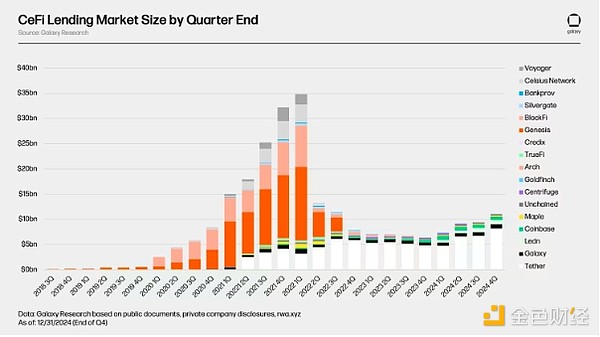
As the CeFi lending market has shrunk over the past three years, outstanding loans have been concentrated in the hands of a smaller number of lenders. At the peak of the CeFi lending market in Q1 2022, the top three lenders (Genesis, BlockFi, and Celsius) accounted for 76% of the market share, holding $26.4 billion of the $34.8 billion in outstanding loans from CeFi lenders. Today, the top three lenders (Tether, Galaxy, and Ledn) collectively account for 89% of the market share.
When evaluating the market dominance of one lender relative to another, it is important to note the differences between lenders, as not all CeFi lenders are the same. Some lenders only offer certain types of loans (e.g., BTC-only collateral products, Altcoin collateral products, and cash loans without stablecoins), only serve certain types of clients (e.g., institutional clients vs. retail clients), and only operate in certain jurisdictions. The combination of these factors makes some lenders larger than others by default.
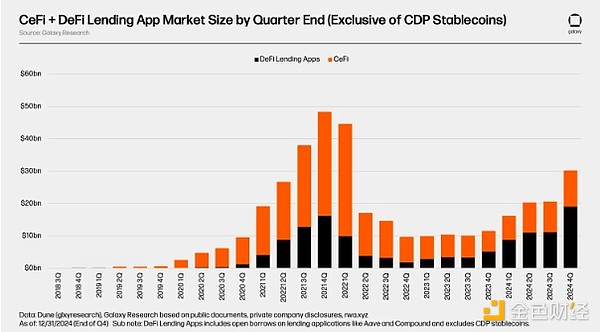
As shown in the chart below, DeFi lending through on-chain applications such as Aave and Compound has seen strong growth since the bear market trough of $1.8 billion in open lending. As of the end of Q4 2024, outstanding lending volume across 20 lending applications and 12 blockchains reached $19.1 billion. This means that in the eight quarters since the bottom, DeFi outstanding lending volume on the observed chains and applications has increased by 959%. As of Q4 2024, the amount of outstanding loans through on-chain lending applications is 18% higher than the peak of $16.2 billion set during the 2020-2021 bull market.
DeFi lending has seen a stronger recovery than CeFi lending. This can be attributed to the permissionless nature of blockchain-based applications and the fact that lending applications have survived the bear market turmoil that caused major CeFi lenders to close down. Unlike those large CeFi lenders that went bankrupt, large lending applications and marketplaces were not forced to shut down en masse and continued to operate. This fact is a testament to the design and risk management practices of large on-chain lending applications, as well as the advantages of algorithmic lending, over-collateralization, and supply-demand based lending models.
Total open interest in the cryptocurrency lending market (excluding the market cap of crypto-collateralized CDP stablecoins) peaked at $48.4 billion at the end of Q4 2021. Four quarters later, in Q4 2022, the cumulative market bottomed out at $9.6 billion, down 80% from its peak. Since then, the market has expanded to $30.2 billion, driven primarily by the expansion of DeFi lending applications, a 214% growth rate based on data at the end of Q4 2024.
Note that there may be double counting between the total size of CeFi loan books and the amount of DeFi borrowing. This is because some CeFi entities rely on DeFi lending applications to provide borrowing services to off-chain customers. For example, suppose a CeFi lender may use its idle BTC to borrow USDC on-chain and then lend that USDC to off-chain borrowers. In this case, the CeFi lender's on-chain borrowing will appear in DeFi open interest and appear in the lender's financial statements as open interest to its customers. The lack of information disclosure and on-chain attribution makes it difficult to screen for such dynamics.
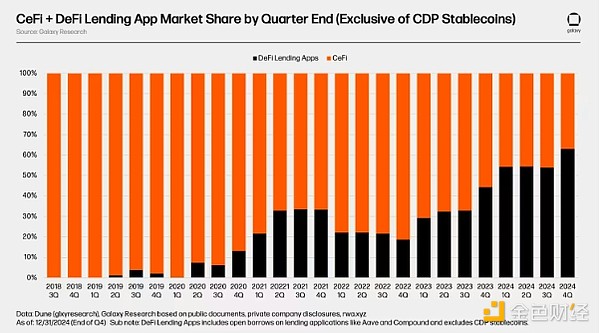
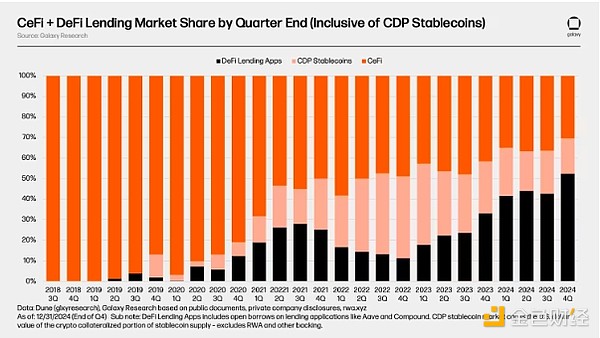
A notable change in the cryptocurrency lending market is that as the market emerges from the bear market and begins to recover, DeFi lending applications have dominated CeFi platforms. During the bull cycle from 2020 to 2021, DeFi lending applications accounted for only 34% of the total cryptocurrency lending (excluding the market value of crypto-collateralized CDP stablecoins); as of the fourth quarter of 2024, this share has risen to 63%, almost doubling.
After including the market value of crypto-collateralized CDP stablecoins, the total size of the crypto lending market exceeded $64.4 billion in the fourth quarter of 2021. At the bottom of the bear market in the third quarter of 2023, the market size was only $14.2 billion, down 78% from the peak of the bull market. As of the fourth quarter of 2024, the market has rebounded 157% from the low point in the third quarter of 2023, with a total size of $36.5 billion.
Note that, as with lending through DeFi lending applications, there may be double counting between the total size of CeFi loan books and the supply of CDP stablecoins. This is because some CeFi entities rely on minting CDP stablecoins backed by crypto collateral to provide lending services to off-chain customers.
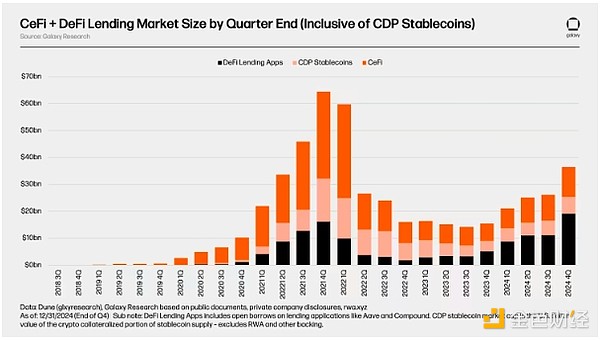
The growth trend of on-chain lending market share is even more significant if crypto-collateralized debt positions (CDP) stablecoins are taken into account. As of the end of Q4 2024, DeFi lending applications and CDP stablecoins together accounted for 69% of the entire market. Since Q4 2022, their share has been on a steady upward trend. It is worth mentioning that the dominance of CDP stablecoins as a source of crypto-collateralized leverage is gradually weakening. This is partly due to the increase in stablecoin liquidity, the improvement of lending application parameters, and the introduction of delta-neutral stablecoins like Ethena.
Market data logic and sources
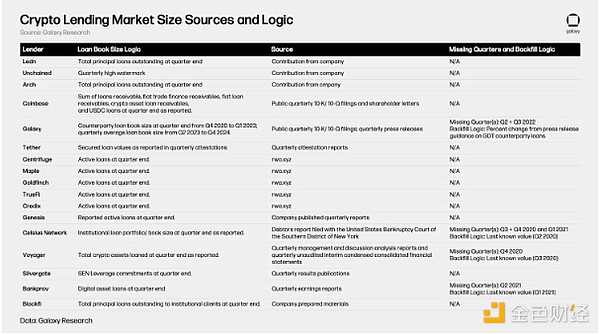
The following table highlights the various sources and logic of the above DeFi and CeFi lending market data. DeFi and CeFi data can be retrieved through on-chain data, which is transparent and easy to obtain, while CeFi data is more complex to retrieve and more difficult to obtain. This is due to factors such as how CeFi lenders account for their outstanding loans, the frequency of public information, and the general difficulty of obtaining such information.
Venture Capital and Crypto Lending
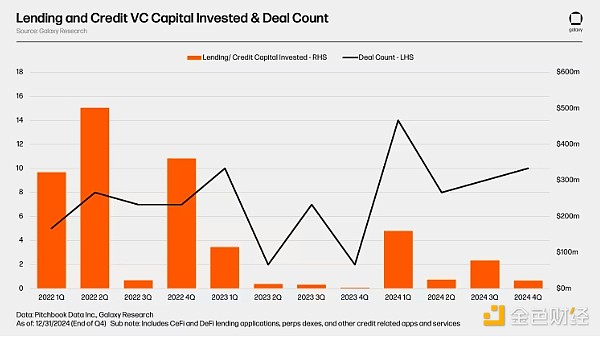
Between Q1 2022 and Q4 2024, CeFi and DeFi lending/credit applications and platforms raised a total of $1.63 billion in 89 transactions with known funding amounts. The category had the highest quarterly funding amount in Q2 2022, with at least $502 million in funding in 8 transactions. Q4 2023 was the lowest funding month, with a total funding amount of only $2.2 million.
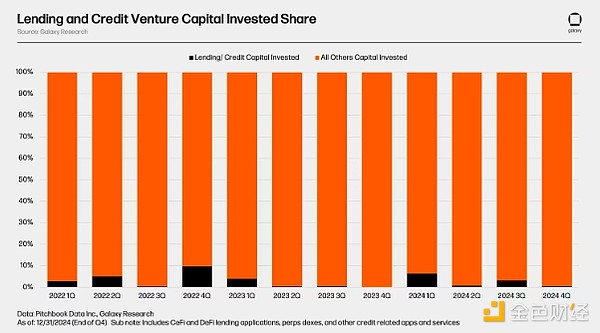
VC funding going to lending and credit apps represents only a small portion of total VC funding in the cryptoeconomy. Between Q1 2022 and Q4 2024, lending and credit apps accounted for just 2.8% of all VC funding in the space on an average quarterly basis. Lending and credit apps had the highest share of total quarterly funding in Q4 2022 at 9.75%. In the most recent quarter, Q4 2024, they accounted for just 0.62% of total funding.
Refer to Galaxy Research’s coverage of the crypto venture capital space for a more comprehensive understanding of historical trends in crypto venture capital financing.
What went wrong?
From the second half of 2022 to the beginning of 2023, the cryptocurrency lending market experienced a dramatic crash, with industry giants going bankrupt. These giants include BlockFi, Celsius, Genesis, and Voyager, which together accounted for 40% of the entire cryptocurrency lending market and 82% of the CeFi lending market at its peak. The collapse of these lenders was ultimately attributed to the collapse of the entire cryptocurrency market, although their plight was exacerbated by poor risk management and acceptance of bad collateral from borrowers.
The cryptocurrency market crash and its impact on collateral value
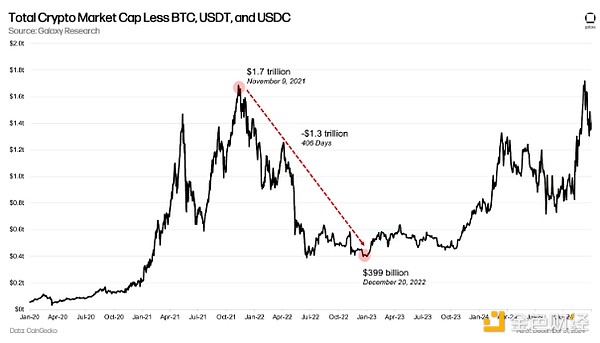
The collapse in asset prices is the main factor causing the credit crunch in the crypto lending market. Excluding BTC, USDC and USDT, the market value of digital assets has evaporated by nearly $1.3 trillion (77%) in the 406 days since reaching the cycle high on November 9, 2021. This includes the evaporation of Terra UST stablecoins worth about $18.7 billion and LUNA tokens worth about $39 billion. This has caused collateral assets to either become worthless or difficult to dispose of as liquidity dries up, and borrowers are trapped in transactions that cannot sustain their livelihoods.
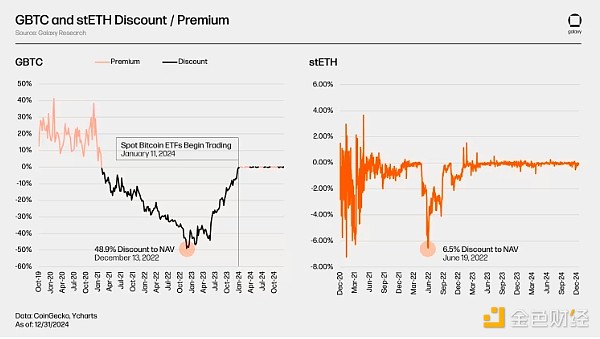
Grayscale’s Bitcoin Trust and Liquid Staked ETH
The downward trend in the market has caused collateral assets widely used by institutional borrowers to become "toxic". Notably, illiquid assets such as stETH, GBTC, and ASIC Bitcoin mining machines have led to the accelerated depreciation of widely used collateral.
The problem with stETH and GBTC in particular is that they do not give investors the privilege of redeeming their underlying assets: stETH for ETH, GBTC for BTC. At the time, Ethereum beacon chain staking withdrawals were not yet enabled, and users could not withdraw the ETH they locked in the staking contract, and GBTC did not allow investors to withdraw BTC under each share due to product structure constraints. This means that the secondary market liquidity of stETH and GBTC is much lower than their underlying assets, and they have to bear all the selling pressure. The end result is that these assets are trading at a discount to their underlying value, exacerbating the already huge pressure on crypto asset collateral. As the market closed positions, the discount rate of stETH fell to 6.25% at one point, and the discount rate of GBTC was as high as 48.9%.
Bitcoin ASICs
A similar situation also occurs in Bitcoin ASIC mining machine collateral loans issued to miners. ASIC mining machines have a dual problem as collateral: 1) the income they generate, and ultimately their value, is closely related to the price of BTC and the difficulty of mining; 2) the launch of new generation mining machines puts pressure on the value of old generation mining machines. These factors, coupled with the poor liquidity of mining machines themselves, have caused the value of mining machines to fall sharply relative to Bitcoin, or in other words, the mining machines used as collateral cannot be disposed of at all.
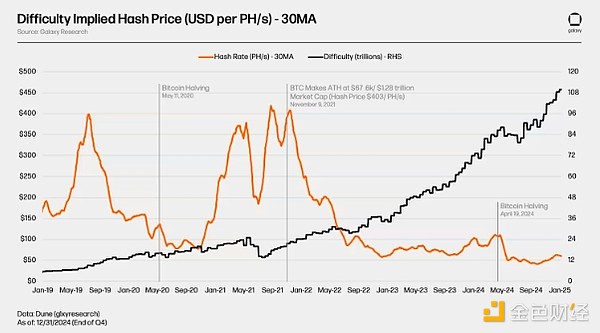
The hashrate price is a measure of the expected daily revenue of an ASIC miner per unit of hashrate (before mining costs). It is usually expressed in USD/(TH/s) or USD/(PH/s). For example, a miner with a hashrate of 0.1 PH/s and a hashrate price of $100/PH/s can expect a daily revenue of $10 (after operating costs). This number, combined with other factors, can be used to extrapolate and discount future revenue/profits to arrive at the value of the miner.
The chart below highlights the trends in hashrate price and difficulty during the 2022 bear market. In November 2021, Bitcoin closed at a cycle high of $67,600, with a hashrate price of $403 per PH/s and a difficulty of approximately 21.7 quintillion hashes. In the 13 months that followed, Bitcoin price fell 75% to around $16,600 and difficulty rose 58%, resulting in an 86% drop in hashrate price and, by extension, estimated ASIC revenue. Note the 11% difference between Bitcoin’s performance and the crash in hashrate price. This difference is due to the increase in mining difficulty. Rising difficulty means increased competition among miners, which, combined with Bitcoin’s daily fixed issuance, ultimately results in fewer BTC produced per unit of hashrate on the network, and, in turn, less revenue. This dynamic is a contributing factor to the massive loss in value for ASICs.
The decline in ASIC mining machine revenue has negatively affected their selling prices. The value of each unit of hash rate for each mining machine by efficiency classification has experienced an 85% to 91% decline from its cycle high to the low point of Bitcoin price in December 2022. As a result, in some cases, the value of collateral loans provided to miners has lost more than 90%. It is important to note that this chart only shows the most commonly used ASIC mining machines before and during the bear market, which are more likely to be used as collateral for miner loans.
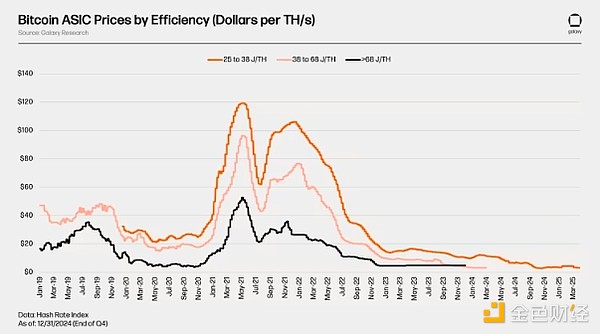
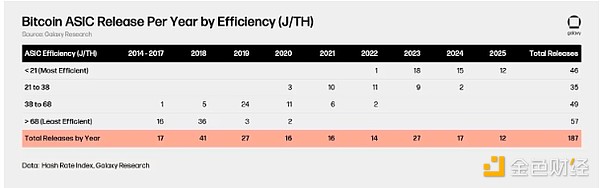
Falling BTC prices and rising mining difficulty aren’t the only headwinds facing the value of ASICs. New, more efficient miners have come to market in 2021 and 2022, including Bitmain’s first miner with a J/TH below 21, which launched in August 2022. This puts more pressure on older miners used as collateral, as they are less attractive for mining.
Poor risk management
To make matters worse, many prominent cryptocurrency lenders at the time had poor risk management practices. However, after the bear market, the industry has begun to self-regulate in the absence of clear regulatory guidelines; this includes stricter risk management and more thorough due diligence. Nonetheless, the lack of risk management by lenders and their poor enforcement played a major role in the digital asset crash in 2022 and 2023.
Asset and Liability Management
Lenders prior to the FTX era failed to properly manage the liquidity of their books. Basically, many institutions would lend on a regular basis and borrow short-term, expecting to replenish liquidity when needed. However, when lenders needed to recover funds in large amounts, there was not enough liquidity to meet the demand. Borrowers were either deeply in debt and unable to repay the borrowed funds, or they were left with term loans that lenders could not recover.
Poor credit risk management
Before FTX came along, it was common practice for crypto lenders to provide unsecured or under-collateralized loans. For example, it is estimated that up to 36.6% of Celsius’ institutional loans are held by unsecured borrowers, while BlockFi also provided unsecured loans to FTX. Lenders also had flawed vetting procedures, failed to adequately verify the solvency of counterparties, and lent funds to unqualified borrowers.
Weak internal risk control
Asset-liability mismatches and lack of credit risk management are attributed to weak internal risk controls. Before the FTX era, many lenders did not have clear risk parameters or templates for loan risk limits. Most of the problems with weak internal controls are company-specific rather than industry-wide. Although some lenders fell victim to the widespread spread of the 2022 cryptocurrency market crash, the lending standards and controls they established helped them survive the bear market.
Where will the cryptocurrency lending market develop next?
Now that the market has begun to recover and cryptocurrency lending is also on the rise, there are some key changes to watch out for in the coming year. They are as follows:
For CeFi lending, traditional institutions like Cantor Fitzgerald, major lenders, and banks entering the market have created opportunities to access funding through existing banking channels, which has increased competition and reduced the cost of funding. This increased competition and access to low-cost funding has also enhanced liquidity and accessibility/scale of services, as these institutions bring deep financial resources and strong market infrastructure to the space. These entities have entered the crypto economy out of personal interest as well as measures by regulators. Most notably, the SEC’s revocation of SAB-121 through the issuance of SAB-122 has added a tailwind to crypto lending, as SAB-121 removed the requirement for public companies (many banks are public companies) to list customer digital assets on their own balance sheets. This requirement of SAB-121, combined with separate bank capital requirements, has effectively made it nearly impossible for banks to provide crypto custody services, hampering their ability to provide ancillary services such as lending. In addition, the rise of Bitcoin ETPs in the United States has enabled high-quality lending platforms to enter and provide leverage as well as lending against ETPs, further expanding the crypto-related lending market.
For on-chain private credit, the future lies in tokenization, programmability, utility, and the resulting yield. Tokenization of off-chain debt introduces an element of transparency and automation that is not available in traditional debt instruments. The combination of these two factors allows for better risk management, which in turn increases lenders’ risk tolerance and reduces administrative costs, allowing lenders to move further down the risk curve and earn more yield. In addition, the utility of private credit tokens in the on-chain economy will continue to expand. Serving as collateral for lending applications or minting CDP stablecoins will likely be the first major use case for these tokens on-chain.
For DeFi lending, the future lies in expanding its institutional user base and centralized off-chain companies built on the lending application technology stack. Increased institutional adoption stems from 1) financial companies becoming more familiar with the risks of blockchain and on-chain applications, 2) the benefits of supplementing off-chain operations with on-chain outlets, 3) regulatory clarity on digital assets from major governments, and 4) the liquidity base and the relative volume of on-chain lending activity compared to off-chain lending activity are growing. In addition, be wary of centralized companies built on the lending application technology stack. As these companies issue assets (such as private credit tokens) and move more of their business on-chain, they are likely to want to use blockchain infrastructure to support the utility of their tokens and company operations. An example of this is Ondo Finance's Flux protocol, a fork of Compound v2 designed to support the utility of its OUSG Treasury token.
Data-driven insights into cryptocurrency lending
The following highlights historical trends in on-chain and off-chain lending activity, including interest rates, the size of various CDP stablecoins, and the assets most commonly borrowed and used as collateral.
Activity
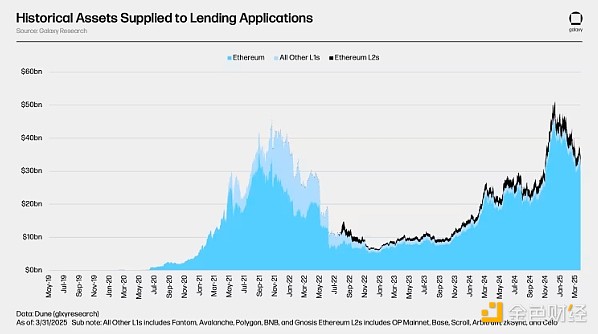
Lending is the largest DeFi category across all blockchains, and Ethereum is the largest lending chain by asset deposits and borrowing. As of March 31, 2025, the total assets deposited on the 12 L1 and L2 blockchains based on the Ethereum EVM are $33.9 billion. There are another $2.99 billion in deposits on Solana, not shown in the figure below. $30 billion (81%) of these deposits are deposited on Ethereum L1. Aave V3 on Ethereum L1 is the largest lending market, with total deposits of $23.6 billion as of March 31, 2025. It is important to note that lending application deposits cover both assets used as collateral and assets deposited solely for the opportunity to earn a yield. The assets that are actively used as collateral on Ethereum Aave V3 will be detailed below.
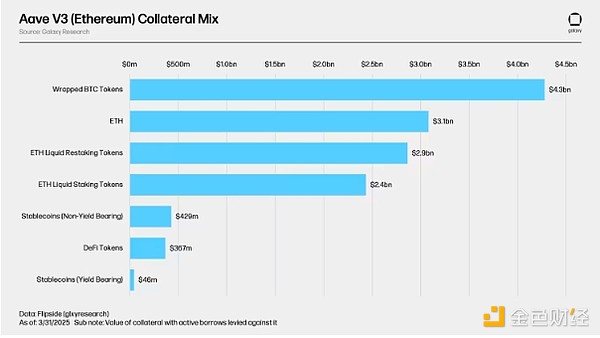
Wrapped Bitcoin tokens (WBTC, cbBTC, and tBTC), ETH, and ETH liquidity (re)collateralization tokens (stETH, rETH, ETHx, cbETH, osETH, and eETH) are the most commonly used collateral in Ethereum Aave V3. In total, there is $13.5 billion worth of collateralized assets with loans against them. In total, the borrowing value of these assets is $8.9 billion, with an average loan-to-value ratio (LTV) of 65.9%.
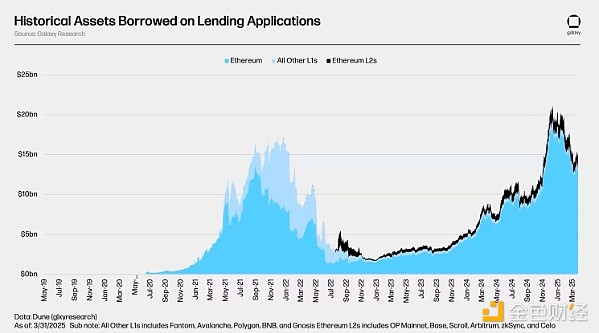
As of March 31, 2025, outstanding borrowings across the 13 chains observed in supply analysis (including Solana with $1.13 billion in borrowings) are $15.33 billion. Cumulatively, this means a utilization rate of 41.45% across all chains. On Aave V3 on Ethereum alone, $8.9 billion (58%) of outstanding borrowings exist. Across the 12 EVM chains observed, total outstanding borrowings reached an all-time high of $20.06 billion on January 24, 2022.
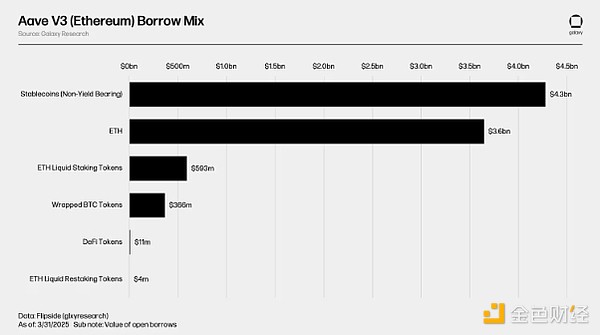
Stablecoins and non-collateralized ETH are the most borrowed assets on Ethereum’s Aave V3 platform. This is because many users stake their cryptocurrencies as collateral to obtain USD liquidity to fund new trades, while borrowing ETH with liquid (re)collateralized ETH allows users to gain leveraged exposure to ETH or short ETH at a lower net arbitrage cost. In this case, the staking yield built into the liquid (re)collateralized tokens denominated in ETH can partially offset the cost of borrowing ETH. More details on this and other on-chain interest rates will be introduced below.
interest rate
This section details the interest rates and stability fees for major stablecoins (including USDT, USDC, GHO, and DAI/USDS, as well as BTC and ETH) in on-chain lending markets and off-chain venues.
On-chain interest rates
Below we examine the interest rates and stability fees of stablecoins, ETH, and (W)BTC across multiple chains and on-chain lending markets.
Stablecoins
As of March 31, 2025, the weighted average lending rate and stability fee for stablecoins on the Ethereum mainnet was 5.67% calculated by the amount borrowed, using a 30-day moving average. The lending rates of on-chain stablecoins largely reflect the prices of digital assets such as Bitcoin and Ethereum. As the value of an asset appreciates, lending rates generally rise, and vice versa.
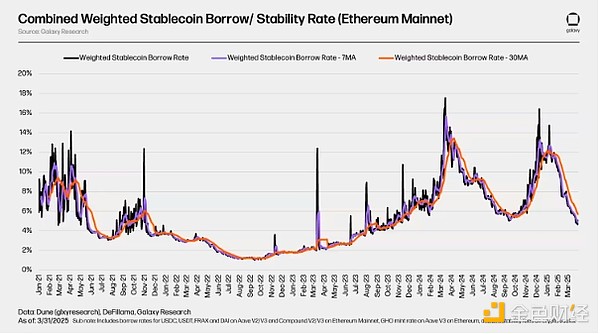
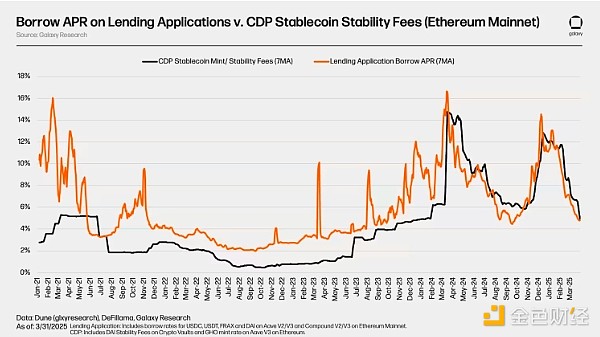
The chart below lists the annual lending rates for stablecoins in lending applications such as Aave and Compound, as well as the stability fees for CDP stablecoins such as DAI/USDS and GHO. The chart focuses on the cost of borrowing LP deposits in lending applications versus the cost of minting CDP stablecoins. It is important to note that the stability fees of CDP stablecoins are relatively less volatile than the market-driven lending rates of lending applications. This is because their interest rates are determined differently: the interest rates of lending applications are market-driven, while the interest rates of CDP stablecoins are determined through regular governance proposals or updates.
BTC
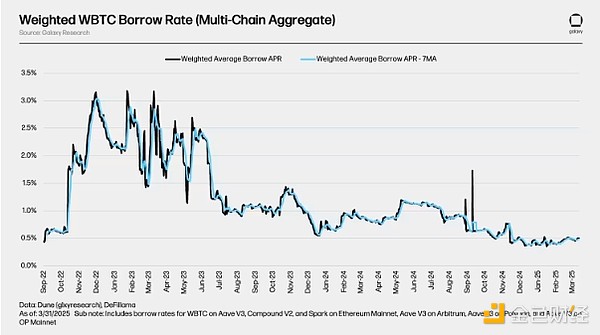
The chart below shows the weighted lending rates of WBTC on lending applications across multiple lending applications and blockchains. Due to the low lending demand for this asset, the borrowing cost of WBTC on-chain is generally low. As mentioned earlier, wrapped Bitcoin tokens are mainly used as collateral in the on-chain lending market, and their utilization rate is not high, which drives up the borrowing cost. In addition, the borrowing cost of BTC on-chain lacks volatility, which is usually caused by users frequently borrowing and repaying debts.
In the context of on-chain BTC lending, it is important to note that native BTC is not compatible with smart contract-enabled blockchains such as Ethereum. Therefore, wrapped Bitcoin tokens are used in the on-chain lending market (in Ethereum, wrapped Bitcoin tokens are ERC-20 stablecoins tied to native BTC). This adds risk to on-chain BTC lending that is not common in off-chain BTC lending (which may include native BTC).
ETH and stETH
The following chart shows the weighted lending rates for ETH and stETH lending applications on multiple blockchains. Although these tokens are all ETH-centric (either directly ETH-centric or ETH locked on the beacon chain in the form of voucher tokens), there are differences between their borrowing costs. This is due to differences in interest rate curves and utilization rates for different lending applications. More on the interest rate curve mechanism will be introduced in the section that details on-chain lending applications later.
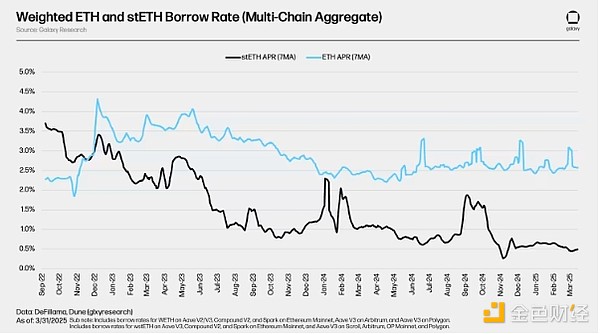
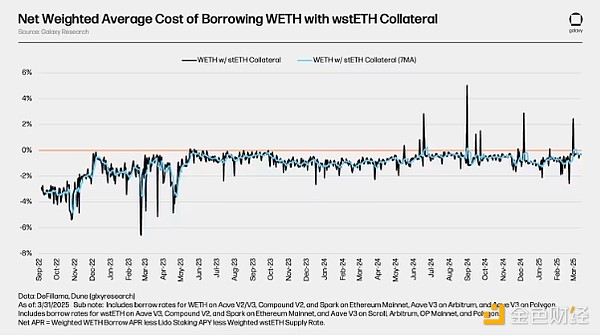
In Ethereum's largest lending market, unstaked ETH is borrowed in large quantities, and Ethereum LST has become the main collateral asset. By using LST (which earns the network's staking annual rate) as collateral, users are able to obtain ETH loans at a low net borrowing rate (usually negative). This cost efficiency has spawned a circular strategy: users repeatedly use LST as collateral to borrow unstaked ETH, stake it, and then recycle the obtained LST to borrow more ETH, thereby amplifying their ETH staking annual rate risk exposure. The accompanying figure shows the net weighted average cost of borrowing ETH using stETH as collateral, which is derived from the weighted average borrowing annual rate of stETH minus the staking annual rate of stETH and its lending supply rate.
OTC Rates
The following section focuses on off-chain, OTC lending rates for USDC, USDT, BTC, and ETH, and compares them to the corresponding on-chain rates.
Stablecoins
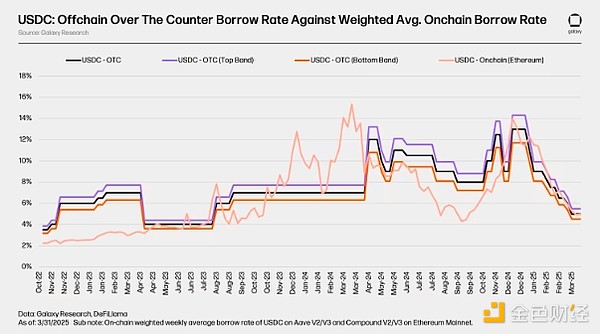
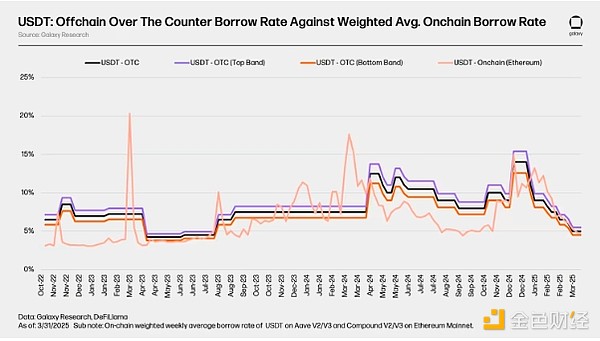
Off-chain stablecoin rates, similar to on-chain stablecoin rates, closely track cryptocurrency price movements and are driven by leverage demand. For example, off-chain stablecoin rates bottomed out in the summer of 2023, months after the FTX crash triggered the crypto credit crisis and bear market. Since then, off-chain rates have continued to rise, specifically starting in March 2024, marking the beginning of the current bull market. On-chain rates, which are more volatile in nature, surged to over 15%, while OTC rates remained in the low 7% to 10% range. By the summer, both on-chain and OTC rates had returned to normal amid range-bound price movements. Overall, on-chain and OTC stablecoin rates tend to move in tandem, with OTC rates being less volatile.
Note that the off-chain exchange rates for USDC and USDT are roughly equal and adjust at similar cadences, while the on-chain exchange rates are more volatile and not always equal. This is because of differences in the relative risk and utility of these stablecoins on-chain versus their use via off-chain lending and how off-chain lenders assess their risk.
USDC
USDT
Bitcoin
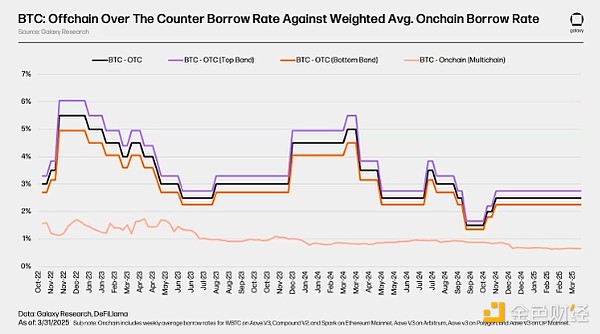
BTC interest rates show a clear difference between on-chain and OTC markets. In the OTC market, BTC demand is driven primarily by two factors: demand to short BTC and use BTC as collateral for stablecoin/cash loans. For example, after the FTX crash in 2022, OTC market interest rates soared as demand for short BTC surged. Similarly, at the beginning of the bull run in February 2024, OTC market interest rates rose as businesses sought to borrow BTC as collateral for stablecoin or cash loans. In contrast, on-chain BTC interest rates have remained largely flat. The on-chain market lacks significant demand, yield opportunities are limited, and most on-chain participants only use BTC as collateral for USD liquidity.
Ethereum
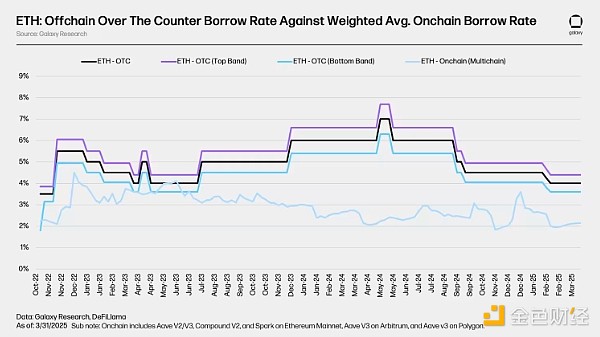
Off-chain ETH rates are generally the most stable, as the ETH staking yield provides a benchmark rate that the market tends to follow. On-chain ETH rates are generally close to the staking yield, as lenders have an incentive to lend at a price lower than the staking rate, while borrowers have limited incentive to borrow ETH due to the lack of opportunities to earn better returns than staking. In the over-the-counter (OTC) market, similar dynamics as BTC are also present, although less pronounced. In bear markets, the demand for short ETH increases; while in bull markets, the demand for borrowing ETH as stablecoin collateral increases. However, in the OTC market, loans collateralized by ETH are less common than loans collateralized by BTC, as companies prefer to pledge their assets rather than use them as collateral.
CDP Stablecoin
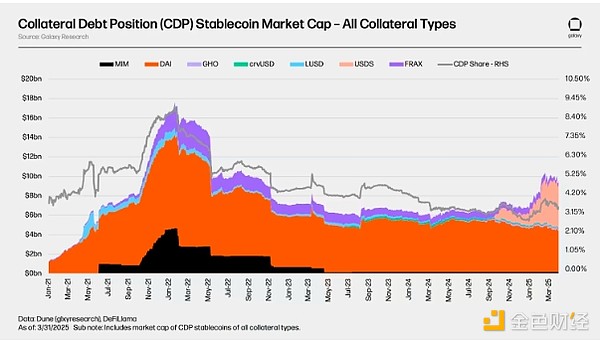
As of March 31, 2025, the total supply of major CDP stablecoins is $9.6 billion. Sky's DAI/USDS is the largest CDP stablecoin, with a supply of $8.7 billion across all collateral types (such as risk-weighted assets, private credit, and cryptocurrencies). Although the total supply of stablecoins is close to its all-time high, CDP stablecoins are still 46% lower than the high of $17.6 billion reached in early January 2022.
As of March 31, 2025, the share of CDP stablecoins in the total stablecoin market value has also fallen from a high of 10.3% to only 4.1%. This is due to the growing status of centralized stablecoins such as USDT and yield-based stablecoins such as USDe, coupled with low demand for CDP stablecoins as a source of on-chain USD liquidity.
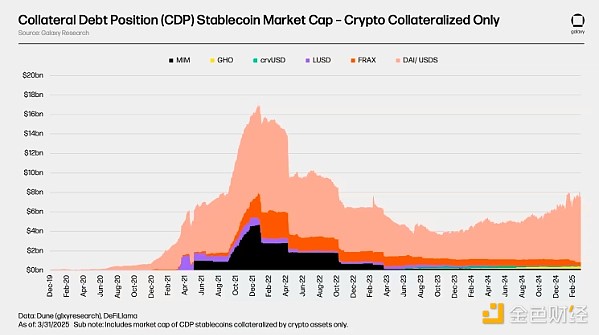
The chart below shows the crypto-collateralized market capitalization of CDP stablecoins (i.e., the market capitalization of CDP stablecoins directly backed by crypto assets). After reaching $17.3 billion in January 2022, the market capitalization of such CDP stablecoins has fallen 55% to $7.9 billion.
The market capitalization of crypto-collateralized CDP stablecoins has fallen from all-time highs to a bear market in 2022-2023, in line with open borrowings on lending applications, highlighting the similarities between their functionality and use as on-chain sources of credit.
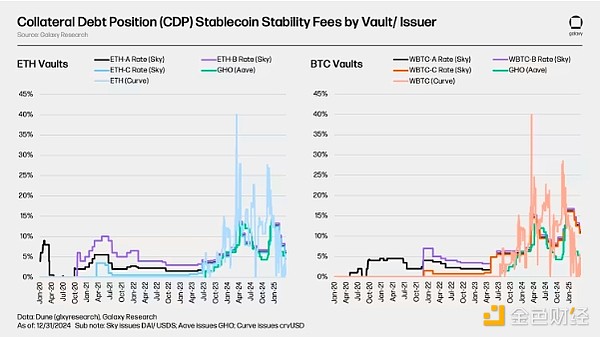
The following charts present a non-aggregated view of stability fees for CDP stablecoins in Bitcoin and Ethereum vaults. They represent the cost of minting Bitcoin and Ethereum CDP stablecoins across the observed platforms. Note that despite assets in the ETH and BTC vaults being used as collateral to mint the same synthetic asset, there is a difference in their stability fees. This is a notable feature of some CDP stablecoins relative to their lending application alternatives, where the collateralized assets rather than the borrowed assets determine the minting rate. More on this, and CDP stablecoins, in the section detailing on-chain lending mechanisms later.
Detailed explanation of the operating mechanism of DeFi and CeFi for cryptocurrency lending
This section covers various verticals of CeFi and DeFi lending, how they operate, the risks involved, and how the DeFi market complements off-chain lending operations.
Why Lend and Borrow Crypto?
Before we delve into how to lend and borrow cryptocurrencies, let’s first understand the reasons why businesses and individuals engage in cryptocurrency lending. Reasons include:
• Gain liquidity in their tokens – allowing borrowers to gain liquidity without having to sell their assets, preserving the potential for future upside.
• Get yield on their money – allowing lenders to earn passive interest on their idle assets.
• Trading with leverage – Individuals can increase the size of their positions by trading with borrowed funds.
• Hedging Long Exposures – Enables individuals to reduce risk on existing long positions by establishing offsetting short positions, effectively managing portfolio delta and reducing directional risk exposure.
• Gaining short exposure – enables traders to take a position based on an expected price decline by borrowing and selling an asset that they expect to buy back later.
• Financing business operations – allows businesses to access working capital that can be used to fund operations.
Depending on the specific reason for borrowing/lending, the assets the borrower or lender owns and where they are held, as well as the amount of capital they wish to borrow or lend will affect the best channel to use.
CeFi Lending
CeFi lending can be divided into three categories: over-the-counter (OTC), prime brokerage, and on-chain private credit.
OTC lending
The following focuses on an overview of CeFi OTC lending details:
How does it work? Counterparties meet each other through bilateral agreements. Each transaction is negotiated and recorded individually, usually via voice or chat (such as a phone or video call, or via email or messaging apps). The collateral of the on-chain borrower is usually held by a multi-signature authority controlled by the lender. In the case of certain three-party agreements, the borrower, lender, and custodian may each control the keys of the multi-signature authority.
Who provides and uses this service? Some of the leading OTC lenders in the space include Galaxy and Coinbase in the U.S.; other large exchanges around the world also offer similar services. Borrowers are typically hedge funds, high net worth individuals, family offices, miners, and other cryptocurrency or cryptocurrency-related companies that meet the Eligible Contract Participants (ECP) requirements.
What are some use cases for borrowed funds? Once a loan is issued, the borrower is typically free to use the loan proceeds as they wish. Some common uses include leveraged trading, financing operations, or refinancing other loans.
Other details of OTC lending: Some OTC lending institutions use on-chain applications to supplement their business. This helps to improve the transparency and accounting capabilities of their books, enabling them to operate 24/7, conduct liquidation and any scheduled operations, and build products on a free and open infrastructure.
OTC lending for individuals and small businesses: While activity at the institutional level is the primary driver of the OTC lending market, individuals and small businesses are also active in this space. Some CeFi lenders, such as Ledn, Unchained, and Arch, serve individuals who want to use cryptocurrencies as collateral, such as for home purchases and business startups. Such customers are typically unable to access financial services from traditional banks, which currently do not accept digital assets as collateral. As a result, these lenders act as a lifeline for such borrowers, who are often rich in digital assets but not necessarily in fiat currencies.
Prime Brokerage Business
The following is a detailed overview of the traditional CeFi prime broker business:
How does it work? Firms that open accounts with prime brokers can take directional positions in cryptocurrency ETFs. ETFs are limited by type and issuer, and only Bitcoin ETFs issued by specific institutions can accept collateral. Typically, only 30-50% margin is required to maintain a position. Positions are usually calculated daily at market prices, and margin calculations are performed daily.
Who offers/uses it? Institutions such as Fidelity, Marex and Hidden Road offer traditional prime brokerage services for cryptocurrency ETFs.
What are borrowed funds used for? Usually for trading or short-term financing (open-ended).
Crypto Prime
Similar Prime services provided by cryptocurrency ETFs are also available for spot cryptocurrencies. However, only a few platforms (such as Coinbase Prime and Hidden Road) provide such services. The setup of the spot cryptocurrency Prime broker service is similar to the traditional service of ETFs, with the main difference being more conservative margin requirements and loan-to-value ratios (LTV).
On-chain private credit
On-chain private credit has quickly become popular in 2021, allowing users to pool funds on-chain and deploy them through off-chain protocols and accounts. In this case, the underlying blockchain actually becomes a crowdsourcing and accounting platform for off-chain credit needs. cDeFi companies have been the main promoters of such loans, managing both the on-chain and off-chain ends of the loan lifecycle - often working with off-chain partners. On-chain operations include launching smart contracts, designing tokens for each loan, and running the infrastructure required to support on-chain applications. Off-chain operations include attracting borrowers, establishing the necessary legal channels to raise on-chain funds, and establishing the processes and infrastructure required for funds to be transferred on/off-chain.
The uses of the proceeds are typically narrow, ranging from corporate startup funding to real estate bridge loans and Treasury bond funds, with loan terms set on a borrower-to-borrower basis. Historically, stablecoins have been used primarily for such applications. The off-chain portion of these products presents unique risks, including the auditability and transparency of loan funds raised on-chain, as well as the performance of the loans themselves. In some cases, the lack or difficulty of auditing off-chain funds has led to problems with borrowers misusing loan funds for uses outside the scope of the loan agreement.
Private Credit and Stablecoin Collateral
On-chain private credit is uniquely applied in DeFi as yield-generating stablecoin collateral, where off-chain debt and interest backs the on-chain stablecoin. This model is most common between Sky and Centrifuge, an on-chain private credit and RWA issuer. Sky allocates a portion of DAI/USDS to allocators on Centrifuge, who use these stablecoins for off-chain structured credit products, real estate financing, and other applications with investment-grade ratings. Allocators then pay the Sky protocol the principal of the DAI issued to them and the interest earned on their off-chain debt protocol. This model of backing on-chain assets with off-chain debt is not different from the traditional collateralized debt position (CDP) stablecoin model, where on-chain debt is used as collateral for the stablecoin.
DeFi Lending
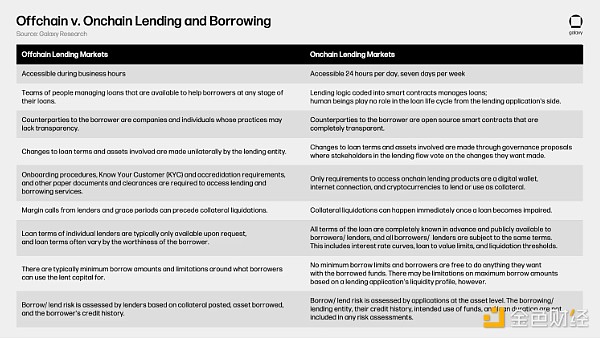
Some lending products and services that exist through off-chain channels also exist in the form of permissionless smart contract applications. Notably, lending applications like Aave, and collateralized debt position (CDP) stablecoin issuers like Sky, allow users to borrow and lend against on-chain assets as collateral. Alternative ways to obtain on-chain credit, such as perpetual contract dexes, allow users to obtain funds based on personalized needs (such as leveraged trading). While offering similar services, the on-chain nature of lending applications and the way other credit is obtained on-chain make them have a series of key differences from centralized off-chain alternatives. The following table highlights some of these differences:
How does DeFi lending work?
DeFi lending functions similarly to secured off-chain lending. The main differences are: 1) DeFi lending is run programmatically through smart contracts, executing a pre-set set of parameters rather than a manually guided process; 2) borrower risk is insured by the borrower; 3) risk compensation measures are adopted (such as lender returns and liquidator rewards).
These parameters, which include interest rate curves, loan-to-value ratios, liquidation thresholds and other elements, are designed at the asset level to manage risks, establish incentive mechanisms, and maximize loan market efficiency.
Setting risk guardrails through asset parameters means that on-chain and off-chain lending differ in where and how risk is ultimately covered. Risk in off-chain lending is covered on a borrower-by-borrower basis through factors such as loan-to-value (LTV) and interest rate, taking into account the borrower’s history, collateral/borrowed assets, and the term of the loan. On-chain lending, on the other hand, risk assessment is based entirely on the combination of collateral/borrowed assets. That is, every borrower using the same collateral and borrowed assets will have exactly the same loan in terms of loan-to-value, interest rate, and all other parameters. This is because the users, their ability to repay the borrowed funds, and the term of the loan are not what pose an existential threat to the functionality of the application or the capital of the lender. The real threat is the collateral assets they provide and the assets they borrow, because in the event of loan impairment, collateral liquidation will keep the lender and the application intact.
Each parameter is fully transparent and known in advance, and they apply to one or more of the three steps of the DeFi lending process:
Deposit collateral assets
Select the borrowed asset
Loan repayment and liquidation
Let’s take a closer look at the life cycle of DeFi loans from the perspective of asset parameters and risk management measures for managing DeFi loans.
Deposit collateral assets
Virtually all lending activity in DeFi is overcollateralized. This requires users to pre-collateralize some assets as collateral for borrowing. These collateral assets are locked on the application for the duration of the loan and loaned to the borrower, maximizing the efficiency of all funds on the application. The user's choice of collateral determines the following parameters, which vary by asset:
• Supply APR – The yield users receive for depositing collateral, as a function of the Borrow APR. The yield generated by these deposits is the interest paid by borrowers. This yield is in addition to the native yield of the provided collateral asset (e.g. the staking yield on stETH). The riskier an asset is considered by the application, the higher the ratio of the Supply APR relative to its utilization. This is done to compensate suppliers for the risk they take and to manage the application’s risk in terms of borrowing/liquidity functionality.
• Loan-to-Value (LTV) – The maximum relative value a user can borrow against their collateral. For example, if the LTV of a collateral asset is 50%, a user can borrow a maximum of 50 cents for every dollar of collateral they deposit. The lower the LTV of a particular collateral asset, the riskier it is considered by the application, and vice versa.
• Liquidation Threshold - When a user's loan-to-value (LTV) reaches this threshold, their collateral will be liquidated and returned to the lender/liquidator. The liquidation threshold is always higher than the maximum LTV. Typically, the volatility and risk of the collateral asset is directly related to the spread between its maximum LTV and the liquidation threshold. This is done to create a safety buffer to prevent immediate liquidation when borrowing at the maximum LTV.
• Liquidation Penalty - Expressed as a percentage of the amount of the liquidated asset, the liquidation penalty is a reward paid to the entity that liquidates a user's collateral. The liquidation penalty is also known as the "liquidation spread" because it represents the percentage discount that a liquidator can enjoy when purchasing a user's collateral. For example, if a user holds liquidable collateral with a market value of $100 and the penalty is 5%, the liquidator can buy it at $95 and then sell it at market value, pocketing the difference. Lending applications typically take a fee from the rewards. Some lending applications use auctions instead of hard-coded liquidation penalties, allowing the market to determine the appropriate discount. The higher the liquidation penalty of a collateral asset, the riskier the application considers it. This is done to fully incentivize the liquidation of collateral and limit the possibility of bad debts.
• Supply Caps - Some lending apps have strict deposit limits on their collateral assets, designed to limit users’ exposure to that asset. Supply caps can limit the amount of a certain collateral asset a user can deposit. A low supply cap may be due to the risk profile of that asset, and the application is limiting its exposure to it. It may also be a sign that the market cap of the asset is relatively small, and the application does not want users to deposit more than a certain percentage of its total value.
• Collateral Weights and LTV Multipliers – Factors applied to the value of a depositor’s collateral, limiting the extent to which it can be used for risk aversion, or entitling them to a higher maximum loan-to-value (LTV), thereby increasing liquidation thresholds. Assets that the application deems riskier are weighted less than 1 to create a buffer between their market value and the share available for borrowing. For example, $100 worth of collateral would have a weight of 0.85 and a borrowing capacity of $85, with a maximum loan-to-value (LTV) applied to that collateral. For collateral <> borrow asset pairs, if the lending application finds that they have a higher value correlation (e.g. borrowing ETH with Ethereum LST), the user is entitled to a preferred maximum loan-to-value (LTV) as the collateral and borrowing assets are less likely to appreciate or depreciate quickly. LTV multipliers and collateral weights only apply to specific assets and are not used by all lending applications.
• Segregated Status - Assets in segregated status cannot be paired with other collateral assets to provide loans. In addition, the amount of collateral assets in segregated status can be borrowed is subject to a specific debt ceiling, which limits its lending scope. In other cases, segregated status means that only one asset can be borrowed, and once borrowed, no other assets in the user's portfolio can be borrowed. In applications that use collateral weights, segregated assets have a weight of 0. Segregated assets are a tool to introduce emerging or volatile assets to lending applications in a risk-averse manner; it also allows applications to host a wider range of assets while compensating for the risks of doing so.
The specific set of parameters that control collateral assets and their precise values vary by application, blockchain, and asset. For example, USDC on OP Mainnet Aave V3 has different parameters than USDC on Ethereum because they are two different tokens (held at different token contract addresses on different blockchains) and exist in different ecosystems; MarginFi on Solana uses collateral weights to manage risk, while Aave does not.
These parameters are all enforced by algorithms and vary only with the combination of collateral/borrowed assets. That is, from the application's perspective, all operations, especially the execution of parameters and the necessary accounting and distribution of collateral returns, are done autonomously through smart contracts; and every user who deposits the same collateral asset/borrows the same asset is subject to the same predetermined parameters. Credit scores, values, and other off-chain metrics for obtaining loans are not used, as the application itself is not subject to any constraints and only requires depositing collateral to borrow. The same principles apply to borrowed assets. However, the networks on which these applications reside may introduce censorship factors, although these factors are not related to DeFi lending itself (such as OFAC sanctions).
The “quality” and risk of the underlying collateral assets that determine its parameter values are assessed based on a number of factors, including but not limited to the following [1] [2]:
• Asset liquidity/market depth and market depth recovery time
• Asset price fluctuations
• Asset market value
• Counterparty risk (how and by whom the assets are managed)
• Smart contract risk (integrity of underlying asset code)
• Liquidator’s execution capacity (how quickly the appointed liquidator can liquidate the assets)
• The oracle’s confidence in the pricing of its collateral assets
Similar risks to the collateral assets outlined by a specific loan application also determine the parameters of the borrowed assets, which is described in the next section.
Select the borrowed asset
Once users deposit collateral, they can choose the assets to borrow. To reduce risk, some collateral and borrowed asset pairs are set as fixed markets (such as Compound V3 and Aave's Lido market), where the collateral provided can only be used to borrow a single asset or a specified collection of assets in an isolated pool; others are free-range, where any collateral asset can be used to borrow any asset on the application. Borrowers are free to use the borrowed assets for any purpose and have full ownership of them. The assets a user borrows determine any combination of the following four components:
• Borrowing Annual Percentage Rate (APR) – The nominal annualized cost of borrowing a specific asset. The interest paid by borrowers is split between the lending application (in the form of a reserve requirement) and the user who deposits the borrowed asset (in the form of a supply APR). In some applications, users can choose between a stable rate loan, where the interest paid is fixed in the short term but can be rebalanced in the long term based on changing market conditions, or a floating rate loan, where the interest paid fluctuates in real time with the market. The vast majority of on-chain borrowing is floating rate loans, as fixed borrowing rates are typically much higher than floating rates, and some applications do not offer fixed rates. All users borrowing the same asset pay the same interest rate, which is determined by the application’s perceived risk of the borrowed asset and the market demand for that asset. Assets that the application deems riskier will have a higher borrowing curve, and vice versa. Lending applications use their assessment of the potential risk of a particular asset to determine the interest rate curve.
• Reserve Factor – The share of interest paid by borrowers that is allocated to the lending application, its DAO (decentralized autonomous organization), or other funds maintained by the application. It is expressed as a percentage of the interest paid by borrowers.
• Liability Weight – A factor applied to the value of a depositor’s collateral to limit the amount that can be borrowed against their collateral. For example, if the borrowed asset is worth $100 and the liability weight is 1.15, the borrowed value is $115, which is factored into the loan-to-value ratio (LTV). This factor can be used as a risk mitigation tool to assess borrowed assets that are considered risky for a loan application.
• Borrowing Caps - Some lending applications have hard limits on borrowed assets, designed to limit users’ exposure; the purpose of this is for liquidity management and to mitigate bankruptcy risk. A hard borrowing cap can limit the amount of assets a user can borrow if liquidity is insufficient. Other applications have “soft” borrowing caps, where borrowing limits are constrained only by the amount of assets provided to the protocol. In this case, the protocol supports an unlimited supply and borrowing of assets, but users can only borrow as much as there is sufficient supply and liquidity for the asset. Hard borrowing caps are typically lower than their corresponding supply caps, and will never be higher. It is important to note that borrowing caps are typically applied globally, rather than per user (i.e., an individual user can borrow up to 100% of an asset’s available liquidity or borrowing cap, provided they have collateral. Applications typically do not limit the size of a single borrow).
Each of these components is based on the lending application’s perceived risk of the borrowed asset, its target liquidity level, the relative returns to borrowers and the application itself, and its strategy for positioning the cost of lending against competing applications in the same market. The risk of the borrowed asset, the specific set of parameters that govern those risks, and their precise values vary by application, network, and asset.
Calculating on-chain interest rates
There are two key factors that affect the interest rate paid by on-chain borrowers: 1) Utilization and optimal interest rate; 2) The slope calculation of the interest rate curve. These two factors vary by asset and lending application. For example, the optimal interest rate and interest rate curve of WBTC on Aave V3 on Ethereum are different from those of USDC; the borrowing interest rate curve of USDC on Aave V3 on Ethereum is also different from the borrowing interest rate curve of USDC on Aave V3 on OP mainnet.
Utilization and Best Rates
The utilization rate of an on-chain lending market reflects the rela