Written by: Pzai, Foresight News
In recent days, Jesse, the head of Base protocol, has been frequently promoting "content tokens" on X. As early as February 24, Zora had already enabled each post on the platform to become a token. On Zora, the official Base account has issued 3 content tokens, with the highest market value reaching $20 million, a series of operations that once sparked market enthusiasm.
From ChillGuy to Base, the rise of content tokens not only reshaped the interaction mode between creators and fans but also opened up imagination for the future of information tokenization. Although successful cases of content tokens are emerging, how to systematically tokenize the vast and diverse information on the internet—such as a blog, a short video, or even an X post—still remains a market gap. Existing solutions are limited to specific platforms (such as Zora's Non-Fungible Token ecosystem) and struggle to cover the internet's diverse content forms. Therefore, Upside.fun hopes to tokenize any link on the internet through Metacoin, and even create a scalable "information economy".
Integration of Content Tokens
On X, Jesse distinguished "content tokens" from MEME tokens. Content tokens more represent the value of a single piece of content, with relatively lower user expectations. Individuals can create many tokens for a single piece of content, and some widely spread content can become a MEME, with its market value correspondingly increasing. MEME tokens can serve as an "integrated" form of a series of content, gaining attention aggregation and higher expectations, with some large MEME tokens even transforming into projects or ecosystems. (For example, BONK, DEGEN, etc.) From the current perspective, fragmented content leads to scattered discussion and funding attention, and "everyone gathering firewood" seems to have evolved into a scattered state.

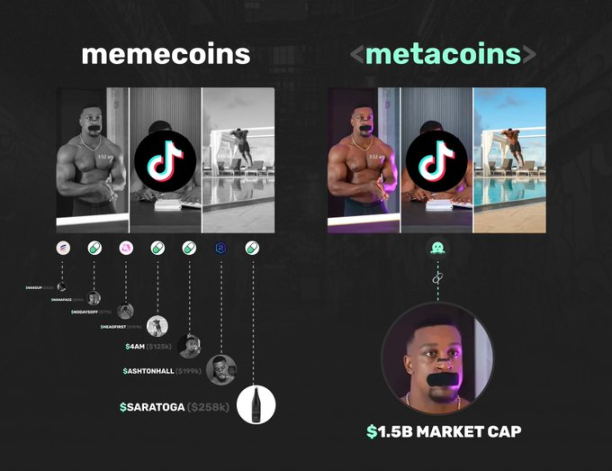
Upside.fun cuts in from this point, integrating scattered "content" into a MEME cluster carried by "metacoins". Under the existing issuance model, each new internet trend spawns dozens of MEME coins. This creates fragmentation of liquidity, attention, and growth potential. In Upside.fun's framework, through a link and token binding mechanism, every internet link (such as Tiktok, X, etc.) can become part of this MEME, and the token's popularity inversely affects its spread, forming a positive cycle. Such a design not only integrates MEME liquidity but also brings the possibility of discovering and profiting from early internet trends, making it the "trending list" of the entire internet.
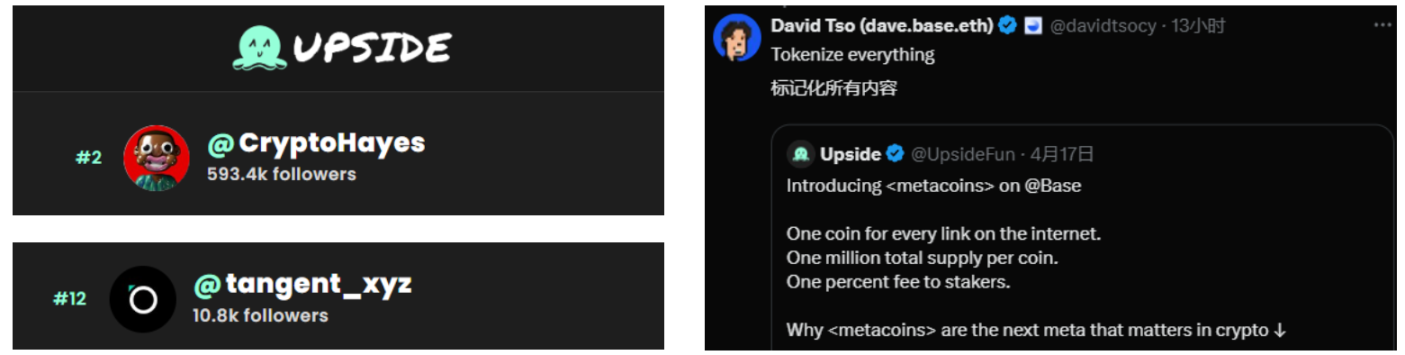
Consequently, after the project's announcement, Upside.fun attracted attention from many crypto users and VCs during the Waitlist phase, including Arthur Hayes and Tangent, and was retweeted by Base ecosystem head David Tso. As a public chain that produced creator economy applications like Friend.tech and Farcaster, Upside's model can concentrate attention on Base and generate significant capital inflow. Users can now obtain a Waitlist opportunity by DMing their intern.
In founder Zachary Dash's introduction, Upside.fun is described as an application of trading truth, viral spread, and relevance. By allowing crowds to set the price of attention and hotspots, truly returning the internet's value to users. "Like Google, but instead of searching to find, users buy to own a part of the internet." After combining the concept of content tokens with a broader content audience, can Upside.fun expand the idea of "content tokens" and recreate the glory of Clancker back then? We can remain expectant.