
Source: Bankless
Author: Jack Inabinet
Translation and Compilation: BitpushNews
Strategy and BitMine are both leading the digital asset vault game in their respective assets. However, while Michael Saylor's company pioneered the Wall Street path of transforming BTC into balance sheet alchemy, Tom Lee's bold, explosive promise to accumulate ETH through billions of dollars in trades in record time is equally noteworthy.
Strategy is continuously accumulating Bitcoin through complex financial engineering, while BitMine is moving forward with a more streamlined approach and has much to prove. These two companies are playing exactly the same game but using entirely different strategy playbooks.
Today, we will compare Strategy with BitMine Immersion Technologies and analyze the differences between these two crypto vault giants of Bitcoin and Ethereum.
The New Strategy
Once upon a time, MicroStrategy defined itself as a business intelligence company selling analytical software to corporations and institutions. Today, the reborn "Strategy" is a massive Bitcoin holding tool, with its valuation multiple times higher than its peak during the tech bubble of the 2000s, with its most sought-after product being financial engineering.
Strategy's initial core method of financing Bitcoin purchases was "at-the-market" (ATM) stock sales and convertible notes, but in this bull market, Strategy has shifted to hybrid exotic fixed-income and preferred stock issuances.
In 2025, Strategy expanded its product line, adding STRK (convertible preferred shares with an 8% dividend), STRF (senior perpetual fixed-income product with a 10% dividend), STRD (junior perpetual fixed-income product with an optional 10% dividend), and STRC (variable-rate perpetual preferred shares with an initial dividend rate of 9%).
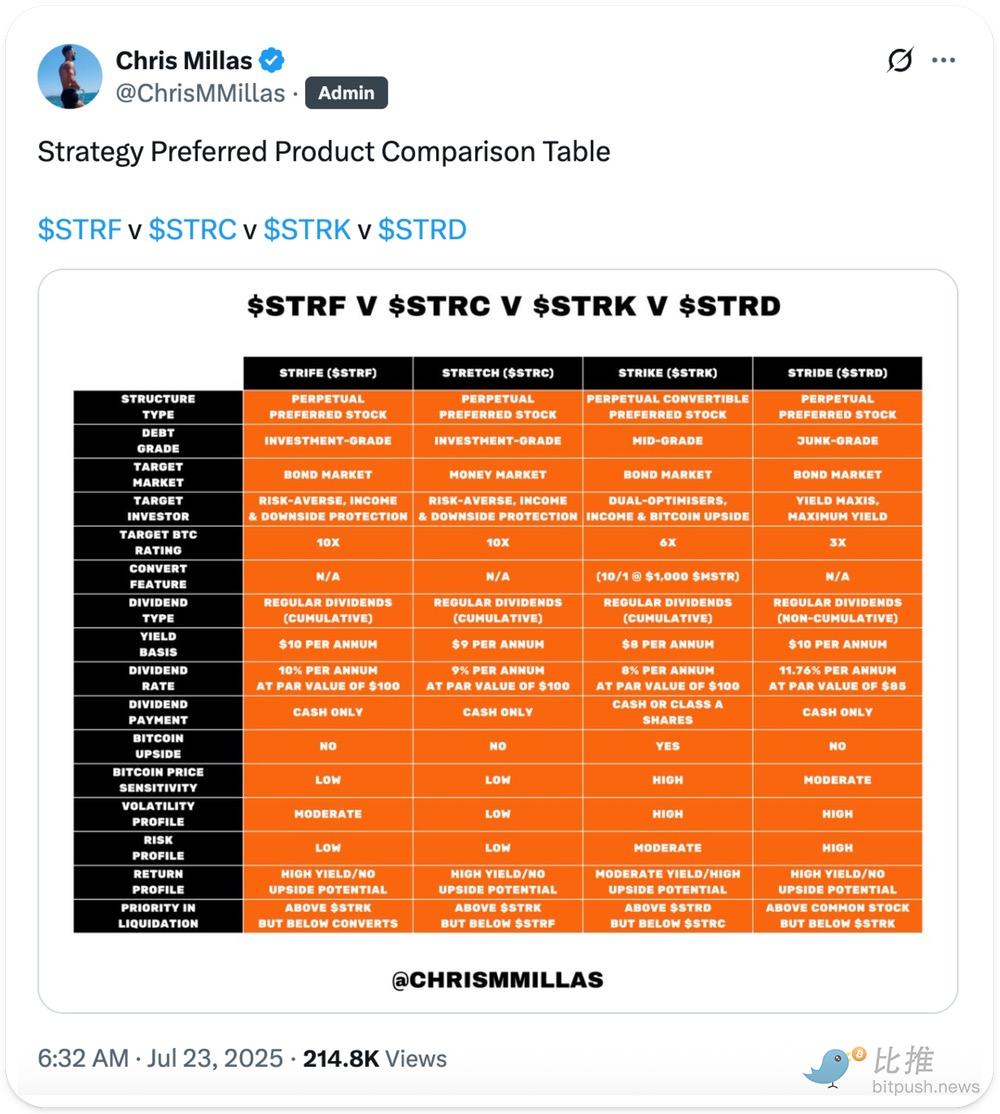
Although the numerous differences between these new-era Strategy products are undoubtedly dizzying, for the purposes of this article, we can ignore these details; more importantly, each tool works in concert to raise funds from investors with different risk and return preferences.
For example, investors seeking a 10% yield far above market levels, with claims priority just below convertible note holders, can purchase STRF; meanwhile, those wanting a slightly lower 8% yield and some upside exposure to MSTR stock can buy STRK.
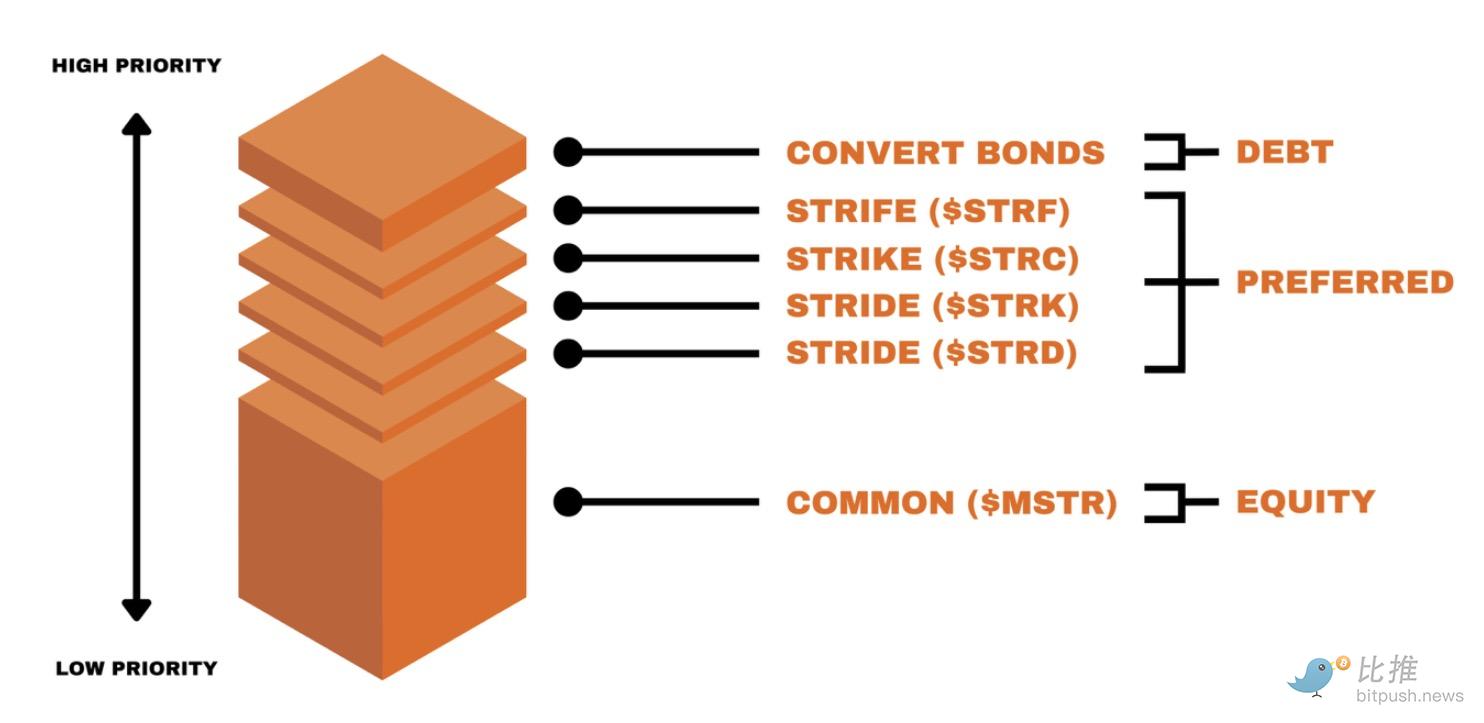
These exotic perpetual preferred stock markets are smaller than the MSTR stock itself, but Strategy has been successful through these channels, raising over $5.5 billion through this suite of products since the beginning of this year.
Notably, these products seem to have replaced Strategy's convertible notes, as the company has not issued any new zero-coupon debt since February 2025. Moreover, the vast majority of funds raised come from the initial issuance of these securities, with only 14% coming from subsequent public market sales.
In its July 31st second-quarter earnings call, Strategy established new common stock dilution guidelines, prohibiting "at-the-market" stock sales when MSTR is trading below 2.5 times its Bitcoin holdings, unless to pay debt interest and fund preferred stock dividends.
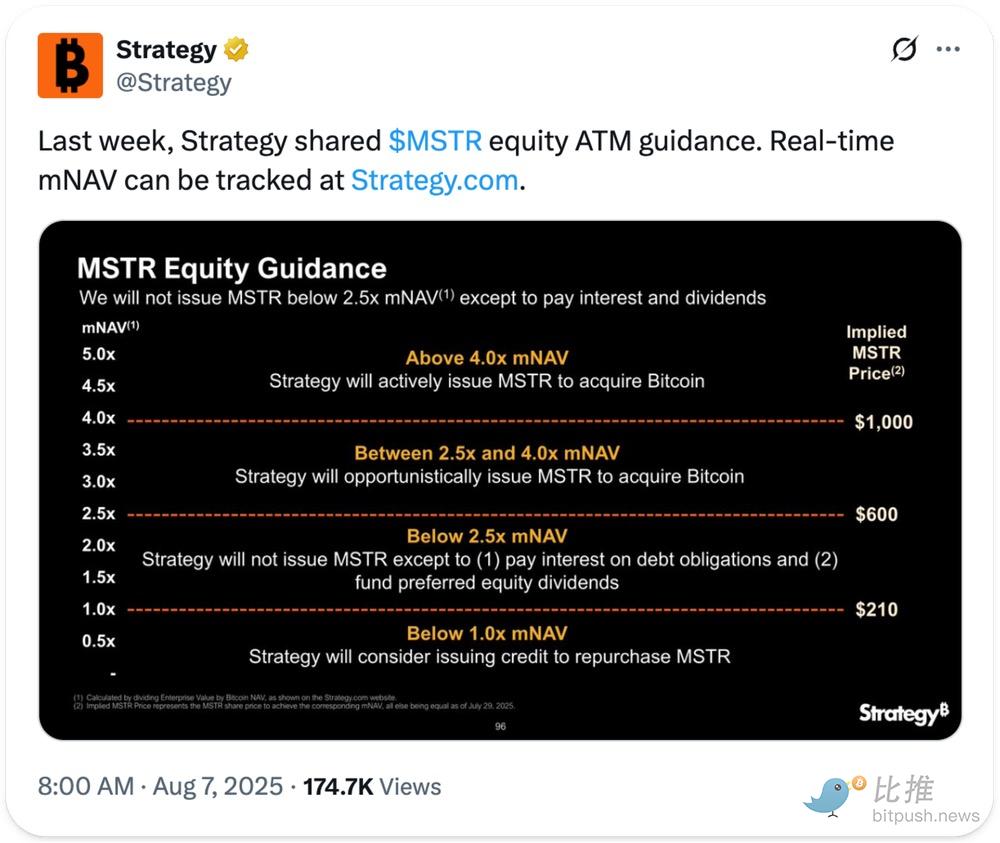
In a market downturn, Strategy might issue new preferred shares to repay debt, but if financing channels truly close, mandatory MSTR sales would ultimately reduce the Bitcoin represented per share.
BitMine's Blueprint
Turn back time to nearly five years before Strategy, swap Bitcoin for Ethereum, and you get BitMine Immersion Technologies (BMNR)! This former Bitcoin mining company began a crypto purchasing frenzy after announcing its Ethereum vault strategy in late June, holding 1.15 million Ethereum worth $5.2 billion at the time of writing.
Unlike Strategy post-2025, which now relies on complex exotic preferred stock portfolios to raise cash, BitMine remains in its "classic" era, depending on "at-the-market" stock sales and convertible notes as primary financing tools.
Strategy and BitMine are both publicly traded companies tying themselves to a single token. The only significant difference is that BitMine focuses on a smaller market cap asset and might have a more prominent public face with its chairman Tom Lee, a familiar face to daytime investor TV network viewers.
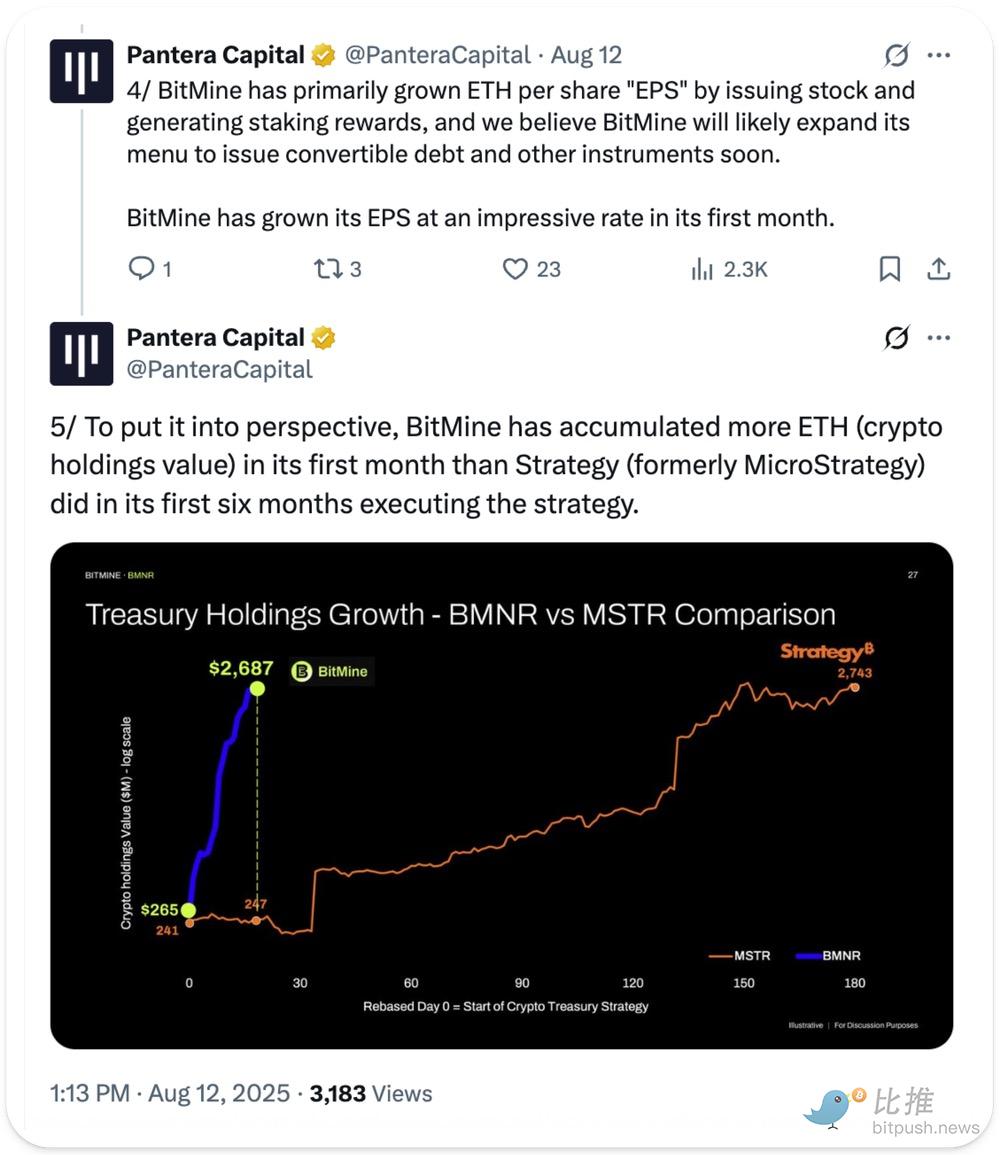
Thanks to Strategy's normalization of crypto vault companies, BitMine has achieved tremendous success in its early growth phase, accumulating crypto asset value in its first operational month that exceeded Strategy's six-month accumulation.
Conclusion
Strategy and BitMine have both emerged as high-beta proxies for their represented cryptocurrencies. Both have made a series of bold bets on a single crypto asset, with Strategy playing the role of an experienced veteran and BitMine a rapidly rising challenger.
Strategy's long-term dominance in the crypto vault space, coupled with its ability to leverage multiple financing sources, gives it greater optionality in facing adverse market conditions. Conversely, BitMine's smaller scale might offer greater investment upside potential.
Despite their different designs, the ultimate rise and fall of Strategy and BitMine will depend on the strength of their chosen assets.
Twitter: https://twitter.com/BitpushNewsCN
BitPush Telegram Group: https://t.me/BitPushCommunity
BitPush Telegram Subscription: https://t.me/bitpush