Author: Yuuki, TechFlow TechFlow
Current Federal Reserve Chairman Jerome Powell's term expires in May 2026, and yesterday, US Treasury Secretary Bessant revealed that Trump is highly likely to announce his nominee for the next Fed Chairman before Christmas. The Fed Chairman's monetary policy stance will significantly influence the pace and end of future interest rate cuts. As the market most sensitive to liquidity and interest rates, the dovish or hawkish stance of the next Fed Chairman is crucial. This article will provide an overview of the policy positions of the current leading candidates, their impact on the crypto industry, their likelihood of selection, and key timelines.

1. Kevin Hassett Kevin Hassett: The most dovish candidate, Trump's economic advisor (most favorable)
Hassett, former chairman of the White House Council of Economic Advisers and a key economic advisor to Trump, is a candidate capable of bringing Trump's interest rate-cutting intentions to the Federal Reserve. He has publicly expressed support for deeper and faster interest rate cuts to stimulate economic growth; at the same time, he has a friendly attitude towards the crypto market, viewing Bitcoin as a tool to hedge against inflation, which may drive the relaxation of regulations on the crypto market. If Hassett is elected as the Fed chairman, it will be an absolute boon to the interest rate-sensitive crypto market, and rapid and significant interest rate cuts will bring the next liquidity bull market for risk assets.
2. Kevin Walsh Kevin Warsh: The most hawkish candidate, supports CBDC and opposes decentralization (most bearish).
Warsh, a former Federal Reserve governor and Hoover Institution fellow, has long held a hawkish stance on monetary policy, favoring tighter interest rates and prioritizing inflation control (and advocating for reducing central bank balance sheets). If he were to take office, he could delay or limit the rapid decline in interest rates, thereby suppressing the valuation and capital inflows into crypto risk assets. Furthermore, Warsh has publicly supported the development of a CBDC (Central Bank Digital Currency) in the United States, which would be a negative factor for Crypto Fundamentals, who pursue decentralization and censorship resistance.
3. Christopher Waller Christopher Waller: A moderate candidate who supports stablecoins (neutral).
Waller is a current Federal Reserve Governor with a conservative dovish stance on monetary policy, supporting gradual interest rate cuts. He has publicly stated that digital assets can serve as a supplement to payment tools and that stablecoins, under proper regulation, can strengthen the dollar's position. Waller's conservative approach may limit the possibility of significant easing. If he takes office, the evolution of the future interest rate path will require further analysis of the overall composition of the voting committee.
4. Rick Ridley Rick Rieder: Neutral to dovish, positive for BTC and other mainstream assets (positive).
Riddell is BlackRock's Global Head of Fixed Income, directly controlling trillions of dollars in asset allocation. His monetary stance is neutral to dovish, emphasizing that the Federal Reserve should remain cautious and flexible after reaching the neutral interest rate. He also believes that in an environment where traditional assets are increasingly correlated, cryptocurrencies have unique safe-haven and hedging value, calling Bitcoin the "gold of the 21st century." His appointment could attract institutional funds to the crypto market, smoothing out volatility and benefiting mainstream crypto assets like BTC.
5. Michelle Bauman Michelle Bowman: A hawkish candidate who rarely comments on the crypto market (negative news).
Bowman is the current Federal Reserve Governor, and his hawkish monetary policy stance is even stronger than Warsh's. Under the market's widespread expectation of interest rate cuts and pressure from the Trump administration, he has clearly advocated for maintaining high interest rates for a longer period of time and has repeatedly stated that he does not rule out the possibility of another rate hike. If he takes office, it will undoubtedly be a substantial negative factor for the crypto market and risk assets.
What are the chances of the above five candidates being elected?
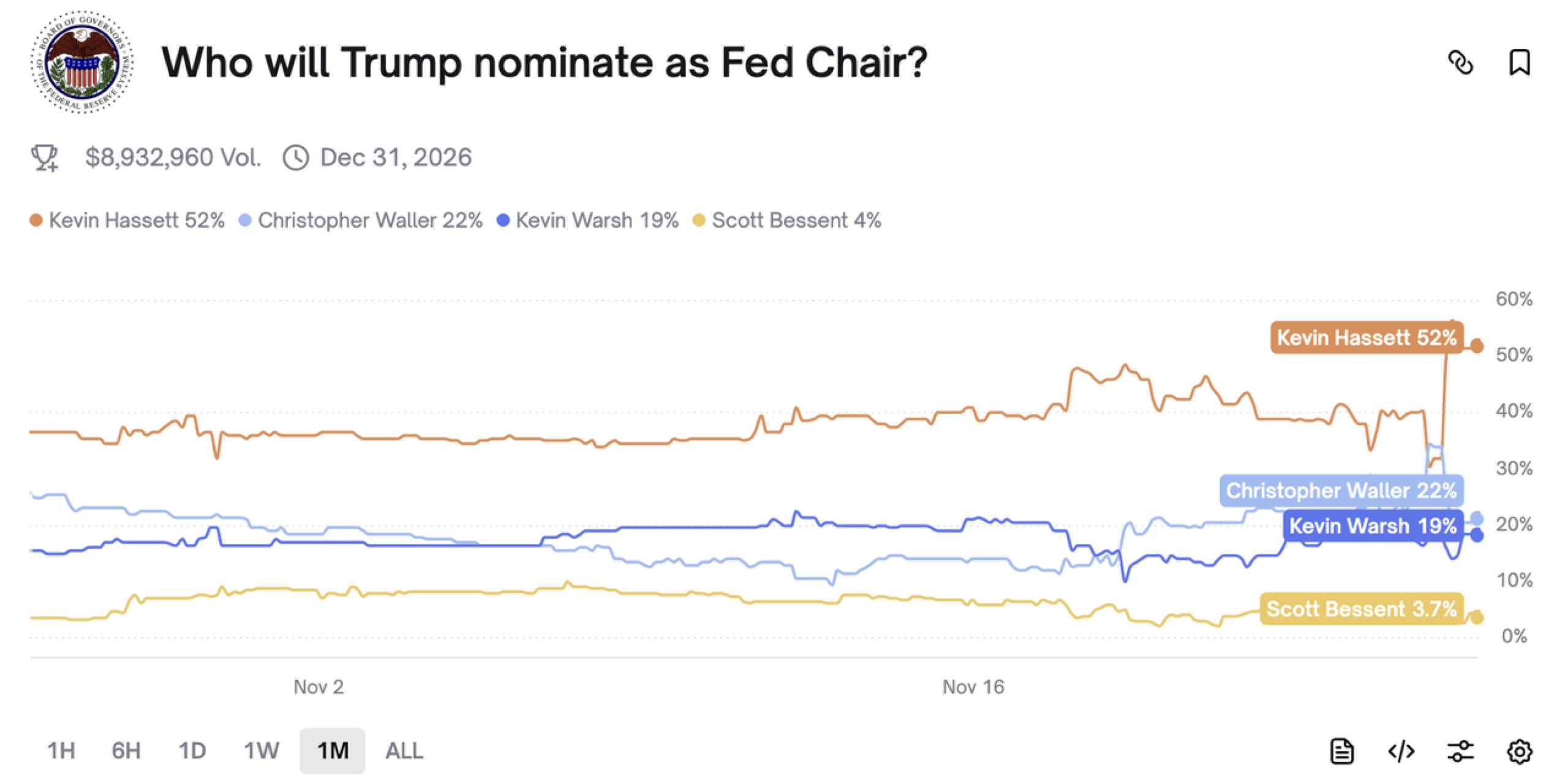
The event is currently in the presidential nomination stage. In the prediction market Polymarket, Kevin Hassett is far ahead with a 52% chance of being nominated. Bloomberg exclusively reported that Hassett is the frontrunner. Second place is Christopher Waller with a 22% chance of being nominated; third place is Kevin Warsh with a 19% chance of being nominated; followed by Rick Rieder with 2%; and Michelle Bowman with 1%.
Key time points to pay attention to
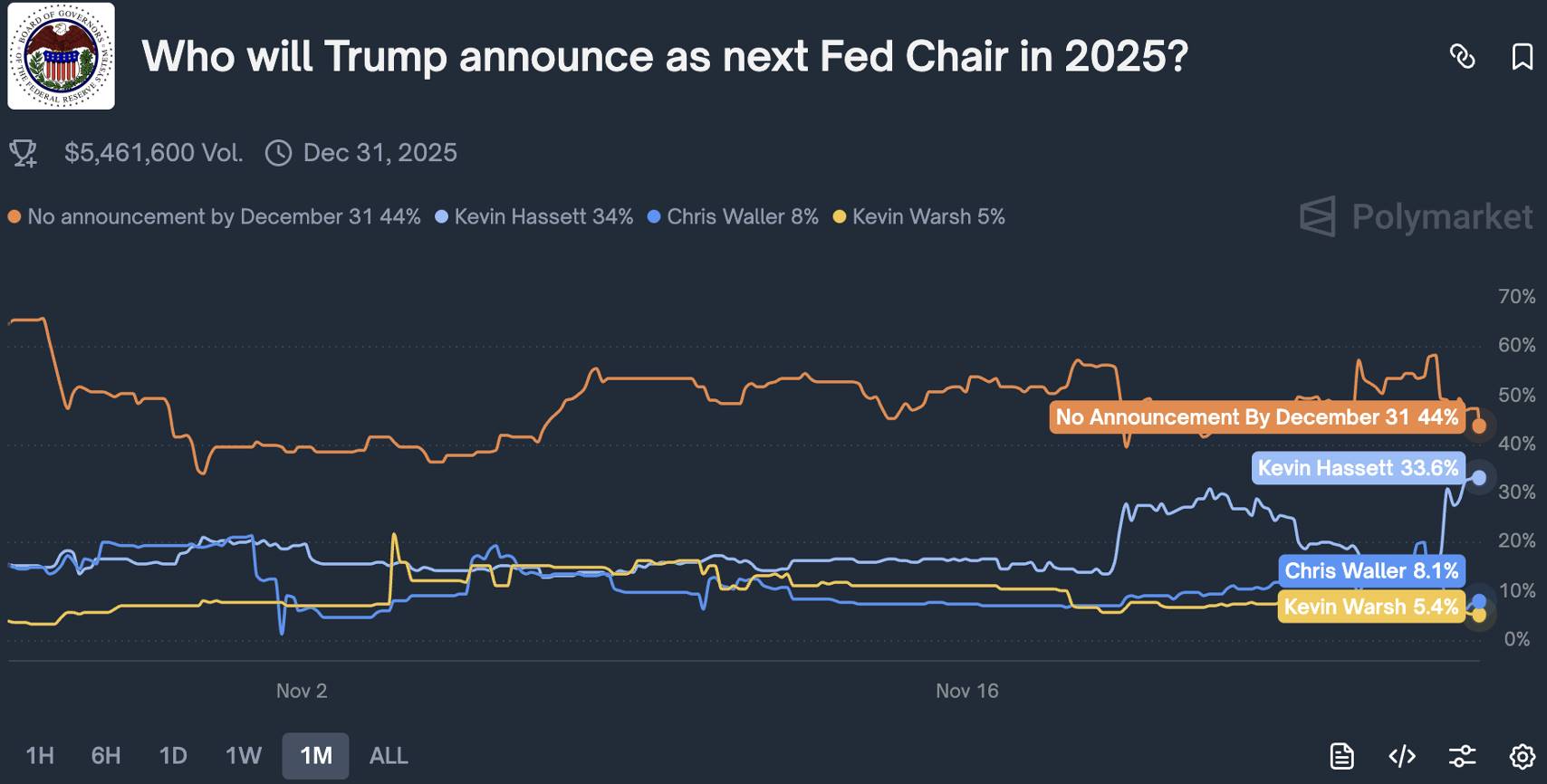
The replacement of the Federal Reserve Chair involves two stages. The first stage involves Trump's team interviewing and screening candidates to determine the final nominee, who will be nominated by only one person. According to Treasury Secretary Bessant, Trump will formally announce his nominee before Christmas. If Hassett is confirmed as the nominee, the crypto market is likely to see a Christmas rally. The second stage involves the Senate vote after the nominee is confirmed. The Senate is expected to hold hearings in January or February 2026, followed by committee and full votes in March or April. It is worth noting that Polymarket currently has a 32% probability that Trump will not formally announce his nominee in December.
In summary, Hassett currently has a leading chance of being elected, but this hasn't yet been reflected in bond yields and risk asset prices. Continued monitoring of this development is necessary. In the short term, if Trump confirms Hassett's nomination before Christmas, the crypto market will likely see a Christmas rally. In the long term, the monetary policy stance of the next Federal Reserve Chairman will directly impact the price performance of risk assets over the next four years.