In most Ponzi schemes, the real collapse never begins with a sharp drop, but rather with the quiet unfolding of seemingly insignificant "small, gradual declines." A sharp drop alerts you, but a gradual decline doesn't; with a sharp drop, you know danger is imminent, but with a gradual decline, you always believe there's a chance for a rebound. ARK's recent price movement is a typical and highly deceptive sign of this late-stage Ponzi scheme. From $42, it plummeted to the $30s, and then continued to fall to the $20s, without any substantial positive news, no real new users, no product launches, and no new funds entering the market. Only one bearish candlestick after another, a little drop each day, a little drop every two days, and a further drop each week—seemingly gentle, but actually brutal. This kind of movement isn't market fluctuation; it's the inevitable result of the scheme reaching its final stage, with its cash flow gradually drying up, large investors starting to withdraw, and internal maintenance costs becoming increasingly high. Anyone who has experienced a Ponzi scheme cycle understands that the gradual decline phase is the most classic and dangerous moment of the final harvest.
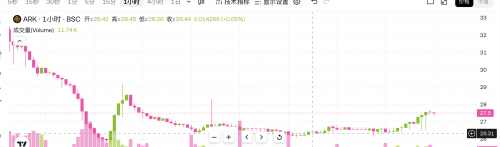
The essence of a continuous, gradual decline is a balance between "maintaining the illusion and allowing large investors to escape."
Why does the price decline gradually instead of plummet towards the end of its run? The reason is simple: a sharp drop would cause panic and everyone would flee; a gradual decline allows retail investors to maintain illusions, believing that "there will be a rebound," "big players will come to the rescue," "the project team will support the price," and "it's just a temporary fluctuation." The biggest advantage of a gradual decline is that it gives large holders, team wallets, and core token holders within the project enough time and space to unload their holdings. You can see the on-chain status of ARK over the past two weeks: the top ten holding addresses have been continuously selling, and even the transaction records of the top three core addresses have been frequently highlighted; while retail investors, more than 95% of whom are locked up by 540-day staking, cannot sell and can only watch helplessly as the price is slowly driven down. This is why a gradual decline is the most terrifying trend—it prevents you from realizing that you have been "slowly harvested." More importantly, a continuous gradual decline will not attract external attention, will not cause large-scale riots in the community, and will not generate a lot of negative publicity, while large holders can smoothly dump their tokens into the market in this "quiet market."
With no new users joining, the market has entered a "self-consumption period."
A healthy project has user growth, real external traffic, and product users; a Ponzi scheme in its later stages is characterized by internal fund circulation, a lack of external funding, and all participants forced to sell at a loss. ARK's current situation is a typical example of the "self-destruction phase": new users aren't coming in, old users are locked up, retail investors can't sell, large investors are selling frantically, and the price naturally keeps plummeting. If you check the daily new users on the blockchain, you'll find that ARK has fallen from hundreds of thousands of users per day at its peak to its current state. The cyclical pattern of Ponzi schemes is very fixed: initial explosive growth, rapid expansion, mid-term consolidation and shakeout, late-stage gradual decline and harvesting, and finally a crash to zero. ARK is currently in the "late-stage gradual decline and harvesting." This is a phase, not an isolated event; it's part of the Ponzi scheme's life cycle, not a short-term trend; it's an inevitable trend, not a random drop. Once in this phase, rebounds are just illusions, support is just rhetoric, and technological updates are just excuses; the only real thing is that the scheme is heading towards its end.
The team's silence, the stagnation of functions, and the weakening of marketing indicate that internal funding has been cut off.
If you look at ARK's recent official channels, you can clearly see the typical changes typical of a project nearing its end: the tweets are becoming increasingly superficial, reduced to fabricated "AI myths"; the official website has numerous bugs, especially the AI module, which has been unusable for months; none of the promised ecosystem applications have been launched; the so-called "national treasury support" is no longer mentioned; AMAs, live streams, and public meetings have all ceased. These are not coincidences; they are clear signals that the team has no money, no resources, and no motivation to continue operating. When a team can't even maintain basic operations, there are only two paths left: first, try to prop up the price to allow large investors to sell off their holdings; second, wait for the final crash and shut down the site. Judging from ARK's actions, they are currently in the "first stage"—the gradual price decline and support stage, which is a stage to lull retail investors into a false sense of security and buy time for insiders to exit. This is why the gradual decline has lasted for so long without any rebound: because the team simply has neither the ability nor the will to push the price up again.
The last sharp drop from 42 to 11 was quickly recovered, so why has it been unable to recover for a week this time?
This is the most crucial signal. Previously, ARK was hammered from $42 to $11 in just a few minutes, then quickly rebounded to around $40. Why? Because at that time, the market was still in its mid-stage, the team still had funds and the ability to maintain price, keeping retail investors confident and motivated to continue adding new investors. But this time, it plummeted from $42 to $38, $35, $30, $26… without any significant rebound for several days. This phenomenon only indicates one thing: the previous "miraculous pullback" was an official operational error by ARK, and this time, they can no longer sustain the price. The funding pool is dry, the team is unable to maintain it, and most of the large investors have already exited; dragging it out will lead to an irreversible "free fall." Many people think the team will try to save it again, but you must understand one fact: a market won't be saved a second time in its later stages because it's meaningless; after the insiders have all left, rescuing the market is a waste of money.
Tighter regulations and policy crackdowns are accelerating the pace of business failures.
Recent policies in mainland China, along with risk warnings from the central bank and the China Internet Finance Association, have been very clear: all Ponzi schemes, pyramid schemes, and projects using AI as a pretext to raise funds will be strictly investigated. ARK happens to cover all the high-risk labels: fake AI, fake ecosystem, extreme lock-up periods, centralized team, token issuance potential, large holders controlling the market, difficulty for new users to enter, and its offline marketing chain involving shady and pyramid scheme activities. Tighter policies will have little impact on legitimate projects, but a huge impact on Ponzi schemes. Because these schemes rely on offline lectures, group shill, and agent recruitment, once these activities violate the law, their capacity to sustain themselves will collapse instantly, accelerating their demise. Projects like ARK, already shaky and supported by illusions, will die even faster in the current policy environment because they have no ability to withstand policy risks.
Retail investors are unable to sell, while large investors are selling frantically – this is the strongest signal that the market is nearing its end.
Now look at ARK's on-chain data: the top ten holding addresses are continuously selling, while the vast majority of retail investors have been staking for 540 days and still can't sell. What does this mean? Large investors are fleeing, while retail investors are waiting to die. The classic endgame scenario of a Ponzi scheme is "large investors selling, retail investors waiting." Many people still cling to the illusion that the team will come to their rescue, but the real answer is: the team is already using this gradual decline to buy themselves time, cashing out the last remaining funds. Once they've cashed out most of their holdings, that's when the price will plummet.