This article is machine translated
Show original
A few days ago, I discussed the topic of "How big is the AI market bubble?" with a friend. I'd like to share our discussion and then do some calculations together.
First, let's roughly estimate the market size. Taking Chatgpt, which has the largest customer base, as an example, it currently has around 800 million monthly active users globally (covering 10% of the global population). Of these, 35-40 million are paying users. Let's take 37.5 million as the median, with most paying $20 per month. Assuming an average monthly revenue of $25, Chatgpt's annual revenue from its consumer-facing (C-end) market is $11.25 billion.
Assuming that each of these 37.5 million customers pays for at least 3 AI services on average, the total C-end market size is $33.75 billion. (I think an average of 3 is a very optimistic assumption. As a heavy AI user myself, I currently pay for only 3-4 AI products, around $100 per month.)
So, what is the market capitalization of the companies serving these AI C-end markets?
Let's exclude the primary market (roughly estimated at around $1 trillion) and focus only on the seven major tech giants in the secondary market: Nvidia $4.4 trillion, Apple $3.9 trillion, Microsoft $3.7 trillion, Amazon $2.4 trillion, Google $2.4 trillion, Facebook $1.7 trillion, and Tesla $1.3 trillion. Except for Nvidia's $4.4 trillion market capitalization, which is purely AI-driven, the others' valuations are more or less not centered on AI. Assuming we only use 25% as the weighting for their AI market capitalization (I believe the actual premium for AI in the capital market is much higher than 25%, but for conservative estimates of a bubble, we'll use 25%), the result is $8.25 trillion (of course, there are many, many AI companies not included in this calculation, such as AMD, Palantir, Qualcomm, Oracle, etc.).
$8.25 trillion divided by $33.75 billion = 244 times P/S. How do we understand this 244 times P/S ratio? We can refer to the P/S valuations of leading companies on March 24, 2000, the peak of the dot-com bubble.
Amazon: 19x
Cisco: 35x
Qualcomm: 22x
Microsoft: 26x
IBM: 3x
Oracle: 27x
Intel: 16x
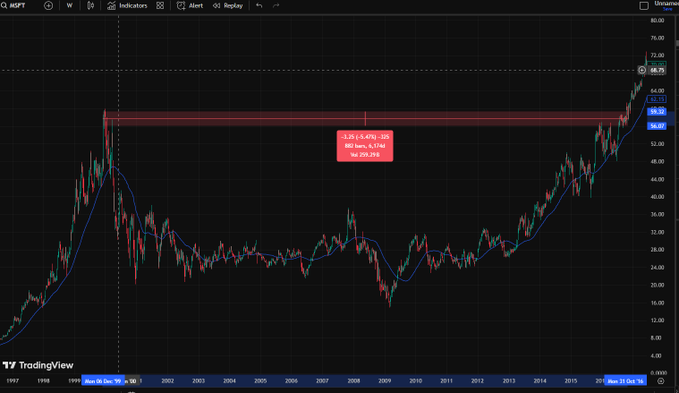
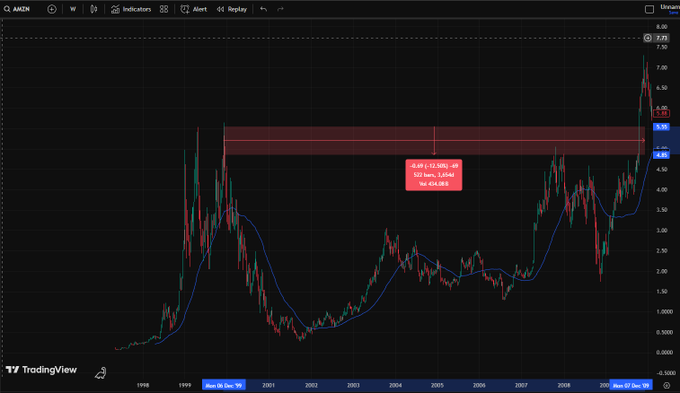
After the dot-com bubble, most of these companies, even giants like Amazon and Microsoft, took 10-15 years to recover their 2000 bubble peaks.
Of course, a P/S ratio of 244x doesn't necessarily indicate a large bubble in the AI sector. Currently, most AI revenue isn't from the $33.75 billion consumer market, but rather from "spending money on GPUs and infrastructure." Ultimately, these companies' investment in GPUs and infrastructure serves the consumer market, which, at least for now, isn't as large as many believe.
The current dilemma facing the AI sector is that even though AI is quite usable, it remains a "production tool," not "productivity" itself. Therefore, AI service companies are still only paid for the "tool," but the capital market is valuing them based on the "productivity" narrative.
What does this mean? If you ask a consumer or business owner to spend $50-$100 per month to equip their employees with AI, they're likely willing to spend that money, and that AI might indeed save the company the cost of one or two junior employees. But if you ask them to spend $2000-$3000, they're unlikely to be willing to spend that much.
So even if the consumer market penetration rate increases tenfold to 375 million people (more than the US population of 350 million), a P/S valuation of 24.4x is still expensive in any industry.
But who knows? Perhaps one day AGI will emerge, and AI will become productivity itself, and these AI companies won't be expensive anymore.
Just like when we look back at 2000, were companies like Amazon, Apple, and Microsoft expensive? It's certainly much cheaper than it is now, but if you bought it in 2000, it would take 10-15 years to break even.
And we don't know when AGI will arrive, or even if it will arrive at all.
Let's just wait and see.
Mr. Mai has finally started watching US stocks! I'm so moved I could cry!
I can't take it anymore. I don't want to guess what the bookmakers are thinking anymore; it feels like a waste of my life.
LOL, bro, I'm counting on you to carry me!
Mr. Mai's comment is so true! 🤣🤣 Many of my friends in the crypto have switched to stocks. Whether they make a profit or a loss, at least they gain experience. Guessing the intentions of big players relies on short-term analysis and long-term luck.

From Twitter
Disclaimer: The content above is only the author's opinion which does not represent any position of Followin, and is not intended as, and shall not be understood or construed as, investment advice from Followin.
Like
Add to Favorites
Comments
Share