
This article is machine translated
Show original
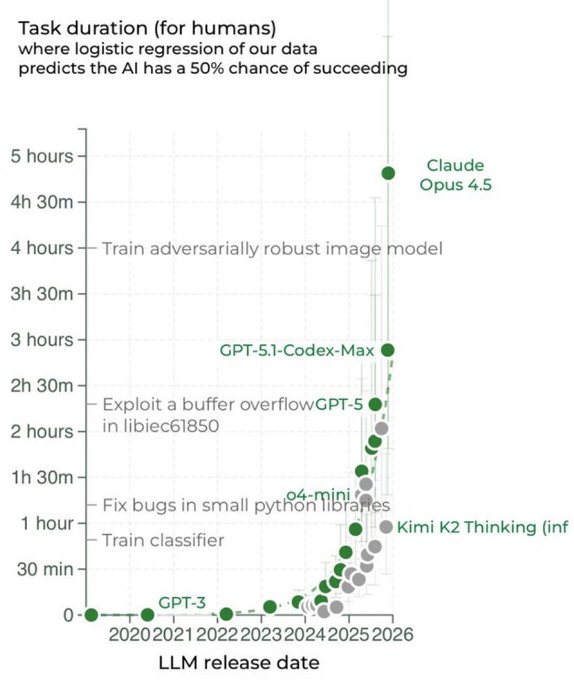
This graph demonstrates the rapid advancement of large-scale language models (LLMs) and their rapidly expanding capabilities.
In summary, AI, while previously capable of simple tasks that humans could perform in minutes, is now rapidly evolving to the point where it can perform complex, specialized tasks that would require four to five hours of human concentration.
- Graph Axes
X-axis: LLM release year (2020–2026)
Represents the emergence of AI models over time.
Y-axis: Task duration for humans
The time it takes a human expert to perform a given task is used as a measure of difficulty. The higher the value, the more complex and specialized the task requires.
- Early Stages (2020–2023)
During the GPT-3 era, AI had a high success rate only with very simple tasks that humans could complete in seconds or minutes, such as sentence completion or simple information retrieval. - Present and Near Future (2024-2026)
The graph suddenly spikes upward, suggesting that technological advancement is occurring exponentially, not linearly.
With the emergence of models like o4-mini, gpt-5, and Claude Opus 4.5, the difficulty of solving tasks has increased dramatically.
- Progress through Specific Task Examples
The tasks listed on the left side of the graph demonstrate just how intelligent AI is becoming.
Fix bugs in small Python libraries (approximately 1.5 hours): Beyond simple coding, AI has begun to develop debugging skills to find and fix bugs in libraries.
Exploit a buffer overflow (approximately 2 hours): This task requires advanced hacking and security knowledge to identify and exploit security vulnerabilities.
Train adversarially robust image model (approximately 4 hours): This is an AI engineering task that goes beyond simply creating images to train robust AI models that can withstand adversarial attacks. - Conclusion and Implications
The core message of this graph is that AI has now moved beyond mere assistance and entered the realm of expert expertise.
If AI can complete tasks that would otherwise take a human half a day in seconds or minutes, it will revolutionize productivity across industries.
This demonstrates the growing potential for AI to perform tasks previously reserved for highly skilled knowledge workers, such as coding, security analysis, and modeling.
The chart shows that the y-axis doubles every four months, suggesting that the day when AI will be able to perform a full day's worth of work (24 hours) or even longer is not far off.

Chubby
@kimmonismus
12-22
In all seriousness: 2026 will be the year where everything changes all of a sudden.
We are so fucking cooked
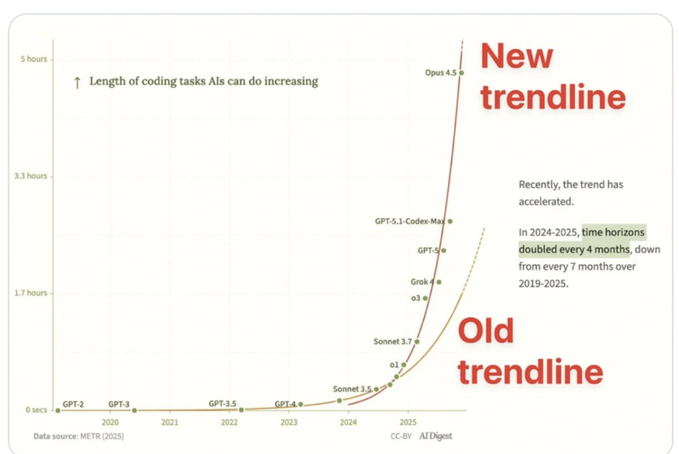
This is "the most important chart in AI"
Every ***4 months***, the length of coding tasks AIs can do (compared to humans) DOUBLES
Do you get how fast that is? x.com/aidigest_/stat…

From Twitter
Disclaimer: The content above is only the author's opinion which does not represent any position of Followin, and is not intended as, and shall not be understood or construed as, investment advice from Followin.
Like
Add to Favorites
Comments
Share
Relevant content