
Compiled by GaryMa (Wu Blockchain Blockchain)
Wu Blockchain team summarizes the highlights of the blockchain technology field in 2025:
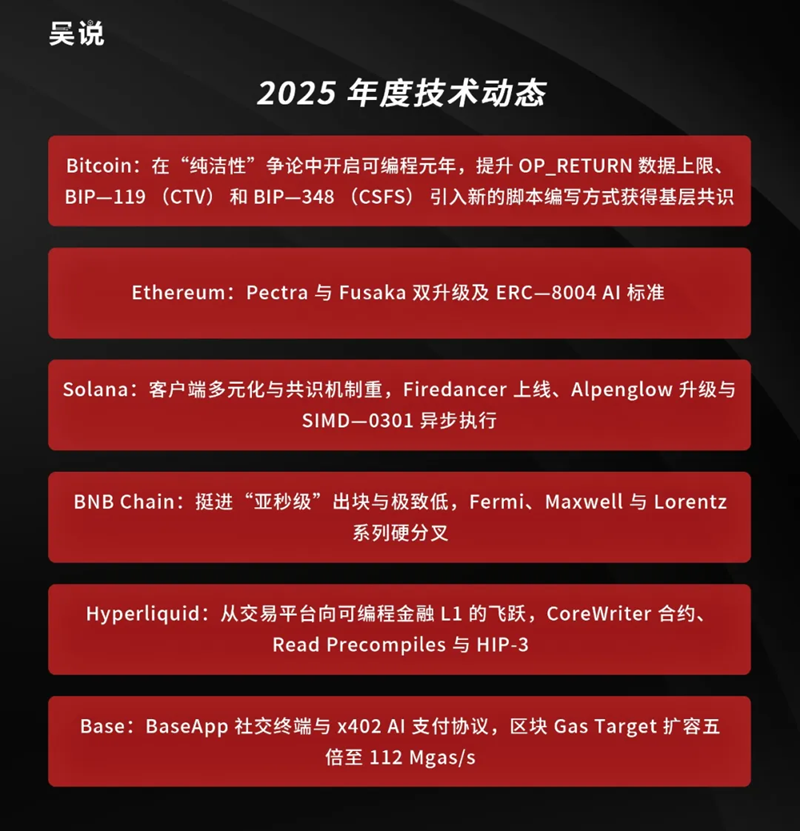
Bitcoin: Ushering in the Year of Programmability Amidst the "Purity" Debate, Gaining Grassroots Consensus Through Increasing the OP_RETURN Data Limit and Introducing New Scripting Methods in BIP-119 (CTV) and BIP-348 (CSFS).
Core v30 default settings changed: Reformers led by Antoine Poinsot pushed to significantly increase the OP_RETURN data limit from 80 bytes to 4MB, marking a substantial opening of Bitcoin as a "data layer".
The basic consensus of the Covenants: BIP-119 (CTV) and BIP-348 (CSFS) have gained widespread support from developers and aim to introduce new scripting methods through soft forks to achieve non-interactive withdrawal and vault functionality.
First "health check report": Bitcoin Core completes its first-ever public third-party audit, with zero high-risk vulnerabilities establishing its robustness as the foundation of global crypto finance.
Ethereum: Pectra and Fusaka Dual Upgrades and ERC-8004 AI Standard
Pectra & Fusaka Hard Forks: The Pectra upgrade was completed in May. Pectra is one of the hard forks in Ethereum history involving the most EIPs (11 EIPs). It further optimizes the Dencun upgrade, aiming to improve user experience (UX), optimize validator operations, and drive Layer 2 scaling. The Fusaka upgrade was completed in December, increasing the mainnet gas limit to 60M. Fusaka is an important step in Ethereum's scaling roadmap: improving L1 performance, expanding blob capacity, improving rollup cost efficiency, and bringing UX improvements. It also introduces the Blob Parameter Only (BPO) fork mechanism for safely increasing blob capacity when rollup demand increases.
AI Agent Benchmark Protocol: The dAI team was established and ERC-8004 was implemented to support seamless transactions for AI Agents within the Ethereum ecosystem, with the goal of building decentralized AI infrastructure.
Privacy roadmap iteration: The original team was renamed PSE (Ethereum Privacy Steward) to advance the L2 design PlasmaFold, which supports privacy transfers, focusing on three major directions: privacy writing, reading, and proof.
Solana: Client diversification and consensus mechanism complexity, Firecanver launch, Alpenglow upgrade and SIMD — 0301 asynchronous execution
Firedancer officially mainnet on the mainnet: The independent validator client developed by Jump Crypto went live, supporting 1 million TPS through a modular parallel architecture, completely eliminating the risk of single-client dependency.
Alpenglow consensus architecture: Introduces Votor (voting and finality) and Rotor (single-layer relay block propagation protocol), which significantly reduces propagation latency and stabilizes block time.
Throughput limit enhancement: By using SIMD-0256 and SIMD-0286, the block computation limit will be gradually increased from 60 million to 100 million CUs; at the same time, SIMD-0301 (asynchronous execution) will be promoted to remove the replay path from the consensus critical path.
BNB Chain: Advancing towards "sub-second" block generation and extremely low latency, Fermi, Maxwell, and Lorentz series hard forks.
Fermi Hard Fork (November 2025): The core technological breakthrough lies in reducing the block interval from 750 milliseconds to 450 milliseconds, achieving industrial-grade throughput through sub-second block generation.
Maxwell and Lorentz upgrade: Phased optimization of BSC block time to 0.75 seconds, final confirmation time reduced to 1.875 seconds, and simultaneous introduction of EIP-7702 smart contract wallet standard.
Economic model fee reduction: The validator proposal reduces the minimum gas fee from 0.1 Gwei to 0.05 Gwei, aiming to achieve a cost of $0.001 per transaction.
Hyperliquid: A Leap from Trading Platform to Programmable Financial L1, CoreWriter Contracts, Read Precompiles, and HIP-3
HyperEVM Two-Way Interaction: The CoreWriter system contract was successfully deployed, allowing the smart contract layer to directly write to and modify the HyperCore (transaction engine) state.
Atomic data reading: Read Precompiles has been launched, allowing contracts to read on-chain order book, price, and position data in real time without the need for oracles.
HIP-3 Permissionless Deployment: Enables network upgrades that allow developers to create perpetual contract markets without permission through Dutch auctions after staking HYPE.
Base: BaseApp social terminal and x402 AI payment protocol, block gas target increased fivefold to 112 Mgas/s
BaseApp Ecosystem: Integrating AI Agent, Mini App, and Farcaster streaming media to create the first Web3 "super app" portal.
x402 Protocol V2: An open-source protocol based on the HTTP 402 status code, providing AI robots with a registration-free, wallet-identity-based native payment layer that supports small-amount instant payments in stablecoins.
Performance scaling: Block Gas Target steadily increased from approximately 20 Mgas/s to 112 Mgas/s, supporting high-frequency social and payment activities.