Author: @intern_cc , Crypto KOL
Compiled by: Felix, PANews
Crypto options are poised to become the hallmark financial instrument of 2026, thanks to the convergence of three major trends: traditional DeFi yields being squeezed by the “yield end”, a new generation of simplified “entry-level products” abstracting options into a one-click trading interface, and institutional endorsement from Coinbase’s $2.9 billion acquisition of Deribit.
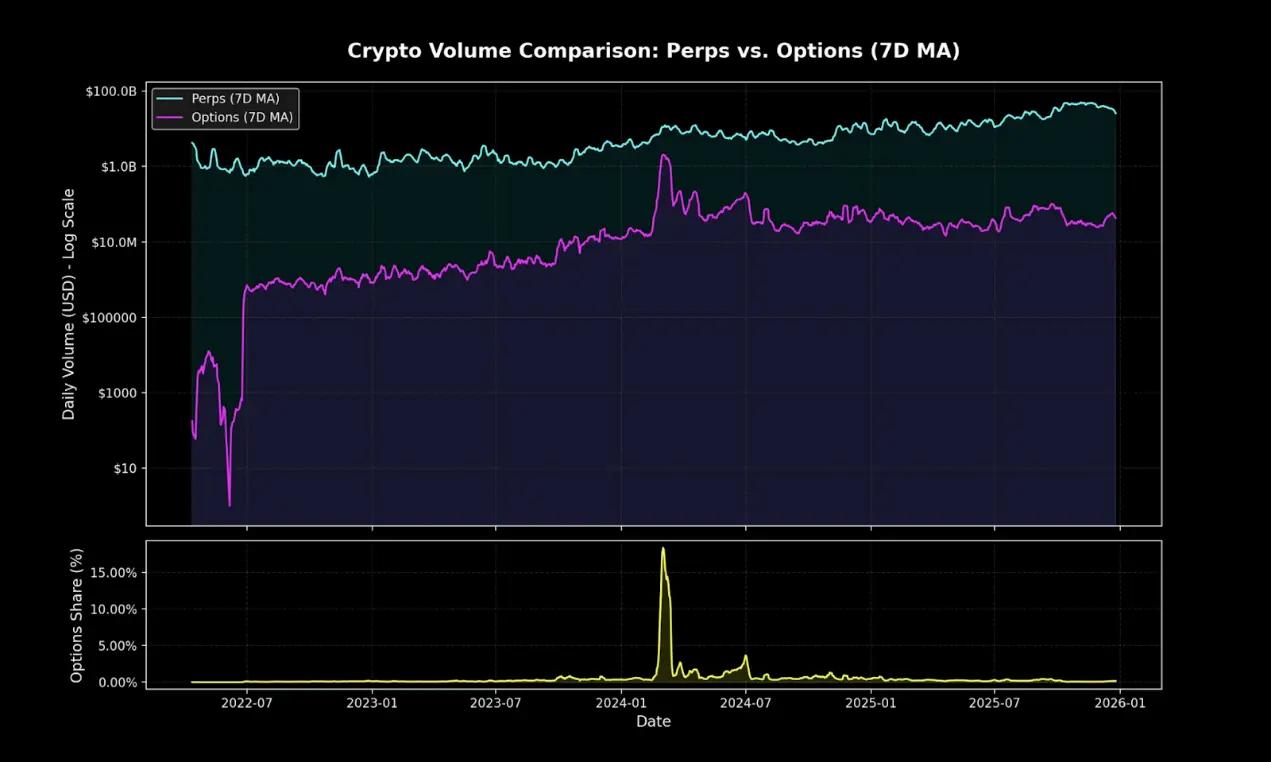
Although on-chain options currently account for only a small fraction of crypto derivatives trading volume, perpetual contracts still hold a dominant position in the market. This gap is strikingly similar to that of TradeFi options before their widespread adoption on Robinhood.
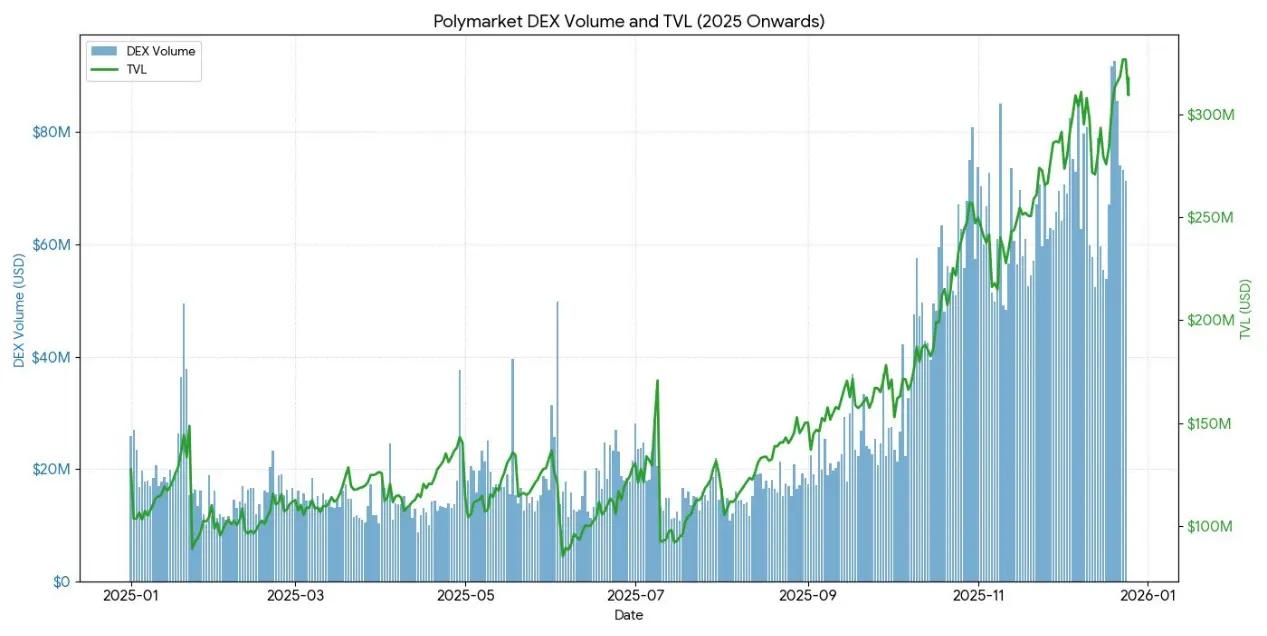
Polymarket processed $9 billion in transactions in 2024 by repackaging binary options and employing excellent marketing. If retail demand for probabilistic betting materializes, can DeFi options achieve the same structural shift? Once infrastructure and yield dynamics finally converge, execution will determine whether options break through bottlenecks or remain a niche tool.
The End of Passive Income
To understand why crypto options might explode in 2026, we must first understand what is dying.
Over the past five years, the crypto ecosystem has flourished, a period market analysts retrospectively refer to as the golden age of "lazy man's returns," where participants could achieve significant risk-adjusted high returns with minimal complex operations or active management. Typical examples are not complex options strategies, but rather simple and direct arbitrage methods such as token issuance mining, cyclical strategies, and perpetual contract basis trading.
Basis trading is central to crypto yield. While its mechanism appears simple, it's not: due to the long-term structural preference of retail investors for long positions, long positions must pay funding rates to short positions to maintain their holdings. By buying spot and short perpetual contracts, savvy participants construct delta-neutral positions unaffected by price fluctuations, while still achieving annualized returns of 20% to 30%.
However, there's no such thing as a free lunch. With the approval of Bitcoin spot ETFs, the entry of traditional financial institutions brought industrial-scale efficiency. Authorized participants and hedge funds began executing such trades with billions of dollars, compressing spreads to Treasury yields plus a small risk premium. By the end of 2025, this "bubble" had burst.
The " graveyard " of DeFi options protocols
- Hegic was launched in 2020 with pool-to-pool innovation, but it was shut down twice in its early stages due to code errors and game theory flaws.
- Ribbon's market value plummeted from a peak of $300 million, primarily due to the market crash in 2022 and the subsequent strategic shift to Aevo, leaving only about $2.7 million that was exploited by hackers in 2025.
- Dopex introduced centralized liquidity options, but it eventually collapsed due to the lack of competitiveness of the option products generated by the model, low capital utilization efficiency, and the unsustainability of the token economy in a brutal macro bear market.
- After realizing that options trading was still dominated by institutions, Opyn shifted its focus to infrastructure and abandoned retail investors.
The failure modes are highly consistent: ambitious protocols struggle to simultaneously achieve liquidity launch and a simplified user experience.
The Paradox of Complexity
Ironically, options, which are theoretically safer and more aligned with user intentions, are not as widely used as perpetual contracts, which are riskier and have more complex mechanisms.
Perpetual contracts may seem simple, but their mechanism is extremely complex. Every time the market crashes, people are forced to liquidate their positions or automatically deleverage, and even top traders may not understand the operating logic of perpetual contracts.
In contrast, options completely avoid these problems. When buying a call option, the risk is limited to the option premium, and the maximum loss is determined before entry. However, perpetual contracts dominate simply because "sliding to 10x leverage" is always simpler than "calculating delta-adjusted risk exposure."
The Mindset Trap of Perpetual Contracts
Perpetual contracts force you to bear cross spreads and pay fees twice on each trade.
Even hedging positions can wipe you out completely.
They are path-dependent; you can't just "leave them unattended" after you've established a position.
Even if you believe that short-term retail investor directional flows will still favor perpetual contracts, options will still dominate market share in most on-chain native finance. They are more flexible and powerful tools for hedging risk and generating returns.
Looking ahead to the next five years, on-chain infrastructure will gradually evolve into the backend infrastructure of the distribution layer, with a broader coverage than traditional finance.
Today's innovative vaults, such as Rysk and Derive, represent the initial wave of this shift, offering structured products that go beyond basic leverage or lending pools. Savvy asset allocators will need a wider range of tools for risk management, volatility management, and portfolio returns to fully leverage the decentralized ecosystem.
Traditional finance proves that retail investors love options.
Robinhood Revolution
The surge in retail options trading in traditional finance provides a roadmap. Robinhood's launch of commission-free options trading in December 2017 sparked an industry revolution, culminating in October 2019 when Charles Schwab, TD Ameritrade, and Interactive Brokers all eliminated commissions within days.
Its impact is enormous:
- The share of US retail options trading volume surged from 34% at the end of 2019 to between 45% and 48% in 2023.
- In 2024, the Office of the Comptroller of the Currency (OCC) cleared a record 12.2 billion annual options contracts, marking the fifth consecutive year of record-breaking volume.
- In 2020, influencer-driven stocks accounted for 21.4% of total options trading volume.
The explosive growth of zero-day expiration options ( 0DTE )
0DTE reflects retail investors' interest in short-term, highly convex bets. 0DTE options trading volume as a percentage of S&P 500 options trading volume grew from 5% in 2016 to 51% in the fourth quarter of 2024, with an average daily trading volume exceeding 1.5 million contracts.
Its appeal is obvious: lower capital investment, no overnight risk, built-in leverage of over 50 times, and same-day feedback loop, which industry insiders call "dopamine trading".
Convexity and explicit risk
The non-linear payout structure of options attracts directional traders seeking asymmetric returns. A buyer of a call option might only incur a $500 premium but could potentially earn over $5,000. Spread trading allows for more precise strategy adjustments: maximum loss and maximum profit can be determined before entry.
Entry-level products and infrastructure
Abstraction as a solution
The next-generation protocol addresses the complexity issue by completely hiding options through a simple interface, a concept known in the industry as "dopamine application".
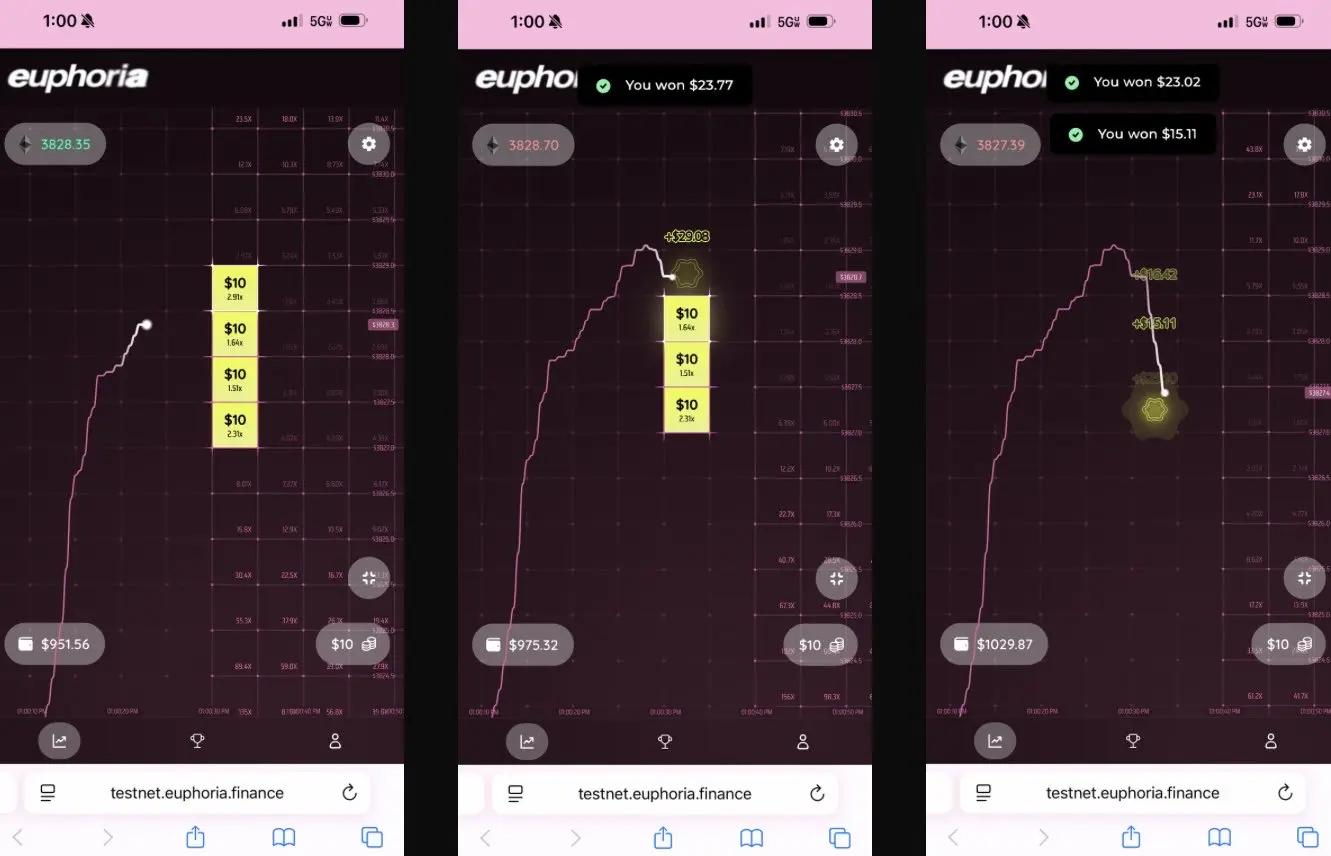
Euphoria secured $7.5 million in seed funding with a radically simplified concept: "You simply look at the chart, see the price line move, and then click on the square in the grid where you think the price will hit next." No order types, no margin management, no Greeks—just execute the right directional bet on CLOB.
Sub-millisecond infrastructure built on MegaETH.
Predicting market booms confirms the idea of simplified strategies:
- Polymarket processed over $9 billion in transactions in 2024, with a peak of 314,500 monthly active traders.
- Kalshi's weekly trading volume has consistently exceeded $1 billion.
Both platforms are structurally similar to binary options, but the concept of "prediction" transforms the stigma of gambling into collective wisdom.
As Interactive Brokers explicitly acknowledges, their forecast contracts are “binary options ‘forecasting markets’.”
The lesson learned is that retail investors don't want complicated financial instruments; they want simple, clear, and probabilistic bets with predictable outcomes.
The current state of DeFi options in 2025
By the end of 2025, the DeFi options ecosystem is transitioning from experimental design to a more mature and composable market structure.
Early frameworks revealed numerous problems: liquidity was scattered across different maturity dates, reliance on oracle settlements increased latency and manipulation risks, and fully collateralized vaults limited scalability. This prompted a shift towards liquidity pool models, perpetual option structures, and more efficient margin regimes.
Currently, DeFi options participants are primarily retail investors seeking returns, rather than institutional investors looking to hedge. Users view options as a passive income tool, selling covered call options to capture premiums, rather than as a volatility transfer tool. When market volatility intensifies, the lack of hedging tools exposes vault depositors to adverse selection risk, leading to persistent poor performance and TVL outflows.
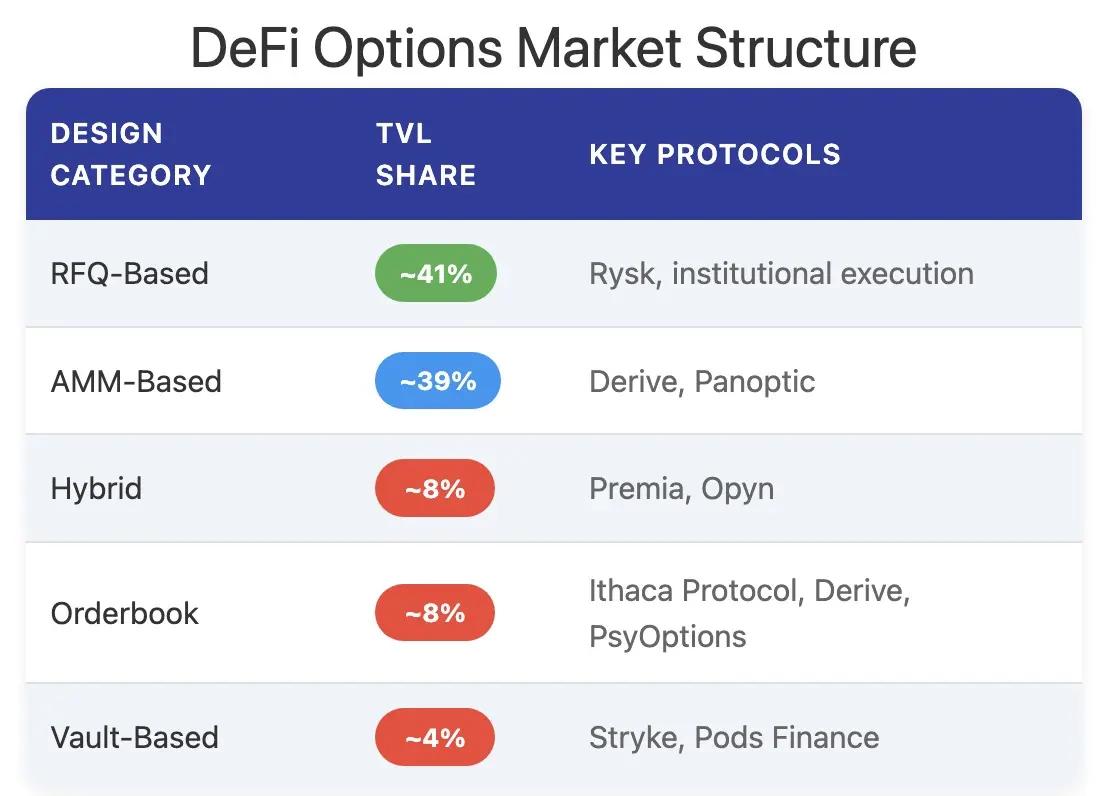
The protocol architecture has transcended the traditional maturity date-based model, giving rise to new paradigms in pricing, liquidity, and other aspects.
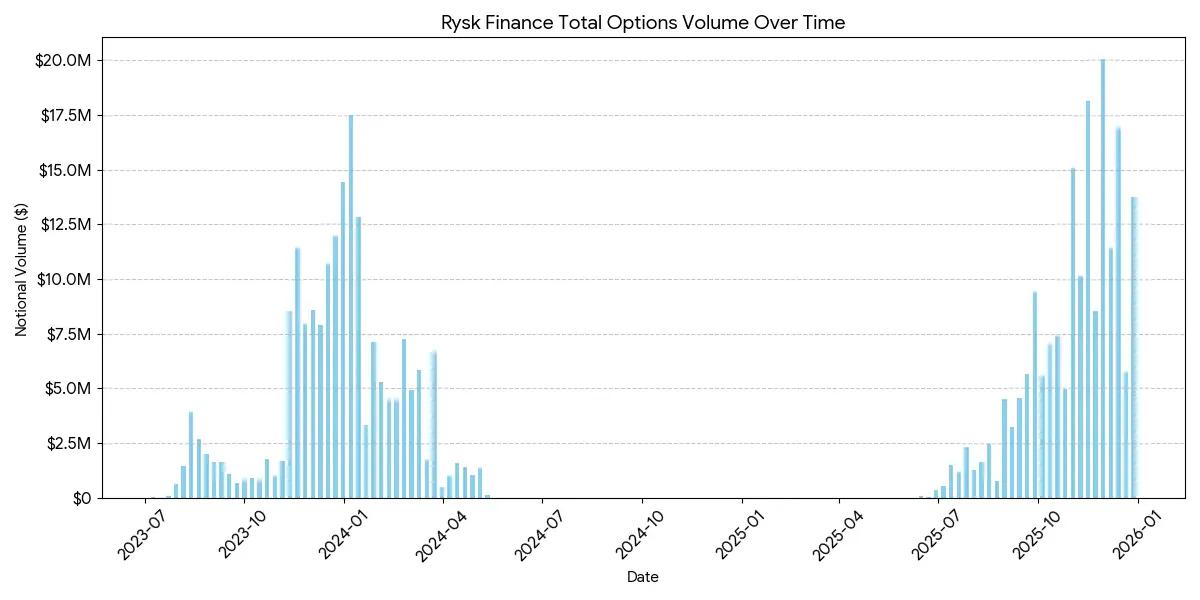
Rysk
Rysk applies traditional options selling mechanisms to DeFi using on-chain primitives, supporting covered call options and cash-backed put options. Users can directly deposit collateral into smart contracts to establish individual positions and customize strike prices and expiration dates. Transactions are executed through a real-time quote mechanism, where counterparties provide competitive bids through rapid on-chain auctions, enabling instant confirmation and early collection of option premiums.
The payout follows a standard covered call option structure:
- If the price at expiration is less than the strike price: the option has no value at expiration, and the seller retains the collateral plus the option premium.
- If the price at maturity is greater than or equal to the strike price: the collateral is physically delivered at the strike price, the seller retains the option premium, but forfeits any potential gains.
A similar structure also applies to cash-backed put options, with physical delivery completed automatically on-chain.
Rysk targets users seeking sustainable, non-inflationary option premiums. Each position is fully collateralized, with no counterparty risk and deterministic on-chain settlement. It supports various asset collateral, such as ETH, BTC, LST, and LRT, making it suitable for DAOs, treasuries, funds, and institutions managing volatile assets.
The average position size on the Rysk platform reaches five figures, indicating institutional-level funding.
Derive.xyz
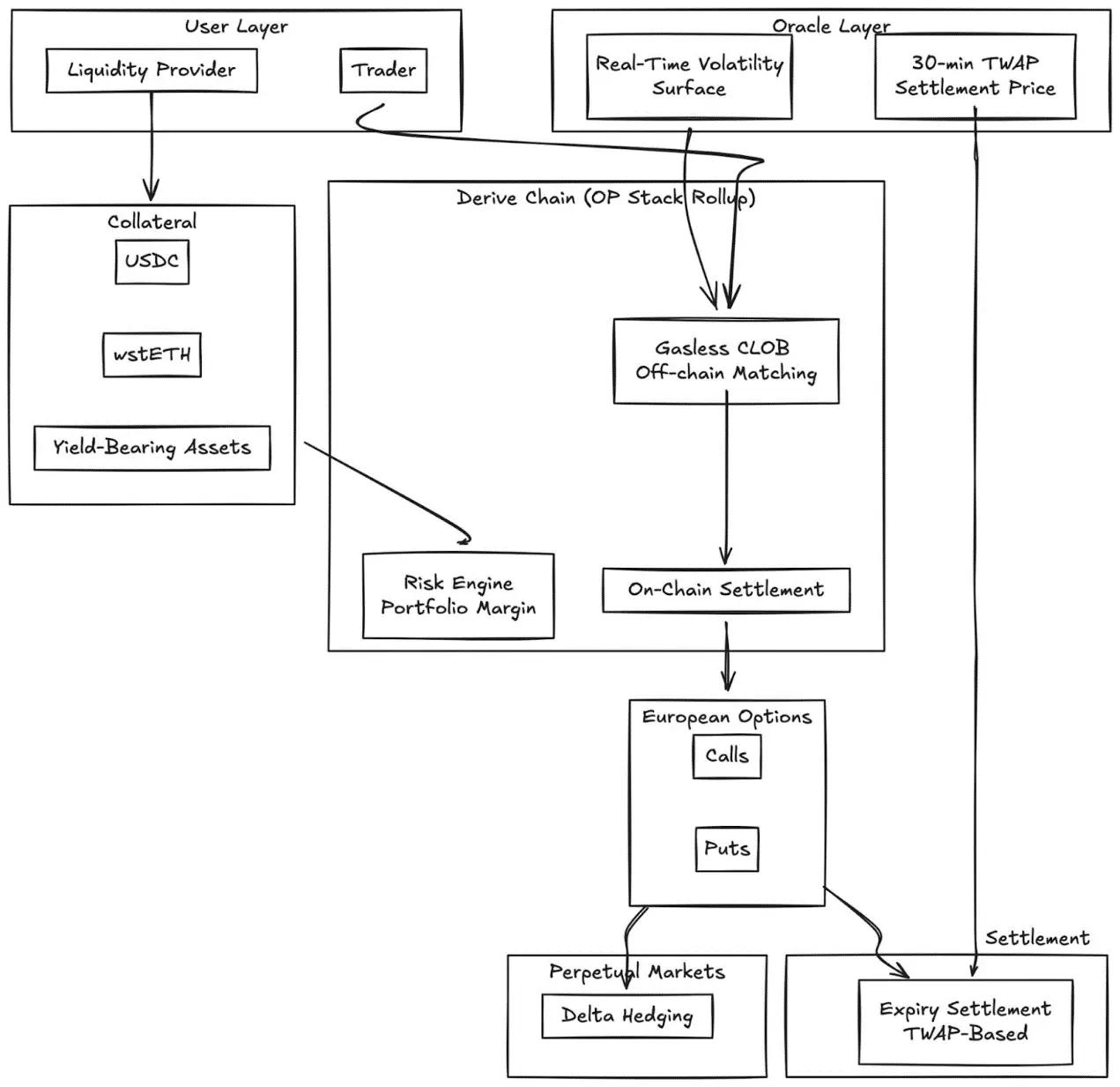
Derive (formerly Lyra) has transitioned from its pioneering AMM architecture to a gas-free, centrally-controlled limit order book with on-chain settlement. The protocol offers fully collateralized European options with dynamic volatility surfaces and settlement based on 30-minute TWAP.
Key innovations:
- Real-time volatility surface pricing via external feed
- A 30-minute TWAP oracle reduces the risk of manipulation upon expiration.
- Integrating perpetual markets to achieve continuous Delta hedging
- Supports yield collateral (wstETH, etc.) and portfolio margin to improve capital efficiency.
- Execution quality: Competitive with smaller CeFi venues
GammaSwap
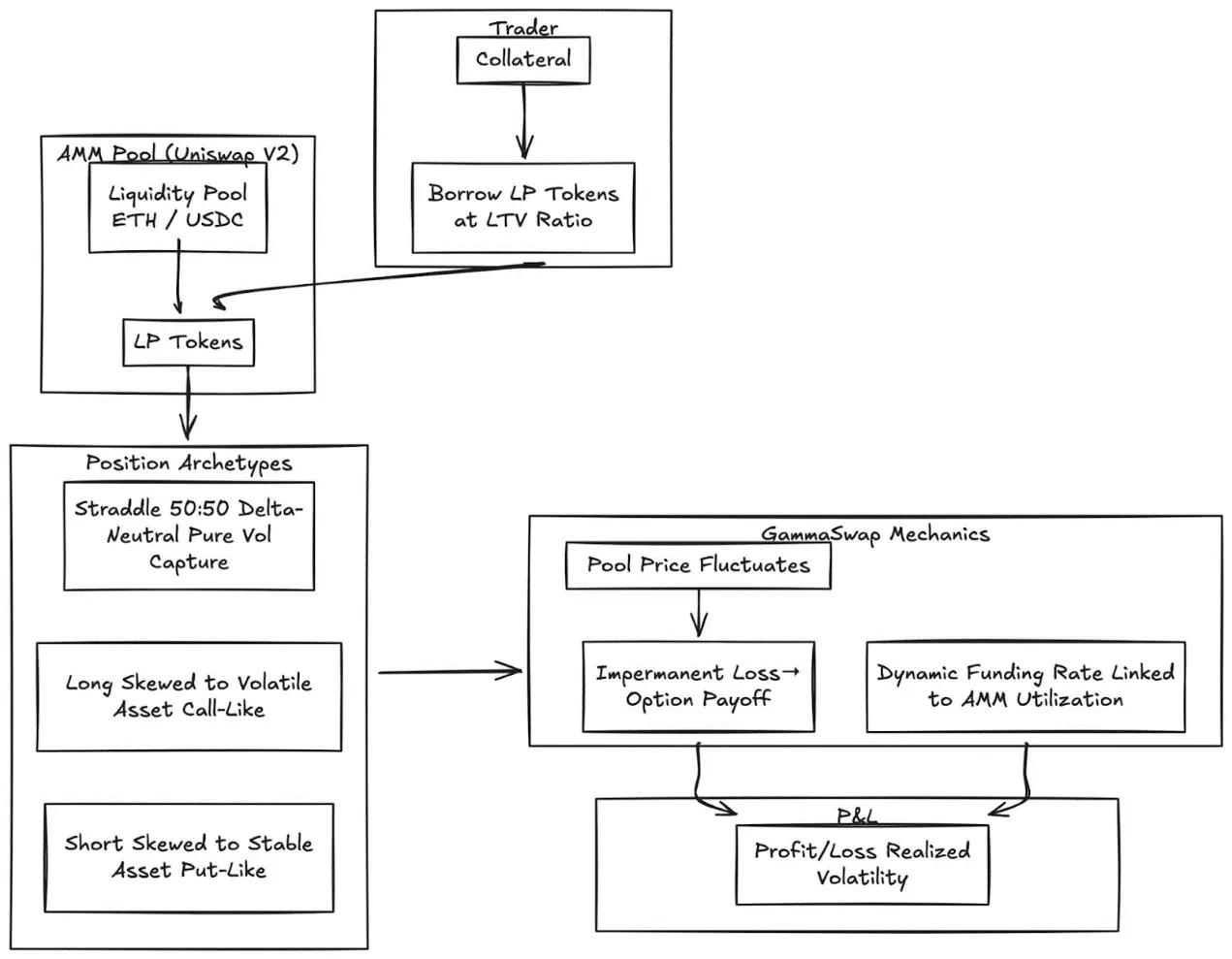
GammaSwap introduces non-synthetic perpetual options built on AMM liquidity.
It does not rely on oracles or fixed expiration dates, but generates continuous volatility exposure by borrowing liquidity from AMMs such as Uniswap V2.
This mechanism transforms Impermanent Loss into tradable option gains:
- Traders borrow LP tokens at a specified loan-to-value ratio.
- As the price of the funding pool fluctuates, the value of the collateral relative to the borrowed amount will also change.
- Profit and loss are proportional to realized volatility.
- Dynamic funding rates are linked to AMM utilization rates.
Position type:
- Straddle Options: Delta Neutral (50:50), purely for capturing volatility.
- Long options: The collateral is biased towards highly volatile assets (similar to call options).
- Short options: The collateral is biased towards assets with higher stability (similar to put options).
This mechanism completely eliminates the reliance on oracles by deriving all prices from the endogenous AMM state.
Panoptic
Perpetual oracle-free options on Uniswap.
Panoptic represents a fundamental shift: perpetual oracle-free options built on Uniswap v3 centralized liquidity. Any Uniswap LP position can be interpreted as a combination of long and short options, with fees existing as a continuous stream of option premiums.
Key Insight: Uniswap v3 positions within a specific price range behave similarly to a short option portfolio, with the delta value varying with price. Panoptic formalizes this concept by allowing traders to deposit collateral and select liquidity ranges to establish perpetual option positions.
Key features:
- Valuation without oracles: All positions are priced using internal Uniswap quotes and liquidity data.
- Perpetual exposure: Options are held indefinitely, with a continuous flow of option premiums rather than a discrete expiration date.
- Composability: Built on Uniswap and integrates lending, structured yield, and hedging protocols.
Comparison with CeFi :
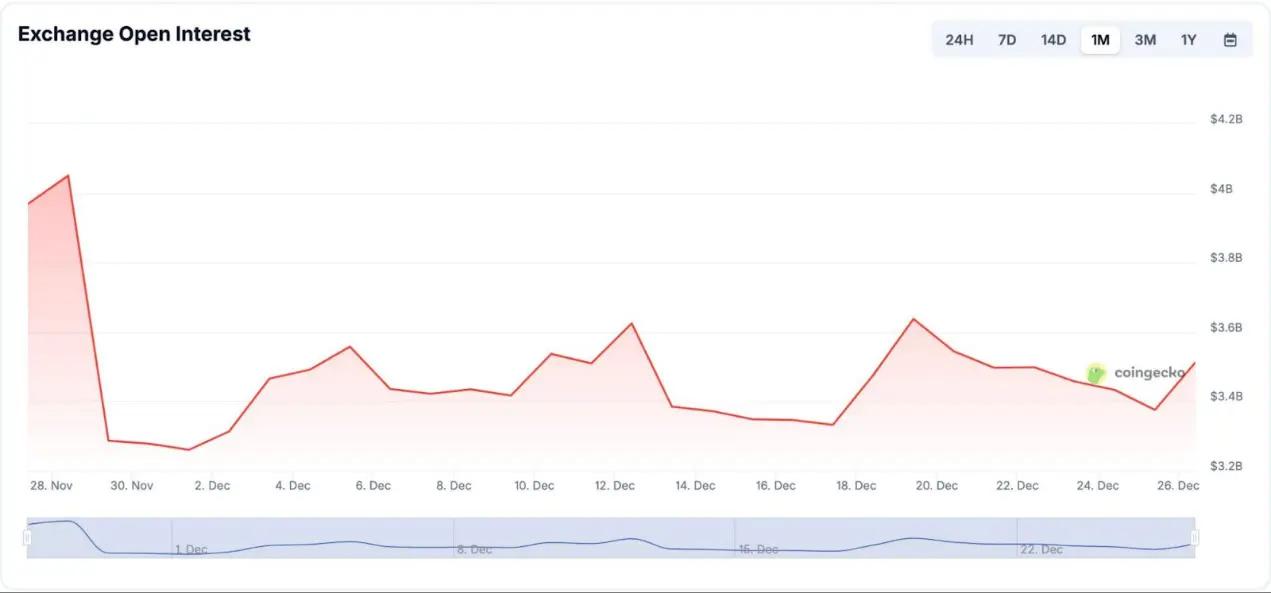
The gap with centralized exchanges remains significant. Deribit dominates globally, with daily open interest exceeding $3 billion.
The following structural factors contribute to this difference:
Depth and Liquidity
CeFi centralizes liquidity in standardized contracts with closely spaced strike prices, supporting tens of millions of order books at each strike price. DeFi liquidity, on the other hand, remains fragmented across protocols, strike prices, and expiration dates, with each protocol operating its own independent liquidity pool and unable to share margin.
Execution quality: Deribit and CME offer near-instant order book execution. AMM-based models like Derive offer smaller spreads for highly liquid, near-at-the-money options, but execution quality deteriorates for large orders and deep out-of-the-money strike prices.
Margin efficiency: CeFi platforms allow cross-margining across instruments; most DeFi protocols still segregate collateral by strategy or liquidity pool.
However, DeFi options offer unique advantages: permissionless access, on-chain transparency, and composability with the broader DeFi technology stack. This gap will narrow as capital efficiency improves and protocols eliminate fragmentation by removing expiration dates.
Institutional Positioning
Coinbase-Deribit SuperStack:
Coinbase's $2.9 billion acquisition of Deribit represents a strategic integration of the entire crypto capital stack.
- Vertical integration: Spot Bitcoin held by users on Coinbase can be used as collateral for options trading on Deribit.
- Cross-margining: In fragmented DeFi, funds are scattered across various protocols. On Coinbase/Deribit, funds are pooled in one location.
- Full lifecycle control: Through the acquisition of Echo, Coinbase controls issuance => spot trading => derivatives trading.
For DAOs and crypto-native institutions, options provide an effective mechanism for managing financial risks:
- Buying put options hedges downside risk and locks in the minimum value of capital assets.
- Selling covered call options to hedge idle assets creates a systemic revenue stream.
- Risk positions are tokenized by encapsulating option exposures into ERC-20 tokens.
These strategies transform volatile token holdings into more stable, risk-adjusted reserves, which is crucial for institutional adoption of DAO funding.
LP strategy optimization
LP scalable toolkit to transform passive liquidity into active hedging or yield enhancement strategies:
- Options as dynamic hedging tools: LPs in Uniswap v3/v4 can reduce Impermanent Loss by buying put options or constructing delta-neutral spreads. GammaSwap and Panoptic allow liquidity to be used as collateral for ongoing option payouts, thereby offsetting the risk exposure of AMMs.
- Options as a bonus: The vault can automatically execute covered call options and cash-backed put options strategies for LPs or spot positions.
- Delta-targeting strategies: Panoptic's perpetual options allow for the selection of delta-neutral, short, or long exposures by adjusting the strike price and expiry date.
Composable structured products
- Vault Integration: Automated vaults package short-term volatility strategies into tokenized yield instruments, similar to structured on-chain notes.
- Multi-leg options: Protocols such as Cega have designed path-dependent rewards (dual-currency notes, automatic redemption options) with on-chain transparency.
- Cross-protocol combination: Combine option payouts with lending, re-staking, or redemption rights to create hybrid risk instruments.
Outlook
The options market will not develop into a single category. It will evolve into two distinct tiers, each serving different types of user groups and offering distinctly different products.
First layer: Abstract options for retail investors
Polymarket's success story demonstrates that retail investors don't reject options, but rather complexity. The $9 billion in trading volume didn't come from traders who understood implied volatility, but from users who saw the problem, chose a position, and clicked a button.
Euphoria and similar dopamine applications will drive the development of this theory. The options mechanism operates covertly within the click-to-trade interface. There are no Greek letters, no expiration date, no margin calculation, only price targets on a grid. The product is the option.
The user experience is like that of a game.
This layer will capture the trading volume currently monopolized by perpetual contracts: short-term, high-frequency, dopamine-driven directional betting. The competitive advantage lies not in financial engineering, but in UX design, mobile-first interfaces, and sub-second responsiveness. The winners at this layer are more likely to be consumer applications than trading platforms.
The second layer: DeFi options as institutional infrastructure
Protocols like Derive and Rysk won't compete for retail investors. They will serve entirely different markets: DAOs managing eight-figure vaults, funds seeking uncorrelated returns, LPs hedging Impermanent Loss, and asset allocators building structured products.
This layer requires sophisticated technology. Features such as portfolio margin, cross-collateralization, inquiry systems, and dynamic volatility surfaces may not be frequently used by retail investors, but they are essential for institutional investors.
Today's vault providers represent an early form of infrastructure at the institutional level.
On-chain asset allocators need the full expressive power of options: clear hedging strategies, yield stacking, delta-neutral strategies, and composable structured products.
Leverage sliders and simple lending markets cannot meet the needs.
Related reading:Is the prediction market an extension of binary options?