Compiled by Saoirse, Foresight News
At its core, crypto tokens are faith. They are the purest financial instruments ever created, designed to extract hope from humanity and convert it into liquidity. Token price fluctuations don't stem from practical value, but from narratives, manipulation, and the ability of someone to use "attention" as a weapon to control the market. This isn't a normal market; it's a psychological battlefield. Most people are completely unaware that they are prey waiting to be slaughtered in this arena.
Price discovery
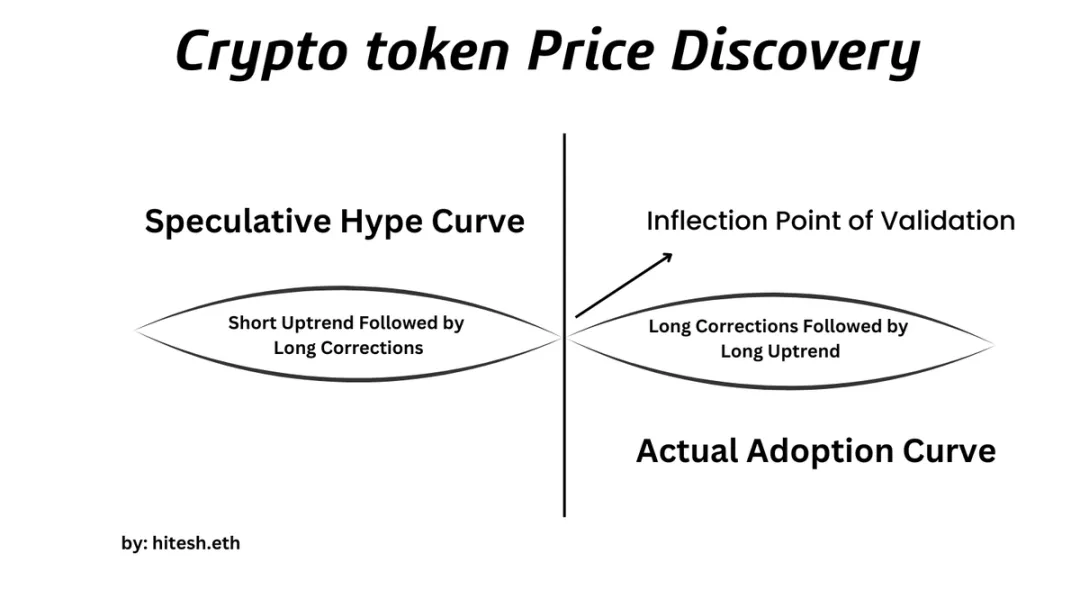
No matter how enticing the promotional narrative, all crypto tokens follow the same price discovery cycle. The cycle begins in the "0-1 phase": at this stage, hype reigns supreme, and actual adoption is virtually zero. Prices soar solely on market sentiment, communities form around fabricated "future blueprints," and the hype completely overshadows reality. Then, the brutal correction inevitably arrives—weeding out weak-willed holders and exposing investors who blindly entered the market based solely on a "promise."
Deep downturns are often critical turning points. Projects without real demand quietly disappear: they stop tweeting, cease technical development, and slowly vanish from the market, while liquidity shifts to other projects. However, a few tokens survive, entering the "1-10 phase"—when hype cools and real-world applications begin to emerge. These tokens experience a slow and uneventful growth period until real demand reignites a second wave of "faith." It is this second wave of faith that fuels a long and robust upward trend. Only these types of tokens can weather cycle after cycle; most tokens don't even make it this far.
Hidden Truth
Looking ahead, tokens will be meaningless for most projects. Once private companies can directly tokenize equity and raise liquidity on-chain, the vast majority of crypto tokens will become worthless. Currently, only tokens in two areas have real value: Decentralized Physical Infrastructure Networks (DePIN) and certain segments of decentralized finance (DeFi)—because they drive supply-side participation and collaboration. All other token-related activities are essentially fundraising schemes disguised as "innovation."
The existence of most tokens is essentially a way for founders to quickly raise funds—but that era is coming to an end. Better fundraising methods are emerging, and regulatory policies are on the way. However, meme coins and worthless tokens won't disappear; in fact, they'll increase—because gambling is human nature. The only change is that the line between "gambling" and "investment" will become clearer in the future: when you're gambling, you can no longer use "long-term investment" as a pretext. You have to make a choice: either admit you're gambling or invest responsibly. Right now, everyone is pretending to be an investor, even those chasing memes and hype.
Psychological traps
Cryptocurrency tokens are essentially "promised data strings," designed to manipulate human behavior. The token supply unlocking mechanism is designed to control people's "hope"; the lock-up period is designed to slowly inject "faith" into the market. The so-called "incentives" are not just financial lures, but also carefully crafted emotional traps. The true "product" of these projects is not the token, but "faith." All the propaganda narratives target people's "reactive thinking"—that is, the part of you driven by emotions such as fear, anxiety, guilt, and desire.
People aren't buying tokens; they're buying "an opportunity to escape current reality." This is why tokens spread faster than logic—because belief spreads faster than truth. This is also why "collaborative hype" exists: venture capitalists enter early, market makers manipulate price movements, exchanges time token listings, influencers incite greed, whale quietly accumulate positions, and finally, retail investors enter at the end of the chain, becoming "bagholders" (providing exit liquidity). This isn't a conspiracy, but rather the inherent process of market operation, the norm for the entire system.
The Demise of Tokens
Token growth is driven by speculation, not practical value. All tokens are fighting in the same "attention war"—tokens that can't retain attention will eventually perish. In this market, attention is more important than "practical application," more important than "revenue," and more important than "product usage." But most project teams don't understand this; they focus solely on price fluctuations while ignoring user growth.
Some projects create a false sense of growth through incentives, but the game is over once users become more concerned with token prices than the product itself. Incentives, meant to be a bridge to real-world adoption, are instead treated as substitutes for genuine needs. When a project loses control over its token dynamics and becomes a prisoner of its own price chart, its core mission collapses: founders cease focusing on development and become perfunctory; the project vision dies, and the token becomes a curse. For projects that could have succeeded without the token, it ultimately becomes their grave.
Exiting liquidity
If you don't know "who you're buying tokens from," then you're someone else's "exit liquidity" (a sucker for being left holding the bag). The token price discovery process is essentially a "collaborative game" controlled by insiders: venture capitalists, exchanges, market makers, investment alliances, whale, and key influencers work together to control the market. When retail investors see a token's "hype" surge, insiders have already built up their positions, waiting for retail investors to enter and provide liquidity. The seed round is the stage that creates the most wealth, but retail investors never have a chance to participate—projects raise funds at extremely low valuations, yet achieve fully diluted valuations of billions of dollars upon IPO.
Retail investors always think they've "entered the market early," but in reality, they're already too late—their entry merely provides an exit opportunity for those who "entered at low prices." To survive in this game, you must anticipate narrative trends, enter before influencers start promoting, and build your position before liquidity incentives kick in. If you wait until YouTube bloggers are all recommending a token before buying, you've already lost. Without your own research, it's not "investing"—you're just "borrowing other people's beliefs," and these borrowed beliefs will ultimately lead to your utter ruin.
Future Differentiation
The crypto space is splitting into two worlds: "regulated crypto" and "crypto anarchy." The former is government-controlled, with compliant infrastructure, approved tokens, and comprehensive surveillance; the latter is raw, brutal, and free—a world where privacy-driven blockchains, true decentralization, and hard-working developers can thrive. Tokens were initially symbols of "counterculture," but that culture has long since died out. Cryptocurrencies have betrayed their original purpose, becoming "Wall Street on the blockchain." However, a "purification" is on the horizon: tokens without real demand will perish, and projects without a core objective will disappear.
Narratives without substance will perish; only tokens tied to "real applications, real cash flow, and real goals" will survive. Everything else will vanish. You need to understand why you're here—because tokens are like a mirror, exposing your greed, your impatience, and your fantasies. Most people come here for "freedom," yet get trapped in speculation; for "wealth," yet lose themselves in greed; for "truth," yet become obsessed with lies. This market can't save you, narratives can't save you—what can save you is discipline and insight. The rules of survival are simple: learn the rules, act ahead of the crowd, never be a sucker, know who you are, and then engage in this "battle."
Conclusion
The crypto market doesn't reward followers; it only rewards those who "see through the illusion." The masses are always slow to react, always chasing hype, and always ending up holding the bag. Don't be part of the crowd: build your own processes, cultivate your own advantages, and develop your own patience. If you understand the game, you won't fear it—in fact, you can use it.
This "purification" won't destroy you; it will only create opportunities. The road ahead won't be easy: the market will test your conviction, your timing, your patience, your emotional control, and your ability to stand firm on the truth when the noise drowns out the crowd. Now is not the time to pray for a bull market, but the time to build your own conviction. Only one question remains: when the next cycle begins, will you be an "early bird" or once again a "bagholder"?