Hey friends 👋 ,
Happy SATURDAY and welcome to a special weekend edition of the Weekly Dose. We’re sending today because we sent our deep dive on a16z yesterday, but let me know what you think about the weekend send. Might be a good way to spend a Saturday morning, coffee in hand, optimism in veins.
One thing I’m personally optimistic about right now is not boring world. It was a great launch week: #1 rising in business, #2 new bestseller overall, top 60 in business. And as we speak, I’m working on drafts of the first two cossays. We might also begin sharing more of the stories that we left on the Weekly Dose cutting room floor. Join us.
For now, we have a new food pyramid, Chinese Peptides, Boltz Lab, HALEU $$$, and Rintamaki on Robots.
Let’s get to it.
Today’s Weekly Dose is brought to you by… Framer

Framer gives designers superpowers.
Framer is the design-first, no-code website builder that lets anyone ship a production-ready site in minutes. Whether you’re starting with a template or a blank canvas, Framer gives you total creative control with no coding required. Add animations, localize with one click, and collaborate in real-time with your whole team. You can even A/B test and track clicks with built-in analytics.
Ready to build a site that looks hand-coded without hiring a developer?
Launch a site for free on Framer dot com. Use NOTBORING for a free month on Framer Pro.
(1) There’s a New Food Pyramid in Town
Joe Gebbia and the National Design Studio
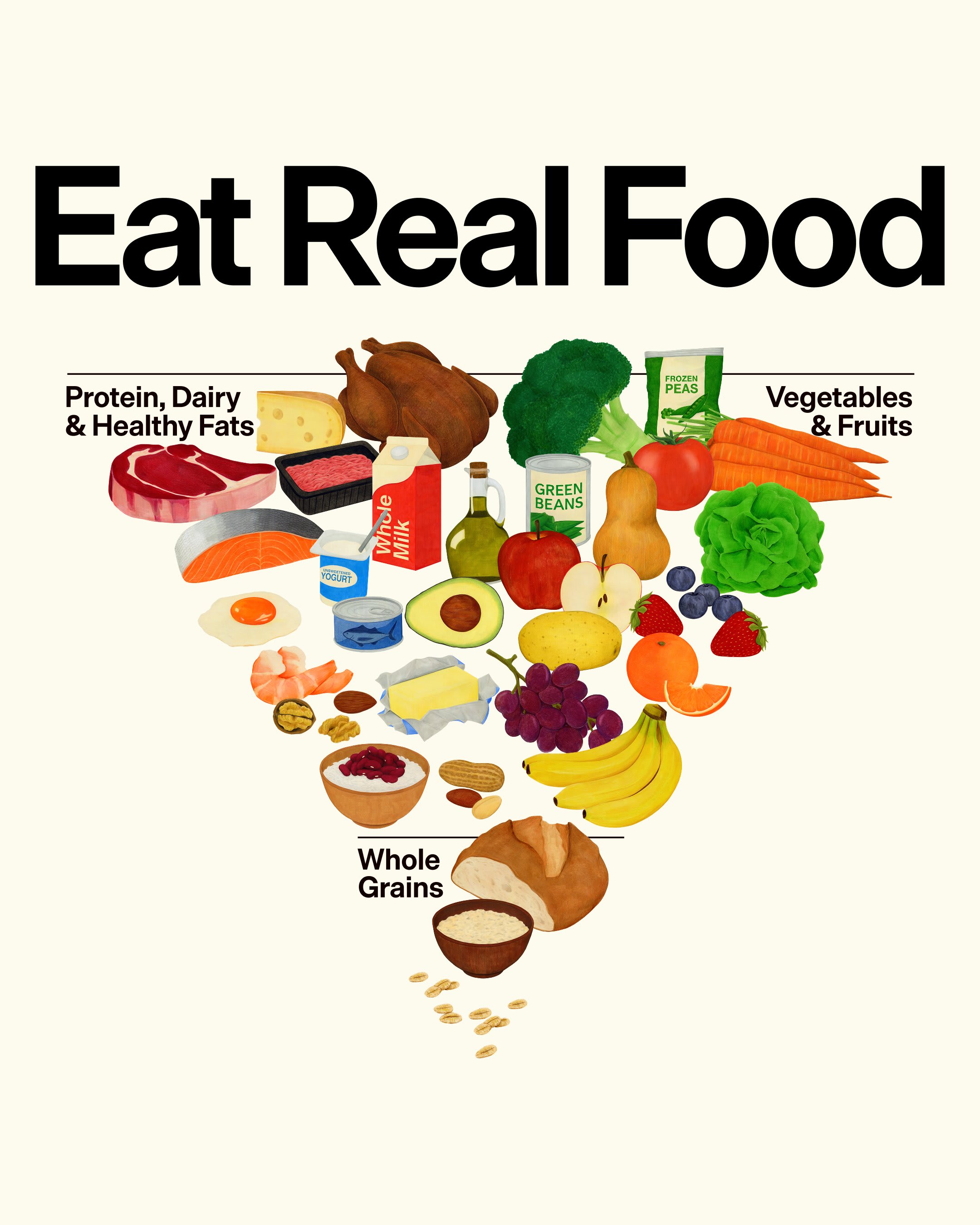
We all grew up looking at the food pyramid. Eat lots of carbs and few fats. Gospel.
Then, in the early 2000s, we learned the food pyramid was probably a pyramid scheme thanks to Gary Taubes’ New York Times piece What if It’s All Been a Big, Fat Lie?
The story goes something like this. We used to eat good, normal diets: meat, eggs, butter, vegetables, the stuff humans had eaten for millennia. Then heart disease rates started climbing in mid-century America, and in the 1950s an ambitious University of Minnesota physiologist named Ancel Keys became convinced that dietary fat was the culprit. His Seven Countries Study showed a correlation between saturated fat consumption and heart disease, though critics later pointed out he cherry-picked his countries and ignored confounding variables. Keys was brilliant and ferociously combative, and he won the institutional war, capturing the American Heart Association and marginalizing skeptics.
Meanwhile, in the 1960s, the sugar industry was quietly paying Harvard scientists to publish research blaming fat instead of sugar, and the Harvard scientists were happy to oblige their sugar daddies.
In 1977, Senator George McGovern's committee translated the fat hypothesis into the first federal dietary guidelines, drafted by staffers with no scientific background over the objections of researchers who said the evidence wasn't there yet. Once the guidelines existed, they created their own gravity: the USDA built food guides around them, the NIH funded research that assumed they were correct, and food companies reformulated everything to be low-fat (adding sugar to compensate). The Food Pyramid arrived in 1992, telling Americans to eat 6-11 servings of bread and pasta while using fats “sparingly.”
Americans dutifully complied, fat consumption dropped, carb consumption soared, and obesity rates tripled. It took until the 2010s for the scientific consensus to finally crack. But since then, frustratingly, while we’ve known, the Food Pyramid didn’t changes, for what I’m assuming are reasons of institutional sclerosis.
And then, this week, the National Design Studio just … published … a new one.
It’s beautiful, and it’s more correct, which means that kids and grownups and whoever else are probably just a little more likely to eat the right stuff. And I mean check out the website, which is a government website.
What makes me most optimistic though is that there was this obviously dumb and wrong thing that everyone agreed was dumb and wrong but did nothing about that we now, as a nation, have done something about. I bet there are a lot of other obviously dumb and wrong thing we can fix now that we’re at it.
(2) Not For Human Consumption - Grey Market Peptides
From on Substack

And if eating real food doesn’t do the trick…
Chinese peptides are so hot right now. Apparently everyone in SF is doing them. For the uninitiated (me), peptide is a short chain of amino acids (the building blocks of proteins) that can act as signaling molecules in the body to suppress your appetite or repair your tissues. A Chinese peptide is a peptide that you can get access to cheaper or extra-legally.
This essay goes into much more depth on Chinese peptide, regular GLP-1s, super GLP-1s (Gen3 GLP-1/GIP/glucagon agonists…) and who should get to decide how much we enhance our own bodies.
A few things stand out…
If you thought GLP-1's were miracle drugs, wait for Gen3 GLP-1/GIP/glucagon agonists, which author SOMEWHERE calls “the “holy grail” of weight loss medications. They work. Astonishingly well.” and which are currently in Phase 3 trials.
Plenty of peptides people are using have thin medical backing and even the ones that do need complex supply chains to work, which the grey market probably isn’t respecting, making drugs even less effective.
Cheap versions of existing drugs are WAY cheaper: grey market semaglutide costs ~$50/month versus $24,000 for brand-name — an 80-200x price differential
These are all considerations in the present. Over the medium term, the author sees a clear trajectory: oral GLP-1s democratize access, myostatin inhibitors add muscle preservation, and eventually gene therapy moves from wealthy self-experimenters to mainstream application. Everyone is going to be skinny and jacked.
Speaking of Oral GLP-1s! For the less adventurous among us, Novo Nordisk launched its Wegovy pill, the first FDA-approved Oral GLP-1 for Weight Loss, on Ro!
(3) Boltz Launches Boltz Lab Platform with AI Agents for Biomolecular Design
On Thursday, Boltz launched Blotz Lab: a platform that provides scientists with access to state-of-the-art open-source AI models:
Boltz-1 for biomolecular structure prediction (released December 2024, matching AlphaFold3 accuracy),
Boltz-2 for structure and binding affinity prediction (June 2025, in collaboration with Recursion and MIT),
BoltzGen for de novo protein and peptide binder design (October 2025)
Plus, new AI agents for small-molecule hit discovery and protein design.
We like open sourcing models to give scientists superpowers with which to give the rest of us superpowers.
We also like the investor list here. Boltz Public Benefit Corporation announced a $28 Seed round from a16z, who I wrote about yesterday, and Amplify Bio, led by great friend of not boring and former not boring capital biotech partner, Elliot Hershberg.
I texted Elliot to ask about the deal, and he told me this:
Boltz is a David and Goliath story. Google DeepMind, with infinite resources and a world-class team, made a huge breakthrough with AlphaFold. But by AlphaFold2, the code wasn’t open-source for other researchers to build on. So a small team at MIT decided to build their own.
With resources for only one training run, the Boltz team built a shipped a state-of-the-art open model for anybody to use. It took off like wildfire and is now used by every top 20 pharma company and >100k scientists worldwide. Now as Boltz PBC, this team has the resources they need to build infrastructure for scientists to make the best possible use of these models for programming biology.
Biology is hard, so I have a very complicated process to try to understand whether something new in bio is legit: I text Elliot. Boltz passes the Elliot test with flying colors. Get out there any program biology, everyone.
(4) General Matter Gets $900M DOE Contract for Domestic HALEU Production
America used to enrich uranium into the LEU and HALEU that most nuclear reactors use as fuel, and then we stopped, and now we rely on Russia, basically. Read our friends at Crucible Capital on the Nuclear Fuel Value Chain for a clearer picture.
Now, we have companies like Founders Fund-backed, Scott Nolan-led General Matter which are bringing enrichment back to the US, and now General Matter now has a $900 million task order from the DOE to “create domestic HALEU enrichment capacity.”
In just a couple of years, we’ve gone from the government blocking nuclear to funding it aggressively, in part because of its growing popularity, in part because of the data center need, and in large part because entrepreneurs are finally giving them something to fund.
To use all this new fuel, we’re going to need a lot of new reactors, so more good news: Aalo Atomics is making progress on the first new reactor building at Idaho National Labs in 59 years!
Critical progress on all fronts.

Jacob Rintamaki is one of a small group of low-twenty-somethings who make me feel like I was educated via cups-on-string whilst they were educated via Somos fiber. Like I simply do not know how he knows so much already.
I first met Jacob a couple of years ago when I stumbled across his work on nanosystems. He wrote about it a bunch, but this monster is probably the best place to start (and finish) for the curious: A Technical Review of Nanosystems.
Nanosystems are like little tiny tiny atomically tiny machines that we haven’t actually figured out to build yet, so it’s probably unsurprising that when Jacob turned to macrobots, regular old robots, the analysis would be child’s play.
Jacob’s writing on the topic is a great mix of technical, economic, and guy-in-the-scene-in-SF-hearing things. I particularly like his idea that robots and data centers are a match made in heaven and form an elegant flywheel: robots build AI infrastructure → better models → smarter robots → more infrastructure.
That’s the means.
What I particularly love about this freewheeling exploration of our robotic future is that Jacob also writes about the meaning. He ends the piece with two short stories on meaning in a post-labor world1. The optimistic take, and the one I agree with, is that the robots are going to make us more human. Beep boop to that.
You can get the PDF here if you want to read the old-fashioned way, by hand.
BONUS: Below the Paywall
I’m going to try something here. I like seeing not boring world grow, looking at number go up on the Stripe dashboard, and taking down the people ahead of me on the Substack Business Top Bestsellers list, so I’m throwing up a paywall.
There’s nothing behind it really. Just a link to a video that I’m in the middle of and really enjoying that you can get on the internet for free. I bet if you’ve been reading not boring for a while, you can even guess who it’s from.
But if you want to subscribe, I’d love to have you and I promise to try to make it worth your while (eventually, not now. whatever is down there is not worth $20/mo or $200/yr).