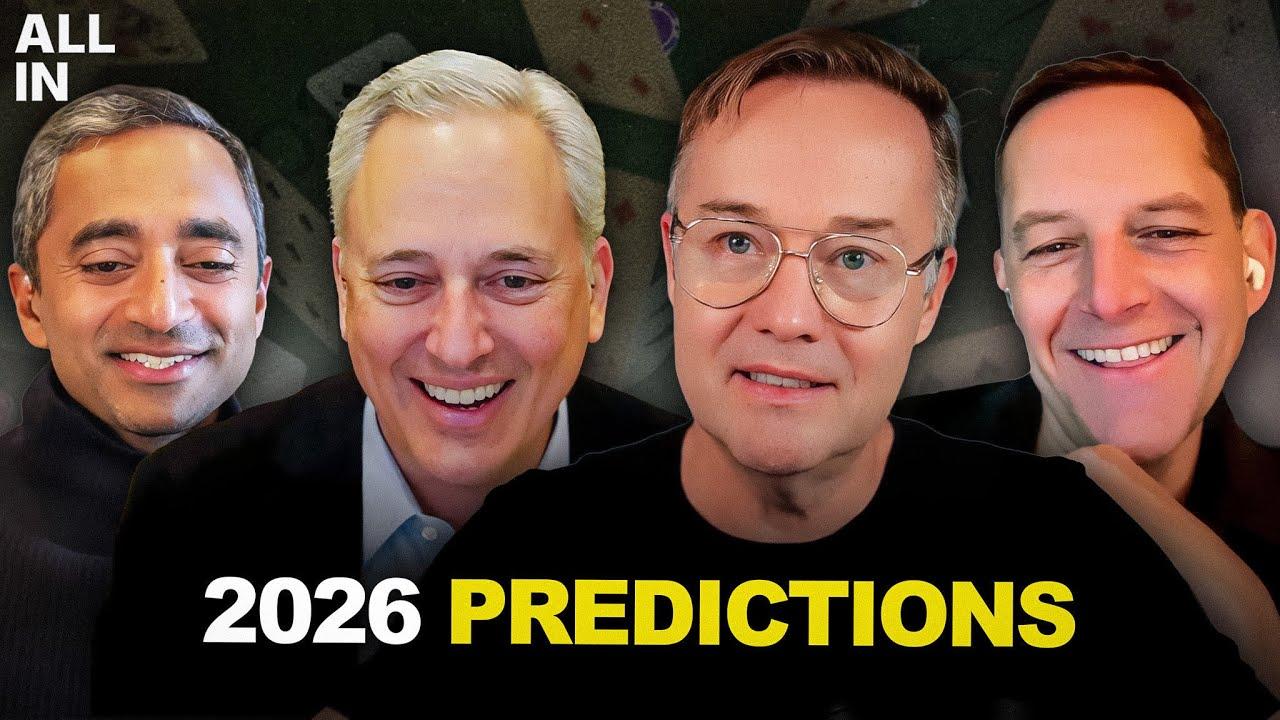
Original text: All-In Podcast
Compiled by: Yuliya, PANews
The All-In Podcast is one of the world's most popular technology and business podcasts, hosted by four top venture capitalists and friends. The hosts are: Jason Calacanis (early investor in Uber and Robinhood, podcast host, responsible for managing the show), Chamath Palihapitiya (billionaire, founder of Social Capital, known as the "King of SPACs," with sharp insights), David Friedberg (founder of The Production Board, with a strong scientific background, known as the "Sultan of Science"), and David Sacks (America's first "AI and Crypto Tsar," a close friend of Elon Musk, co-founder of Craft Ventures, former PayPal executive, and recently deeply involved in US political activities). In this episode, the four provide in-depth predictions on political, business, and technological trends for 2026, covering topics such as California's wealth tax, Trump's economics, the impact of AI on employment, geopolitics, and specific investment advice.
The following is a detailed transcript of the conversation, translated by PANews:
Prologue: Escaping California and the Wealth Tax Crisis
Jason Calacanis (hereinafter referred to as Jason): Welcome back to the world's number one podcast. David Sacks, everyone's been wondering how you've been settling into Texas?
David Sacks (hereinafter referred to as Sacks): I love the 70 degrees Fahrenheit (about 21 degrees Celsius) weather here. I moved in December, bought a new house, went to the DMV, and signed a lease for Craft Ventures' Austin office. Everything is settled.
Jason: Chamath, what about you guys?
Chamath Palihapitiya (hereinafter referred to as Chamath): We're going to take a look, but we haven't made a final decision yet.
Sacks: The funniest thing is that when we were discussing the California wealth tax in our group chat, Chamath was still putting on an act, saying, "I'm going to stay and fight, I'm not leaving my home." Then I got a call from my agent saying she was helping Chamath find a house.
Jason: Wow! Is Chamath involved in a "backroom deal"?
Chamath: I'm just hedging my bet! If you look at our friends who have clearly left, their combined net worth is about $500 billion. This is very bad for California's long-term budget. If you also include those who are still waiting but may be forced to leave, roughly half of California's projected taxable wealth will be lost.
Sacks: I predict this (California's wealth tax) will be a hot topic all year. They're collecting signatures; they need about 850,000 signatures to put the proposal on the ballot. If it makes the list in April, it will cause huge panic, and many people will leave because they can't afford the risk. Even if it doesn't pass in 2026, people expect some version to come back in 2028. That's why I decided to leave.
Chamath: If you're an entrepreneur with a great idea, it's very difficult to start a business here. Because once you succeed, you'll have a lot of illiquid stock, but you'll have to pay 5% of the stock's value as tax, which could bankrupt your company.
Sacks: And what if your company goes bankrupt the following year? You'll still owe tax bills. Also, one reason Larry Page and Sergey Brin (Google founders) left might be the super voting rights clause in the proposal. This clause stipulates that if you have super voting rights, the IRS will calculate the value of all your shares based on a multiple of the super voting rights. For example, if they owned 52% of Google's voting rights, and Google's market capitalization was $4 trillion, their net worth might be considered to be $1 trillion each, instead of the actual $200 billion. For them, the 5% tax effectively became 25% or even 50% tax.
Jason: What's your prediction? Will this "asset seizure tax" be passed?
David Friedberg (hereinafter referred to as Friedberg): I don't think it will get any votes.
Chamath: I don't think it will pass, but there will be a vote at the meeting.
Sacks: Polymarket previously predicted it had only a 45% chance of winning the vote, but that surged to 80% after Ro Khanna and Bernie Sanders got involved. There are only two scenarios where it won't win: either the union (SEIU) doesn't have the money to collect signatures, or Gavin Newsom (Governor of California) can negotiate with them to withdraw.
Chamath: But if it gets voted on, the probability of it passing is 40%.
The biggest business winner in 2026
Jason: Next up are the business winners. Last year, Friedberg chose robotics and self-driving hardware, Chamath chose stablecoins, Gavin chose large companies that effectively utilize AI, and I chose Tesla and Google. You could say we were all quite accurate. Friedberg, who will you choose this year?
Friedberg: I have two options.
- First is Huawei . I believe that Huawei's cooperation with SMIC and its deep strategic deployment in the chip field mean they are going all out, and their performance this year will exceed Western expectations.
- Second is Polymarket , which has evolved from a quirky niche market into a platform offering current affairs insights, and I expect it to explode this year. Following our partnership with the NYSE, I anticipate all exchanges, including Robinhood, Coinbase, and even Nasdaq, will make moves this year. Prediction markets will not only become markets, but also news.
Chamath: I choose copper . In a world increasingly leaning towards unilateralism and emphasizing national economic resilience, we still severely underestimate the gap between global demand and supply for a few key elements. In this context, the asset most likely to "take off" is copper. It is currently the most useful, cheapest, most ductile, and most conductive material, found everywhere from data centers to chips to weapons systems. At the current rate, by 2040, there will be a global copper supply shortfall of approximately 70%.
Sacks: I think 2026 will be a big year for IPOs. A huge number of companies will successfully go public, creating trillions of dollars in new market capitalization. For some time now, there have been concerns about a shrinking number of publicly traded companies and many going private. 2026 will be a major reversal of this trend, and it's part of the "Trump boom."
Jason: I made the right choice with Google last year, and this year my choice is Amazon . I believe they will be the first "corporate singularity," where robots contribute more profit to a company than humans. Their self-driving car company, Zoox, is progressing well, and they are massively replacing human employees with robots. In Austin, we can now order anything from Amazon and get it delivered the same day, thanks to a huge automated warehouse and logistics network.
Sacks: I think Jason's assessment of Amazon will ultimately be correct, but for reasons completely unrelated to what he gave.
The biggest business loser in 2026
Jason: Now that we've talked about the winners, let's look at the losers. Last year, we all had a lot in common: Friedberg, Chamath, and Gavin all pointed to enterprise SaaS (Software as a Service), while I chose traditional car companies and real estate. As it turns out, enterprise SaaS did indeed perform poorly in 2025, with companies like ServiceNow, Workday, and DocuSign seeing their stock prices decline. Friedberg, what are your predictions for the business losers this year?
Friedberg: I believe state governments will face significant financing difficulties. As more instances of waste, fraud, and abuse by state government agencies are exposed, their long-term solvency will begin to be questioned. More seriously, the massive unrealized pension liabilities of various states will come to light this year, revealing a huge black hole in state government finances.
Chamath: I chose the software industrial complex, specifically the companies that sell licensed SaaS to U.S. enterprises. This is an economy worth three to four trillion dollars annually, but 90% of that revenue comes from "maintenance" and "migration." With advancements in AI models and technology, I believe the economic opportunities in these two areas will shrink dramatically. Enterprises will still need software, but incremental revenue will be significantly lower, which will severely impact publicly traded SaaS companies.
Sacks: I still choose California . The shadow of a wealth tax and the stringent regulatory environment are driving businesses and capital out of the state. I sincerely hope you're right and that this bill doesn't make the vote. If it does, there will be a panic exodus.
Jason: My choice is young white-collar workers in the US . I think it's becoming increasingly difficult for them to find entry-level jobs because companies are finding it easier to automate tasks with AI than to train recent graduates. I see many companies using AI to replace some low-level, repetitive tasks that are typically done by recent graduates. This isn't to say that young people don't have opportunities, but rather that they need to become more resilient, more independent, and must learn to use AI tools.
Friedberg: I have a different view. I've heard from some CEO friends that hiring recent graduates is difficult now, not because of AI, but because of cultural issues. Many Gen Z graduates seem to lack work motivation, organizational skills, and execution capabilities. This could be a specific phenomenon during the COVID-19 pandemic, or it could be a deeper cultural shift. So I think the difficulty young people face in finding employment is a result of both cultural factors and AI automation.
Jason: I think both are true. Maybe these young people are either spoiled or their parents have enough money to let them coast along. But I have also seen many companies tell me that they can replace the bottom third of the tasks, which are usually done by recent graduates.
The biggest deal of 2026
Jason: Next, let's predict the biggest deal of 2026. Sacks, what are your thoughts?
Sacks: I don't want to name specific companies, but I think there will be a major breakthrough in the coding assistants and tool use space. Just like chatbots at the end of 2022, this space is gaining momentum rapidly, and I think it will become increasingly important this year.
Friedberg: I believe the Russia-Ukraine conflict will be resolved this year. There are many economic and political factors driving this process, which will bring more stability to the region.
Chamath: I don't think it's about a specific deal, but rather a shift in the way deals are conducted: IP licensing deals will replace traditional mergers and acquisitions (M&A) . Large-scale M&A deals are becoming extremely difficult due to increasingly stringent antitrust scrutiny. Therefore, companies will turn to large-scale IP licensing agreements to acquire technology and talent. The collaborations between Google and Character.AI, Microsoft and OpenAI, and Nvidia and Grok are all examples of this model. I believe this type of deal will become more prevalent and mature by 2026.
Jason: I think we'll see a massive merger exceeding $50 billion. It could be one of Apple, Meta, Microsoft, or Amazon acquiring AI upstarts like XAI, Mistral, Perplexity, or Anthropic. I know most of these AI companies want to go public, but I think an irresistible offer will eventually come along. President Trump may instruct the government to "make M&A great again," which is crucial for America to remain globally competitive.
The boldest contrarian prediction for 2026
Jason: Now for everyone's favorite part: the boldest contrarian predictions. Last year, I predicted OpenAI would lose its leading position, and that's exactly what happened; Chamath predicted a crisis in major banks; Gavin predicted GDP would grow by more than 5% annually; and Friedberg predicted a resurgence of socialism. You could say everyone's predictions were quite forward-thinking. Friedberg, what's your contrarian prediction for this year?
Friedberg: My prediction is based on the premise that a revolution will occur in Iran and the Ayatollah regime will fall. This isn't my contrarian view; I believe it will happen. My contrarian view is that the fall of Iran will not bring stability to the Middle East, but rather trigger more conflict. Many people consider Iran a destabilizing force in the region, but I believe it actually plays a stabilizing role. Once this regime disappears, other Arab countries (such as the UAE, Saudi Arabia, and Qatar) will erupt into new conflicts for power and influence, especially after the emergence of the two-state solution in Palestine. The situation in the Middle East will be worse than anyone anticipates.
Sacks: My contrarian prediction is that AI will increase, not decrease, the demand for knowledge workers. I'll cite the Jevons paradox: when the cost of a resource decreases, the aggregate demand for it actually increases because people find more use cases. For example, a decrease in the cost of generating code will lead to society creating a massive amount of software; a decrease in the cost of radiological scans will make scans more widespread, thus requiring more radiologists to interpret and verify AI results. The so-called "unemployment narrative" is not only wrong, we will actually see job growth.
Chamath: I have two reverse predictions.
- First: SpaceX will not go public; instead, it will be merged into Tesla. I believe Elon Musk will use this opportunity to consolidate his two most important assets into a single shareholding structure to solidify his control.
- Second, central banks will recognize the limitations of gold and Bitcoin and seek a new, controlled crypto paradigm. To maintain national sovereignty, they need a tradable, secure, and completely private asset that is not easily spied on by other countries (whether friend or foe). Moreover, technically, it must be able to withstand the challenges posed by quantum computing, which may emerge in the next 5 to 10 years, to existing cryptographic systems.
Jason: My contrarian prediction is that the standoff between the US and China will be largely resolved. I think this could be a landmark achievement of President Trump's second term. The two sides will reach a win-win working relationship, rather than a zero-sum game where one side loses.
Best performing assets in 2026
Jason: Last year, Gavin predicted that the stock prices of high-bandwidth memory manufacturers (such as Micron) would surge by 230%, and Friedberg's predictions for Chinese tech stocks also performed exceptionally well. What assets do you think will perform best this year?
Friedberg: I choose Polymarket again. Its network effects are emerging, it is replacing the functions of traditional media and markets, and its potential is enormous.
Chamath: I've chosen a basket of critical metals . This aligns with the logic I mentioned earlier regarding copper; the demand for these fundamental materials will be inelastic given the geopolitical landscape and supply chain reshaping.
Sacks: I'd choose the tech sector's expansionary supercycle . It's still part of my "Trump Prosperity" theory. And, just as we're recording this show today, the Atlanta Fed has just raised its fourth-quarter GDP growth forecast to a staggering 5.4%.
Chamath: There are a few things that people don't realize.
- First, due to immigration issues, non-farm payroll data was reset, and the income of low-income groups has grown very rapidly.
- Second, the productivity gains brought about by AI.
- Third, the tax reduction policy that will take effect in 2026.
All these factors combined create a huge growth engine. Don't short the US economy; it's ready to take off. 6% GDP growth is not unrealistic.
Jason: In this environment where the economy is about to take off, interest rates may be lowered, and people have spare cash, my choice is the speculative and gambling sector, including platforms like Robinhood, Polymarket, PrizePicks, and Coinbase. People will have more spare cash to bet and speculate.
The worst performing assets in 2026
Jason: Last year, our predictions for the worst-performing assets were remarkably consistent, almost all pointing to enterprise SaaS and traditional automotive/real estate, and our judgment has proven correct. Sacks, which asset do you predict will be the worst performer this year?
Sacks: I think it's the high-end luxury homes in California. This market will face enormous pressure due to the ongoing rumors of a wealth tax. I even hope that if the wealth tax proposal ultimately fails, there will be a "dead cat bounce" so I can clear out my properties.
Chamath: I think it's hydrocarbons, which is oil. I believe the downward trend in oil prices is irreversible. Regardless of your views on climate change, the trends of electrification and energy storage are unstoppable. This will continuously shrink the effective use cases for oil. I think oil prices are more likely to fall to $45 a barrel than back to $65.
Friedberg: I think Netflix will be the worst-performing asset (provided they don't complete the Warner Bros. acquisition), or more broadly, the worst-performing traditional media stocks . Netflix's content library is facing challenges from all sides, and their current conditions for content creators (cost plus 10%) are very harsh, causing many good creators to no longer want to work with them. They will face huge difficulties if they don't expand their content library through acquisitions. Meanwhile, traditional media is being challenged by independent creators and citizen journalism.
Jason: I choose the dollar. Our national debt continues to grow, and is projected to increase by another two trillion dollars this year. If President Trump does increase the military budget by 50%, that will be directly added to our debt. All of this will challenge the value of the dollar, which is one of the reasons we're seeing people turning to gold, silver, and even copper.
The most anticipated trends of 2026
Jason: Last year, the trends we anticipated included the return of M&A and IPOs, the rapid development of AI, and the construction of nuclear power. What trends are you most looking forward to this year?
Friedberg: I think Iran becoming an independent democracy would be the most anticipated trend this year. The people there, especially the young people, yearn for freedom, and the economic crisis is also driving this change. This could be the most significant event reshaping the Middle East.
Sacks: The trend I'm most looking forward to is the auditing of government spending at all levels. We need to normalize the "decentralized DOGE (Department of Government Efficiency)" so that the public can see where the money is going.
Chamath: What I anticipate is the expansion of "Trumpism." Regardless of your political stance, as an economic participant—whether running a business, investing in the stock market, or speculating in cryptocurrencies—understanding the changing global economic landscape is crucial. Unilateralism and economic resilience are massive trends that will result in significant GDP growth.
Jason: I still stand by my prediction from last year and extend it to 2026: the return of the IPO market. I believe that at least two of the giants like SpaceX, Anduril, Stripe, Anthropic, or OpenAI will file for IPO this year. This will ignite the market and be an exciting time for Silicon Valley, for the employees of these companies, and for the pension funds and endowments that hold their shares.
The biggest political winner in 2026
Jason: Okay, let's move on to the formal predictions. First, who will be the biggest political winner in 2026? Looking back at last year's predictions, Friedberg said it was a young candidate, Gavin (the guest host) said it was Trump and centrists, Chamath said it was fiscal conservatives, and I said it was representatives of Generation X and millennials. Friedberg, what's your pick this year?
Friedberg: Democratic Socialist in the United States (DSA) . Just as the MAGA movement took over the Republican Party, I believe the DSA is taking over the Democratic Party, and this trend will be solidified by 2026.
Chamath: Anyone committed to combating waste, fraud, and abuse at the federal, state, and local levels. It's an open track, and I think this political strategy will be very effective in 2026.
Sacks: I believe the "Trump Boom" will be the biggest political winner. Good economic news is already emerging: inflation has fallen to 2.7%, core CPI is 2.6%, Q3 GDP growth is 4.3%, the trade deficit is at its lowest level since 2009, and layoffs have dropped significantly. The S&P 500 continues to hit new highs, oil prices are falling, mortgage costs have decreased by $3,000, and real wages have increased by more than $1,000. I predict that by June we will see a 75 to 100 basis point rate cut, and thanks to larger standard deductions and tax exemptions for tips, overtime pay, etc., there will be a large-scale tax refund in April. All of this will have a huge impact on the political landscape next year.
Jason: What is your prediction for GDP?
Sacks: I choose 5%.
Chamath: I think the lower limit is 5% and the upper limit is 6.2%. You know, if we can reach 6%, the only near-competitor in the modern world who can do that is China, and that's during a period when it has complete coordination and dominance over federal, state, and local economies. It would be amazing if we could do that under democracy and capitalism.
Friedberg: My prediction is 4.6%.
Jason: My predictions oscillated between JD Vance and "The Mamdani Moment" (referring to young socialists like New York City Mayor Zohran Mamdani), but I ultimately chose "The Mamdani Moment." He's only 34, and the Democrats seem to think that going full socialism is the easiest way to win in 2026. I think Trump, by ignoring the needs of the American working class, has actually created space for this path. He's now more like a neoconservative, bombing seven countries this year and threatening to occupy Colombia and Greenland, which has disappointed many people.
The biggest political loser in 2026
Jason: Now that we've talked about the winners, let's talk about the losers. Last year, Gavin and I both predicted Putin, Chamath predicted progressivism, and Friedberg predicted the pro-war neoconservatives. Sacks, who do you think will be the biggest political loser in 2026?
Sacks: I think it's Democratic centrism . This is actually the other side of the spectrum where you think socialists will win. There are two reasons:
- First, socialist ideology has gained the upper hand among the Democratic Party's base voters (especially young people);
- Secondly, due to the redistricting, most congressional districts no longer have real competition. The only real threat to incumbent Democratic members comes from their left-wing challengers, so even moderates are forced to shift to the left.
Chamath: The biggest loser in 2026 is the Monroe Doctrine. I think historians will rewrite it when they look back on President Trump's term. I believe there is a clear "Trumpism" that surpasses the Monroe Doctrine. How do we view war? How do we view our spheres of influence? How do we view economic multilateralism versus unilateralism? All of that is outdated. Trump's view is hemispheric dominance, proactive intervention in very specific situations, such as fighting drug cartels, controlling immigration, and securing vital assets. We have more transactional relationships, which allows us to react more readily.
Friedberg: I think the biggest political loser in 2026 will be the tech industry . Artificial intelligence and tech wealth have become the target of populism on both the left and right. The right is splitting, and the alliance between tech and MAGA is facing strong populist challenges; while the left is hardening because of the alliance between tech and the right. I think the 2026 midterm elections will be a referendum on the tech industry.
Chamath: Friedberg is absolutely right. I just met with three senior Republican senators yesterday, and they are very disappointed and distrustful of some tech companies and their leaders.
Sacks: I think MAGA is a natural ally of the tech industry because we still believe in property rights and innovation. If the Democrats really move towards socialism, they will want to reshape your relationship with property rights. The populist right is angry because they remember censorship, deplatformization, and the shadow ban. Tech companies need some "truth and reconciliation" meetings with conservatives. Many companies did this under pressure from the Biden administration, and they also made the mistake of only donating to left-wing causes.
Jason: I agree with Sacks that the biggest political losers in 2026 will be Democratic centrists.
Sacks: Jason, you mentioned twice that Trump is a neoconservative, and I have to respond to that. Neoconservatism is characterized by large-scale invasions, long-term occupations, and nation-building. But did Trump do any of that? No. Take Venezuela, for example. The entire operation lasted only three hours, no Americans were killed, and it was perfect. We didn't overthrow the entire regime; we cooperated with the existing one. This is a completely new paradigm, not neoconservatism.
Jason: I acknowledge that Trump's military operation was indeed very precise and efficient, and our troops performed exceptionally well. But things can always go wrong. If the operation had failed and we had taken hostages, today's discussion would be entirely different. We must remain cautious.