Numbeo, a well-known international price comparison platform, recently released its latest 2026 Asian city cost of living index rankings. This article focuses on East Asia for further analysis.
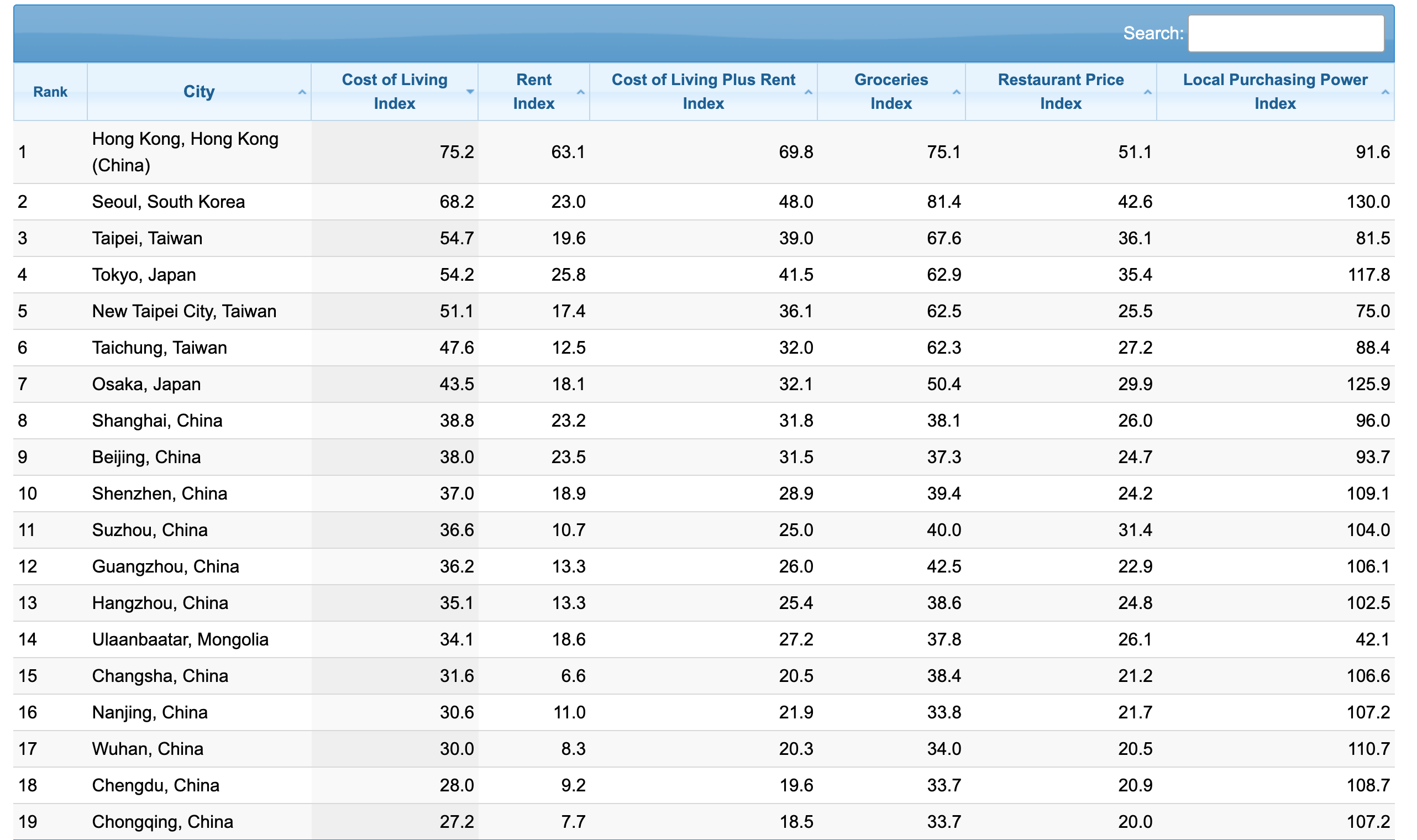
First, Hong Kong remains Asia's most expensive city with a cost of living index of 75.2, while Taiwan has three cities in the top ten: Taipei, New Taipei City, and Taichung, reflecting that the cost of living in Taiwan's major metropolitan areas is also at a relatively high level in Asia.
Explanation of the Numbeo index:
| English name | Chinese name | illustrate |
|---|---|---|
| Cost of Living Index | Cost of living index | Measure overall daily living expenses (excluding rent). |
| Rent Index | Rental Index | Measuring the cost of renting in a city |
| Cost of Living Plus Rent Index | Cost of living + rent index | Overall indicators of combined cost of living and rent |
| Groceries Index | Grocery Index | Measuring the price of supermarket shopping and groceries |
| Restaurant Price Index | Restaurant Price Index | Measuring the cost of eating out |
| Local Purchasing Power Index | Local Purchasing Power Index | A measure of the real purchasing power of local wages relative to prices. |
In-depth analysis of Taiwanese cities
Taipei: The third most expensive city in Asia, with a cost of living slightly higher than Tokyo.
Taipei ranks third in Asia with a cost of living index of 54.7, behind only Hong Kong and Seoul, and even slightly higher than Tokyo's 54.2. It's worth noting that Taipei's rental index is 19.6, far lower than Hong Kong's 63.1 and Tokyo's 25.8, indicating that Taipei's high cost of living mainly stems from daily expenses rather than rent.
In terms of the grocery index, Taipei reached 67.6, ranking third among the top ten cities, only behind Seoul (81.4) and Hong Kong (75.1), reflecting that Taiwanese people spend relatively more on daily shopping.
New Taipei City: Cost of living is about 7% lower than in Taipei.
New Taipei City ranked fifth with a cost of living index of 51.1, about 7% lower than Taipei. Its rent index of 17.4 is also more affordable than Taipei's 19.6, and its restaurant price index of 25.5 is also lower than Taipei's 36.1, indicating that the cost of eating out in New Taipei City is significantly lower.
However, New Taipei City's local purchasing power index is only 75.0, the lowest among the top ten cities, reflecting that the actual purchasing power of local residents is relatively limited.
Taichung: Moderate cost of living in the central metropolitan area
Taichung ranks sixth with a cost-of-living index of 47.6, the lowest among the three Taiwanese cities on the list. Its rent index of 12.5 is also the lowest among the top ten cities, making it a crucial reference point for those considering relocating to central Taiwan.
In addition, Taichung’s local purchasing power index reached 88.4, higher than Taipei (81.5) and New Taipei City (75.0), which means that residents living in Taichung can enjoy relatively high purchasing power.
Taiwan vs. Japan: Which country has a higher cost of living?
Many Taiwanese people aspire to live in Japan, but data shows that Taipei's cost of living index (54.7) is actually slightly higher than Tokyo's (54.2). However, Tokyo's rental index (25.8) is significantly higher than Taipei's (19.6), and Tokyo's local purchasing power index (117.8) is also far superior to Taipei's (81.5), indicating that the real income and purchasing power of Japanese office workers are still better than those in Taiwan.
Osaka's cost of living index is 43.5, lower than that of Taiwan's three major cities. Coupled with a local purchasing power index as high as 125.9, Japan's quality of life may be more competitive than Taiwanese people considering overseas development.
Seoul has the most expensive grocery stores, while Hong Kong boasts the highest rents.
Data shows that Seoul's grocery index is as high as 81.4, the highest among Asian cities, highlighting the continued concern about food prices in South Korea. However, Seoul's local purchasing power index is the highest on the list at 130.0, indicating that South Koreans' wages are sufficient to support their high cost of living.
Hong Kong continues to lead Asia with a rental index of 63.1, which is 2.4 times that of second-place Tokyo (25.8). The cost of living remains the biggest source of stress in Hong Kong.
Chinese cities generally have lower prices, but their purchasing power is quite good.
The cost of living index in first-tier Chinese cities such as Shanghai, Beijing, and Shenzhen is below 40, far lower than that of major cities in Taiwan. However, the local purchasing power index in these cities is generally between 93 and 109, higher than that of Taipei and New Taipei City, reflecting the increasing salary competitiveness of first-tier Chinese cities.