The months-long "reality show" of selecting the Federal Reserve Chair is about to reach its final chapter, with the market predicting a frenzy of betting on the former Fed governor who once declared "inflation is an option."
Written by: Sanqing, Foresight News
On January 30, US President Trump officially confirmed that the final nominee for Federal Reserve Chair will be announced on Friday morning local time (tonight Beijing time). This news marks the end of a months-long "selection" process that has captivated global financial markets. Trump stated, "The nominee won't be too surprising, and it's someone everyone in the financial world knows. Many people thought this person could have taken the position years ago."
The prediction market reacted most quickly. After Trump's announcement, Polymarket's market for "Who will Trump nominate as Federal Reserve Chair?" instantly exploded. Former Federal Reserve Governor Kevin Warsh's odds of winning skyrocketed, soaring to 95% at the time of writing, while Rick Rieder, a BlackRock executive who had previously led the pack, plummeted to 3%.
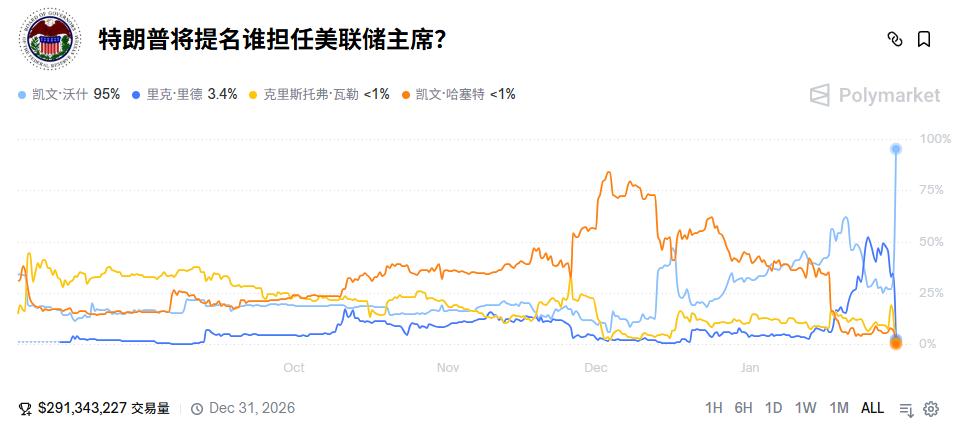
Image source: Polymarket
From "four competitors" to "one standout".
The battle for the Federal Reserve chairmanship has been full of twists and turns. Over the past few months, Trump's list of interviewees has changed repeatedly, eventually settling on four candidates with very different styles.
Kevin Hassett: A Loyal "Withdrawer"
As a long-time advisor to Trump and the current director of the National Economic Council (NEC), Hassett was once the frontrunner for the position. He possessed the quality Trump valued most—loyalty. However, as the selection process progressed, Trump repeatedly hinted that he wanted Hassett to "stay in the White House" to continue assisting with economic policy, which caused his chances of winning to plummet from an initial 50%+, ultimately making him a "runner-up" in this game.
Christopher Waller: A "Safety Card" Within the System
Current Federal Reserve Governor Waller is a typical technocrat; he understands the Fed's inner workings but doesn't have the strained relationship with Trump that Powell has. In mid-December, Waller's chances of success briefly surged after a "productive" interview with Trump. He's seen as a "safe option" on Wall Street, but under Trump's vision of "disruptive change," Waller appears too moderate and traditional.
Rick Rieder: A fleeting "dark horse"
Just two weeks ago, Rick Rieder, BlackRock's Global Chief Fixed Income Investment Officer, suddenly emerged victorious. Leveraging BlackRock's dominance in the financial world and his advocacy for "lower interest rates" (which aligned with Trump's preferences), Rieder's chances of winning surged to over 40%, making him the frontrunner at the time. However, as a representative of a "globalist" financial institution, he struggled to gain the full trust of Trump's MAGA base, and this dark horse ultimately fell short of victory.
Kevin Warsh: The "Hawk Reformer" Who Had the Last Laugh
Warsh had been on the shortlist of candidates for a long time, but unlike the previous candidates, he did not have a clear "one-man show" until the last minute. As a former Federal Reserve governor, he had the qualifications and Wall Street background (he had worked at Morgan Stanley and was a partner of legendary investor Druckenmiller). More importantly, he had the "Hollywood" image that Trump preferred—young, rich, and handsome.
Kevin Warsh: Wall Street darling, Federal Reserve rebel, and a familiar face in the crypto world.
Warsh was by no means a traditional central banker. Back in 2006, at just 35 years old, he became the youngest governor in the history of the Federal Reserve. Known for his hawkish stance, he was a long-time critic of the Fed's quantitative easing (QE) and excessive market intervention (Fed Put).
One of Warsh's most famous arguments is: "Inflation is not the weather, it's the climate, it's a choice made by governments and central banks." He advocates that the Federal Reserve should be more independent and should not sacrifice long-term monetary credibility to cater to short-term market fluctuations. This means that if he takes office, the market may face more aggressive quantitative easing (QT) and less readily available liquidity support.
However, compared to Powell's caution, Walsh has a deeper understanding of and involvement in blockchain technology:
- Warsh has explicitly opposed the Federal Reserve issuing retail CBDCs for the public, arguing that it would lead to excessive government surveillance of individual privacy, even calling it "dangerous." Instead, he supports using blockchain technology to transform the interbank settlement system (wholesale CBDCs) to improve the efficiency of dollar payments.
- While Walsh has criticized Bitcoin for being "too volatile to be used as a unit of account," he is not a blind opponent. In fact, he was an early investor in the algorithmic stablecoin project Basis and served as an advisor to the crypto index fund management company Bitwise. This demonstrates that he not only understands crypto technology but has also been involved with it financially for several years.
- Warsh favors incorporating stablecoins into the regulatory framework of "narrow banking," requiring issuers to hold 100% cash or short-term Treasury reserves. While this would lead to stricter regulations, it is also seen as an important step towards the compliance and institutionalization of stablecoins.
"If the president wanted a weak man, I wouldn't have gotten this job." This is a famous quote from Walsh during his job interview. He may not be the kind of "obedient" chairman Trump wants, but he is definitely the one who can bring about "dramatic change."
Will the Federal Reserve hand over the reins to this familiar face in the crypto world tonight Beijing time? Polymarket traders have already given their answer.