DEX developers focus on capital efficiency, reducing slippage, impermanent losses, and fees.
Written by: Ignas
Compilation: Deep Tide TechFlow
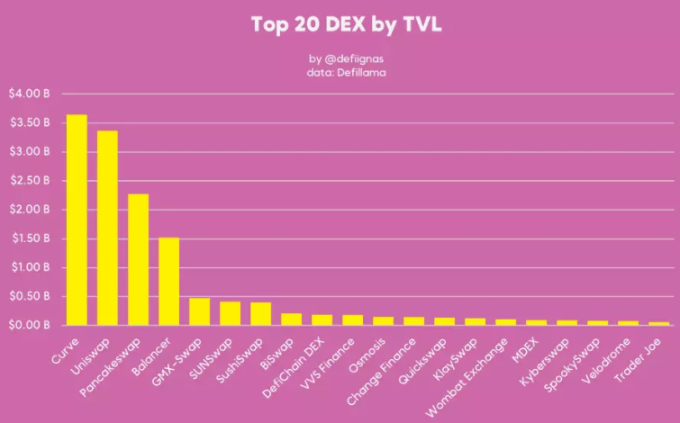
There are 200 DEXs on DeFi Llama, too many, so I just want to talk about the "top 20" among them. However, the Top 20 list will vary depending on whether TVL or volume is selected.
First look at the top 20 DEXs by TVL.
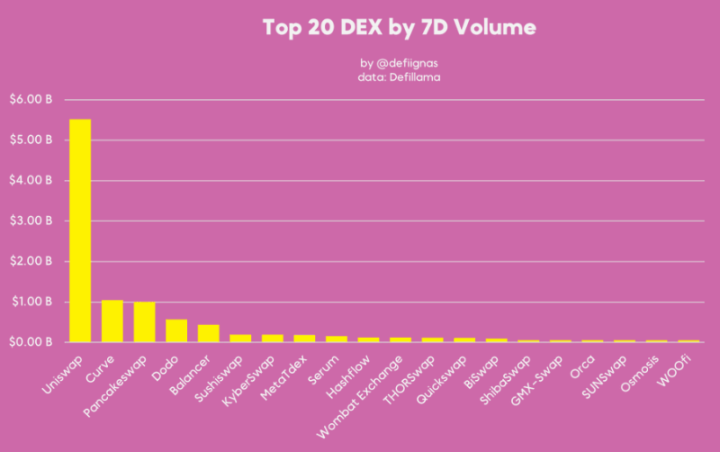
If you choose the 7-day trading volume indicator, the top 20 changes dramatically:
- Uniswap has become the well-deserved number one DEX.
- Dodo came in fourth.
- MetaTdex, Hashflow, Serum, THORswap, ShibaSwap, Orca, and WOOfi all entered the ranking.
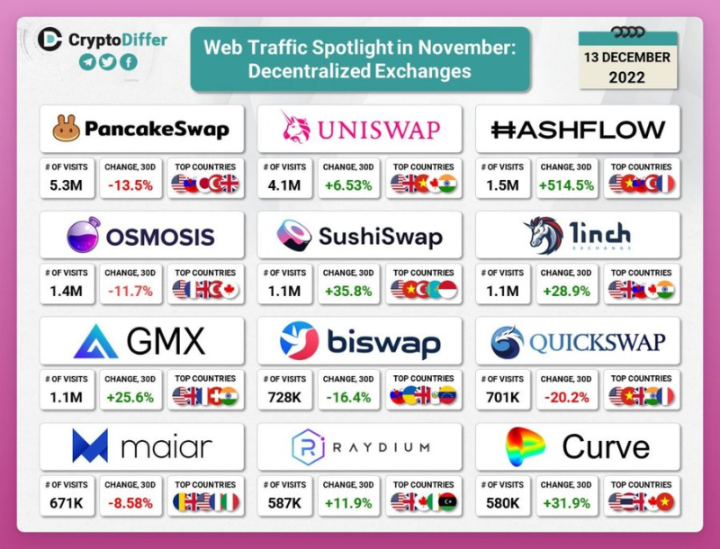
When the indicator was replaced with network traffic data, the ranking changed again, and PancakeSwap became the first.
Therefore, instead of reviewing DEXs based on pure metric rankings, I will focus on innovations, features, and the impact they have on the space.
But one thing that still surprises me is why DODO ranks fourth by volume?
With a TVL of $46 million, it has traded $568 million in the past seven days -- which should imply decent capital efficiency.
However most of its trading volume comes from 2 stablecoin pairs:

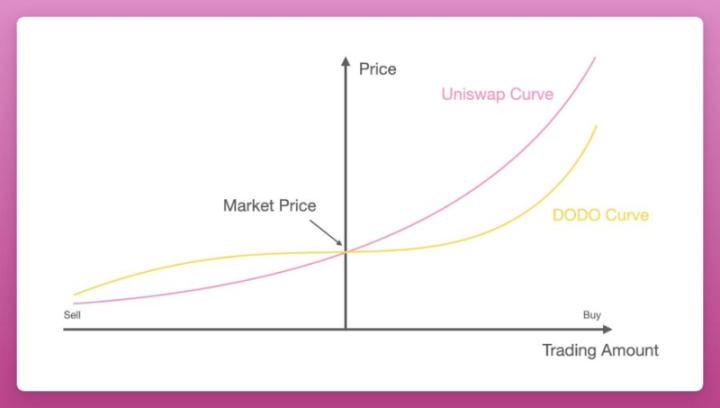
Dodo's innovation comes from the Proactive Market Maker (PMM) algorithm.
PMMs reduce slippage by aggregating more funds around market prices. Dodo also introduces single-token LPs to reduce impermanent losses.
Capital efficiency is the focus of most innovations. Uniswap's V3 "centralized liquidity" launches in 2021.
This year Kyberswap launched Kyber Elastic with similar functionality.
It differs in that:
- Anti-JIT/Snipe protection.
- LP fees are reinvested into the LP pool.
Trader Joe's solution is the Liquidity Book. LB concentrates liquidity into a specified specific price range, but LP can deposit liquidity into multiple ranges.
The end result: better prices and lower slippage. However, Joe is excluded from the top 20 by 7-day transaction volume, probably because it is only deployed on Avalanche.

Hashflow's capital efficiency is achieved by connecting traders and professional market makers.
It uses market maker quotes instead of AMMs, providing us with a 0 slippage CEX trading experience.
It also provides MEV protection and cross-chain swaps without cross-chain bridges.

Surprisingly, BiSwap on BSC entered the top 20.
As a Pancakeswap competitor, $BSW is a fork of Uni V2.
Its main selling point is the incentives: 50% exchange fee refund, 0.2% exchange fee, farm, referral program, Launchpad, lottery, staking, trading competitions...

Pancakeswap has not stopped this year:
- Capping the supply of $CAKE at 750 million.
- ve tokenomics with vCAKE.
- Introduce perpetual contracts through cooperation with ApolloX.
- Extended to Ethereum and Aptos.
Main goal: burn as much $CAKE as possible.
$CAKE is not the only DEX adopting veToken.
Balancer has adopted veBAL, which consists of locking 80% of BAL and 20% of ETH LP tokens, to facilitate long-term alignment of token holders.
This comes at a price: whale-dominated governance directs BAL rewards into his pool.
Velodrome takes ve token economics to the next level.
Velodrome is an improved version of Andre Cronje's failed Solidly.
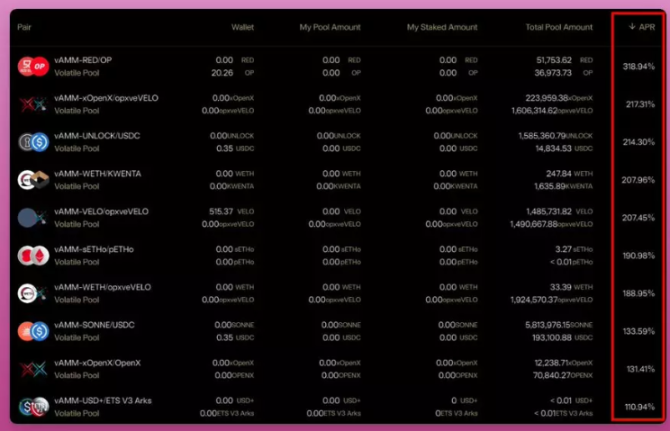
By pledging $VELO 4 years, users can get veVELO: an ERC-721 governance token in the form of NFT, which uses the ve(3,3) rebase mechanism.

Holders of veVELO are “bribed” for having the power to vote on emissions.
It turned out to be popular with Optimism's projects as they could get liquidity cheaper than doing their own liquidity mining campaigns.
This year has been quite a downturn for Sushiswap.
Sushi no longer has a moat, so the DAO voted to send all of Sushi's fees directly to the treasury. In at least a year, introduce new token economics.
Despite this, Sushi managed to maintain a top 7 position by TVL calculation and a 6th position by transaction volume calculation.
Two stablecoin-focused DEXs are launching their own...stablecoins.
For Curve and Platypus Finance, liquidity is critical. To attract it, they reward users with their tokens.
But their own stablecoins should make liquidity attractive cheaper and more "sticky."
The core idea of Curve's crvUSD is the Lending-Liquidation AMM Algorithm (LLAMMA). It is itself a continuous liquidation or de-liquidation AMM, which should reduce the risk of bad debts.
In addition to its own stablecoin, Platypus is also innovating with NFTs.
The Platypus vePTP system needs to pledge $PTP to obtain higher stablecoin deposit returns. But Platypus Hero NFT can help you speed up the generation of vePTP, keep a part of vePTP when unstaking, etc.
Stablecoin swaps are coming to Cosmos.
Osmosis is the place for transactions and yield staking on Cosmos, and the team is about to launch stablecoin swaps.
It is established by upgrading and modifying A.Cronje's Solidly curve formula.

Finally, Uniswap.
Uni V3 launches in April 2021. Since then it:
- Launched NFT transactions;
- Improved interface and analysis;
- Deployed on more chains;
- Added the ability to buy cryptocurrencies with fiat currency.
In 4 more months, Uni V3's anti-fork license will expire. What's next?
Summarize:
- DEX developers focus on capital efficiency, reducing slippage, impermanent losses and fees;
- Solutions built around centralized liquidity or market maker models;
- Scale to other chains and NFTs;
- launch of stablecoins;
- Incentives rule everything around.