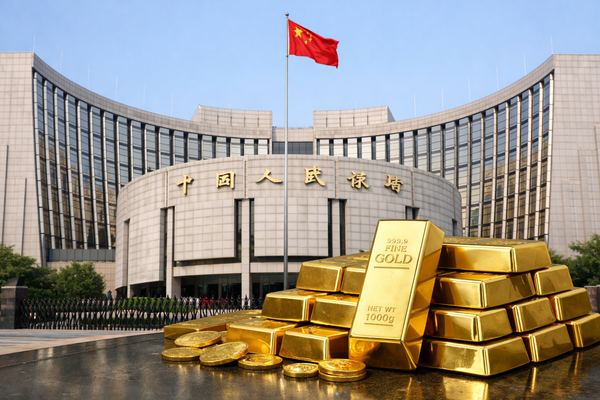
China has been a net buyer of gold for 15 consecutive months, shifting the focus of its foreign exchange reserves back to gold. Amid the protracted US-China conflict, the interpretation that this is a structural response to the dollar-centric financial order is gaining traction.
The People's Bank of China announced that its gold holdings reached 74.19 million ounces as of the end of January, an increase of 40,000 ounces from the previous month. After a brief pause following 18 consecutive months of gold purchases through April 2024, the country resumed net buying for 15 consecutive months from November of that year to January of this year. Last year alone, gold holdings increased by 860,000 ounces.
The purchaser is the People's Bank of China, China's central bank. Central bank gold purchases differ from speculative demand aimed at short-term profits. They are long-term positions directly linked to currency credibility and national strategy, and thus receive different weightings from the market.
This expansion in gold purchases is interpreted as a signal that goes beyond simple asset diversification. Amidst ongoing geopolitical tensions, including the US-China technological hegemony competition, tariff disputes, and semiconductor export controls, the decision to reduce the proportion of dollar assets and increase gold holdings is interpreted as a move to minimize sanctions risk. Gold is a physical asset not tied to a specific country's credit and is not subject to the control of international payment networks or financial infrastructure. Its relative political neutrality is considered a strength.
Another factor is the preservation of the yuan's credibility. While the internationalization of the yuan is a long-term strategy for China, its status as a global reserve currency remains limited. Increasing gold holdings is a means of improving the quality of foreign exchange reserves and enhancing their defensive capabilities in times of crisis. This also aligns with the trend toward expanding the use of local currencies in trade settlements among BRICS countries.
China has been gradually reducing its holdings of US Treasury securities in recent years. This reduction in dollar assets necessitates alternative assets. Gold is a prime example of a tool that can fill this gap. Continued central bank purchases are likely to act as a structural factor supporting downward pressure on international gold prices.
This trend also has implications for the digital asset market. As the strategic value of physical gold grows, the appeal of gold-backed tokenized assets, known as "gold RWA (real-world asset tokenization)," may increase. With dollar stablecoins established as a core part of the global digital payment infrastructure, attention is focused on whether gold-backed digital assets will emerge as an alternative store of value.
China's gold purchases are not simply a matter of increasing numbers. They represent the intersection of complex trends: a gradual rupture of the dollar's hegemony, the potential for a restructuring of the monetary order, and the expansion of digital finance based on real assets. While the gold bullion accumulating in vaults is quiet, its implications are far from trivial.