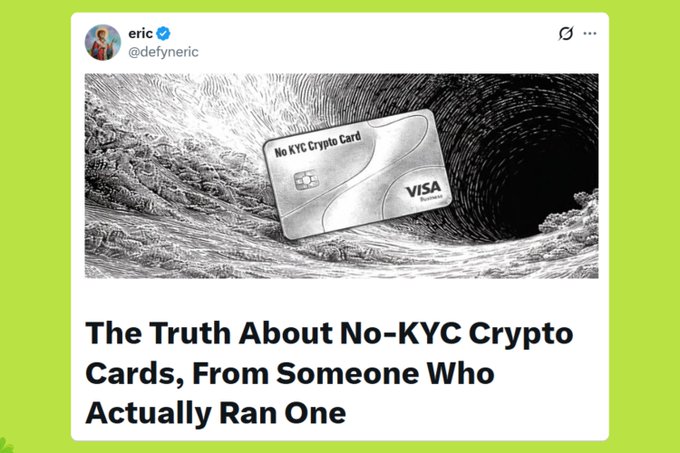
THE TRUTH ABOUT CRYPTO CARDS WITHOUT KYC 💳 Crypto cards that require no KYC (no identity verification) are attracting a lot of attention. Thanks to the effective marketing strategies of some projects, this product is seen as a convenient solution: easily topping up cryptocurrency and spending globally. However, behind that simplicity lies a complex operating mechanism and many potential risks. I previously directly managed a no-KYC card program, working with the issuing bank, the program management unit, and the compliance department. Those experiences showed that reality is far different from the advertised image. Why is there a need for cards that don't require KYC? This need is real. In some countries with financial restrictions, people may own assets but cannot spend internationally. Some are willing to go through KYC but are still rejected due to nationality or sanctions. In such circumstances, no-KYC cards become a temporary solution. In addition, there's the issue of trust. After numerous data leaks at major exchanges and service providers, many people are reluctant to continue providing personal information. For them, avoiding KYC isn't about concealing wrongdoing, but about minimizing the risk of data breaches. The less-discussed downside ⚠️ During operation, I noticed that a significant proportion of high-spending individuals were involved in fraud or illegal activities. When a payment system doesn't require strict identity verification, it naturally becomes a target for those seeking to avoid contact tracing. Initially, I assumed that most customers were simply looking to optimize costs or taxes. However, recurring patterns of behavior—the way they asked questions, moved money, pushed usage limits—revealed a much more complex reality. This raised questions not only about legality but also about ethical responsibility. Ultimately, I decided to terminate the program. How do non-KYC cards actually work? If a card is used on the Visa or Mastercard network, there is always an issuing bank behind it. And this bank is legally required to know the account holder. If a user doesn't complete KYC, another legal entity does it instead. The majority of "KYC-free" programs actually use a corporate card model. The company completes the KYB verification process, then issues the card to an "employee" or authorized person. The end user is not the legitimate account holder. This model survives thanks to an operational vacuum, but it is very fragile. The familiar life cycle 🔄 These programs usually follow the same script: - Launched quietly - Users Chia successful experiences. - The product is spreading rapidly. - Volume increased - The issuing bank or payment network conducts a review. - The program has been suspended or terminated. When the program I was running was shut down, approximately $50,000 of user funds were frozen for six months. Users had no direct legal relationship with the bank, so there was virtually no mechanism to protect their rights. Even if the money were returned, my reputation would have been severely damaged. Is there another way forward? 🚀 Some new models seek to bypass the traditional card network, integrating directly at the merchant level. In this case, stablecoins are transferred directly and converted to fiat currency for the merchant. In theory, this approach could reduce reliance on the old structure. However, this is still the early stage, and there are many challenges regarding scale and compliance.
This article is machine translated
Show original

Upside GM
@gm_upside
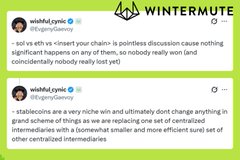
🤔 CHÚNG TA ĐANG Ở ĐÂU TRONG CRYPTO?
Theo @EvgenyGaevoy (nhà sáng lập kiêm CEO của Wintermute), những cuộc tranh luận kiểu $SOL so với $ETH hay bất kỳ blockchain nào khác ở thời điểm này có lẽ không mang nhiều ý nghĩa.
Thực tế là chưa có hệ sinh thái nào tạo x.com/gm_upside/stat…
Sector:

From Twitter
Disclaimer: The content above is only the author's opinion which does not represent any position of Followin, and is not intended as, and shall not be understood or construed as, investment advice from Followin.
Like
Add to Favorites
Comments
Share