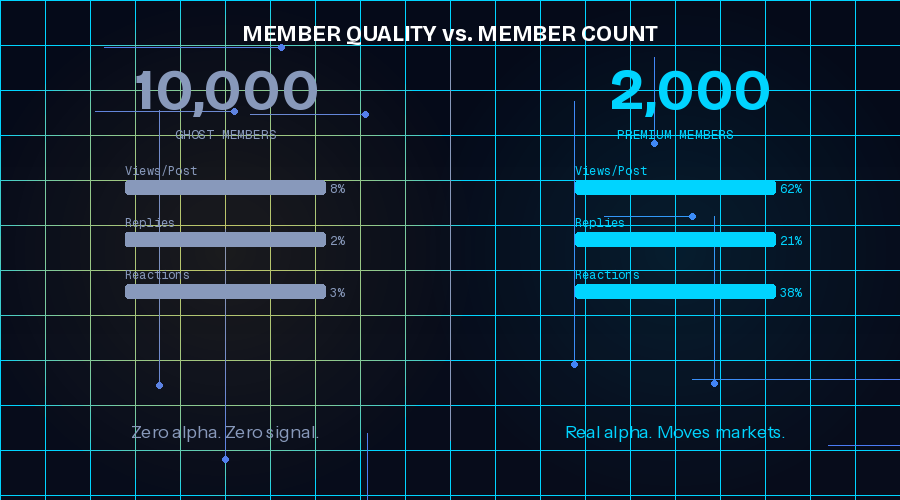
Here is the honest answer: nothing in the member count itself. A Web3 project can have 50,000 Telegram subscribers and still see every announcement land in silence. Meanwhile, a tightly built channel with 1,800 engaged members can move markets, generate CT buzz, and give VCs genuine confidence before a token launch. The difference is not the number — it is member quality, engagement architecture, and growth strategy.
In 2026, Telegram has crossed 1 billion monthly active users. Roughly one third of them actively engage with crypto content. That means the platform is not a niche tool anymore; it is the primary communication layer for Web3. The question is no longer whether your project needs a Telegram community — it is whether the community you are building actually works.
This guide breaks down exactly how to build one that does.
Section 1. Why Premium Users Matter More Than Member Count
Telegram Premium is not just a cosmetic upgrade. For Web3 projects, it has become one of the most meaningful quality signals in community building.
Premium users pay for their subscription. That single fact changes everything about how they behave. They are not airdrop farmers who joined for a raffle and went silent. They are not bot accounts inflating your member counter. They are people who have decided Telegram is worth investing in — and that mindset translates directly into higher message open rates, more consistent participation in polls and AMAs, and longer retention inside communities they genuinely value.
In early 2026, the WonderChain project demonstrated this publicly. Of their 370,000-member community, approximately 4,000 Premium users contributed voluntarily to their Telegram Boost campaign. Exchanges reviewing the project cited that Premium user engagement as a key quality signal when evaluating the project for listing. That is real-world evidence that Premium members are no longer a vanity metric — they are an indicator that serious due diligence reviewers look at.
There is also a functional advantage. Premium subscribers can upload files up to 4 GB, react with exclusive emoji, and access Telegram's Boost system — which directly unlocks your channel's ability to post stories, set custom wallpapers, and climb platform visibility rankings. When Premium members boost your channel, you gain access to features that further increase organic reach. It is a compounding loop that starts with quality members.
WAGMI is easy to say. But you only WAGMI if the people in your channel actually want to be there.
The practical implication: when planning your Telegram growth strategy, weight Premium user acquisition heavily. A channel with 500 Premium members is more valuable, more defensible, and more credible than a channel with 5,000 inactive free-tier accounts.
Fansgurus offers dedicated Telegram growth services specifically targeting Premium-tier members (https://fansgurus.com/telegram), built to help Web3 projects build the community quality that actually moves the needle.
Section 2. Telegram Engagement Architecture — Building for Retention
Most projects treat engagement as a content problem. Post more. Post better. That is only half the equation.
Engagement architecture is the underlying structure that determines whether your content has anywhere to land. Think of it as the difference between talking into a room with no acoustics versus a concert hall designed to amplify every note.
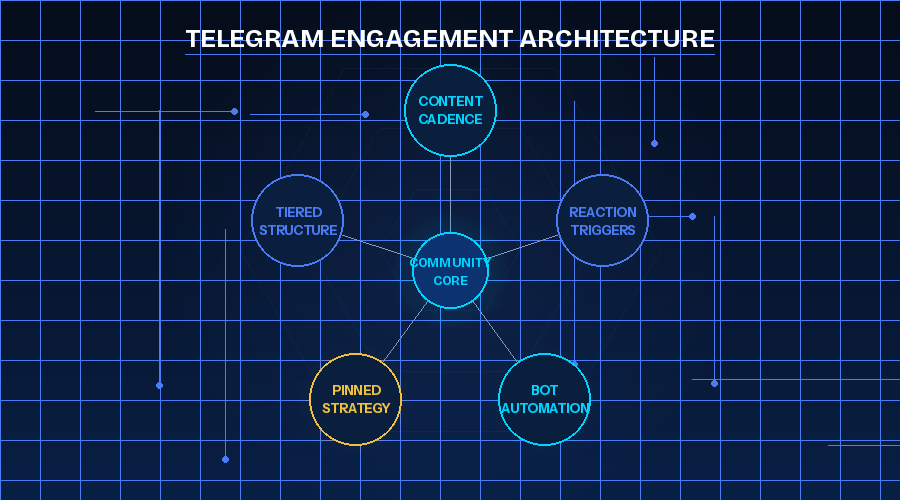
Here is what a functional engagement architecture looks like for a Web3 Telegram in 2026.
Content cadence with intentional variation. Daily posts create habit, but variety drives reaction. Rotate between protocol updates, educational threads, community polls, meme moments, and team AMAs. A channel that only announces partnerships will get ignored. One that mixes alpha drops, market context, and genuine community interaction creates FOMO for anyone who has not joined yet.
Tiered community structure. Serious projects in 2026 run at least two layers: a public announcement channel and a separate group chat for discussion. The channel broadcasts, the group converts. Members who move from passive follower to active group participant are the ones most likely to become long-term holders and advocates.
Pinned content strategy. Your pinned messages are the first thing a new degen sees when they join. Do not waste them on a bot welcome message. Pin your whitepaper, a short GM introduction from the founder, and a link to your latest AMA. First impressions in Telegram are pinned impressions.
Bot automation for engagement triggers. Telegram bots in 2026 handle everything from trading alerts to governance voting reminders to anti-spam moderation. Projects like PancakeSwap built deep community loyalty partly because their bot kept members engaged with live data between major announcements. Set up bots that give members a reason to check back — not just notifications for things they already know.
Reaction and reply incentives. Ask questions. Run polls. Create moments that require a response. A message that ends with "drop a GM if you are holding through the next cycle" is not cringe — it is architecture. It turns passive readers into participants, and participation data is what tells you which members are worth nurturing for ambassador or moderator roles.
Engagement does not happen by accident. It is designed.
Section 3. The Cold Start Problem for New Web3 Projects
This is where most projects quietly fail. They build a Telegram channel, spend two weeks trying to get traction organically, watch the member count sit at 47, and then either abandon the platform or dump a thousand bot accounts into it out of desperation.
Both outcomes are bad. An empty channel signals to every real investor who looks it up that the project has no community. A channel full of obvious bots signals something worse: that the team is willing to fake credibility. Neither builds trust in a space where scam awareness is at an all-time high after years of rug pulls.
The cold start problem in Telegram community building is real and it is not solved by grinding harder on organic content. Here is why: Telegram's discovery mechanisms favor channels that already have momentum. New members are more likely to join a channel with 3,000 members than one with 30, even if the content quality is identical. Social proof is not a bonus feature — it is a prerequisite for organic growth to work.
The legitimate path through the cold start phase involves three simultaneous actions.
First, cross-platform seeding. Your CT presence, your Discord, your email list, your KOL relationships — all of these should be actively directing people into your Telegram in the launch phase. Do not treat Telegram as a standalone growth channel before you have traffic flowing in from elsewhere.
Second, strategic collaborations. Partner with projects at a similar stage and do mutual channel cross-promotion. The alpha community in CT respects projects that move together. A simple "we are aligned with this team" post from a credible KOL can move hundreds of targeted members into your channel in 24 hours.
Third, and most effectively for the cold start phase: use professional growth services that can deliver real members quickly without destroying channel credibility.
This is exactly where Fansgurus (https://fansgurus.com/telegram) solves a real problem. Their real-member Telegram growth service is built around a base of 150,000+ real, verified users who complete interactions manually. The members that come in have actual profile activity — profile photos, bio, posting history. They are not hollow shells that get wiped in the next anti-spam update. This matters enormously because sophisticated community watchers can identify fake growth within minutes of looking at a channel's member list. Real members that look real, because they are real, protect your credibility during the critical early-stage period when trust is everything.
Section 4. Growth Services That Actually Work (vs. Bots That Kill Your Channel)
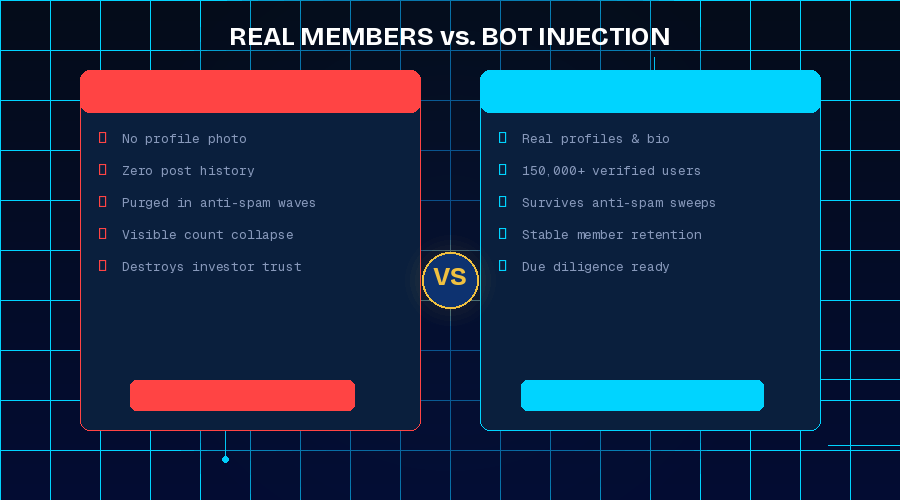
Let us be direct about something. The market for Telegram growth services is not all the same. There is a category of service that will destroy your channel faster than a bad launch tweet.
Bot-based member services inject fake accounts that inflate your counter but produce zero engagement. Worse, Telegram's anti-spam systems have become significantly more aggressive in 2024 and 2025. When bot accounts get flagged and purged — and they do get purged, often in waves — your member count drops by thousands overnight, publicly. That visible collapse is one of the most damaging things that can happen to a project in its growth phase. It signals to every watching investor that your numbers were manufactured. CT does not forget.
The distinction to look for is real versus automated delivery. Real growth services route member acquisition through actual human accounts. Engagement comes with behavioral signals — view patterns, reaction history — that look exactly like what they are: real people making a deliberate action.
Fansgurus is built on this model. Their Telegram services combine two specific products that are particularly relevant for Web3 projects.
The first is real-member delivery: genuine Telegram users sourced from a managed global network who join your channel or group. These members have real account histories, reducing churn and protecting your channel from anti-spam sweeps. For projects building toward exchange listings or fundraising rounds, these are the members that due diligence reviewers will see when they click through your member list.
The second is Bot Start: a service that drives real Telegram users to start your project's Telegram bot. For Web3 projects with utility bots — trading assistants, airdrop managers, wallet trackers — Bot Start seeding accelerates the activation threshold required to make the bot feel alive and functional to new users. A bot with 12 active users feels like a demo. A bot with 3,000 starts feels like infrastructure. That perception gap affects how seriously developers, partners, and users take your product.
Both services are available at Fansgurus (https://fansgurus.com/telegram), and both are designed specifically for projects that need credible, sustainable growth — not the kind of inflated numbers that collapse the moment Telegram runs a cleanup.
One additional note for teams evaluating services: Fansgurus customer support operates primarily via Telegram at https://t.me/fansgurus. For teams already living in the Telegram ecosystem, this makes coordination straightforward.
Section 5. Real Community Benchmarks for Web3 Projects in 2026
Before setting your growth targets, it helps to understand what the actual landscape looks like. Here are realistic benchmarks based on current Web3 Telegram performance data.
Seed-stage project (pre-launch or early testnet): A realistic and credible community for this stage is 1,500 to 5,000 members with an engagement rate of 15 to 25 percent on major announcements. At this stage, quality is far more important than size. A visible core of 200 to 300 active commenters gives investors more confidence than 10,000 silent accounts.
Growth-stage project (live product or approaching TGE): Target range of 10,000 to 50,000 members with engagement rate of 8 to 15 percent. By this stage, your Premium member percentage becomes a trackable quality signal. Projects approaching token launches in 2026 are increasingly being asked by launchpads and tier-1 exchanges to demonstrate real engagement metrics rather than raw member counts.
Established DeFi or infrastructure project: Top-tier projects like Uniswap and Chainlink run channels with hundreds of thousands of members, but their teams will tell you privately that the signal they watch is active group discussion volume, not channel subscriber counts. Protocol update discussions with 200 substantive replies are more valuable than 500,000 subscribers who never respond.
A benchmark that increasingly matters in 2026: the Boost level of your channel. Telegram's Boost system is a direct public signal of community quality. Higher Boost levels — unlocked primarily by Premium user engagement — give your channel additional features and visible credibility. Exchanges and launchpads have started factoring this in alongside traditional community metrics.
For reference, Telegram now reports over 2.4 million public channels and groups indexed on the platform. Standing out in that volume requires genuine community quality, not just member count. FOMO about growth numbers is understandable, but in 2026, the projects that raise cleanly and list successfully are the ones that built real communities, not performed ones.
Frequently Asked Questions
Q: How many Telegram members does a Web3 project need before approaching exchanges for listing?
A: There is no universal number, but most tier-2 and tier-1 exchanges in 2026 look for a combination of factors: active group discussion, Premium user presence, Bot interaction data, and consistent engagement on announcements. A project with 3,000 real, engaged members and strong engagement metrics will typically outperform a project with 30,000 dormant accounts in exchange due diligence. Focus on quality first. If you need to accelerate real member growth quickly, services like Fansgurus (https://fansgurus.com/telegram) provide real-member delivery that holds up to scrutiny.
Q: What is the difference between a Telegram channel and a Telegram group for Web3 projects?
A: A channel is a broadcast tool — only admins post, members receive. A group is a two-way discussion space. Most successful Web3 projects run both: a channel for official announcements that preserves message clarity, and a group for community discussion and direct interaction. The group is where community identity forms. The channel is where authority and trust are built. Both need to grow together.
Q: Why do Telegram Premium users matter for my crypto project's credibility?
A: Premium users are paying subscribers who have made an active choice to invest in the Telegram platform. In community contexts, they tend to have higher engagement rates, longer retention, and behavioral signals that distinguish them from bot or airdrop-farming accounts. Crucially, exchanges and launchpads reviewing your project in 2026 are increasingly factoring Premium user participation — particularly in Telegram Boost activity — as a community quality signal. Building Premium member density early protects your credibility throughout fundraising and listing processes.
Q: What is Telegram Bot Start and why would a Web3 project need it?
A: Bot Start is a metric that tracks how many users have initiated interaction with your project's Telegram bot. For Web3 projects with utility bots — price trackers, governance vote reminders, airdrop managers, wallet connectors — high Bot Start counts signal active product engagement. A low Bot Start count makes a utility bot look abandoned, which undermines product credibility. Fansgurus offers Bot Start services that seed real user activations, giving your bot the activity baseline it needs to look and function like a live, adopted product.
Q: How do I spot fake Telegram growth services that could damage my channel?
A: Watch for three red flags. First, services offering thousands of members for extremely low prices with instant delivery — real human networks cannot scale that cheaply or that fast. Second, member accounts with no profile photos, no bio, and no post history are almost always bots. Third, delivery timelines that are suspiciously short: genuine real-member services build in realistic delivery windows because they are routing through actual humans. If a service can deliver 10,000 members in one hour, they are bots. When those accounts get flagged and removed by Telegram, your channel's visible member count collapses publicly. The reputational damage in CT from that kind of drop is severe and hard to recover from. Choose services that prioritize quality and transparency, like those available at Fansgurus (https://fansgurus.com/telegram).
Building a real Web3 Telegram community in 2026 is not a growth hack problem — it is an architecture problem. Get the engagement structure right. Prioritize member quality over raw numbers. Solve the cold start phase with professional real-member services rather than bots. Understand what exchanges and launchpads actually look at. And remember that every degen scrolling CT is asking the same question: is this community real, or is it theater?
WAGMI is earned, not announced. Build accordingly.