
I've wanted to discuss this topic before. Aside from its strengths in precision manufacturing and robotics, Japan has indeed lagged behind global development in other technological fields. I think there are several reasons for this: 1. Culturally, Japan is relatively conservative and risk-averse, valuing iterative optimization over innovation. Therefore, they tend to continuously optimize existing products but are unwilling to experiment with new ones. The lifetime employment system in companies also hinders transformation and agility. 2. Wartime economic stagnation. The Korean and Vietnam Wars spurred Japan's economic recovery and rise, greatly stimulating its heavy and chemical industries. This led to a massive influx of Japanese industrial capital and talent into these sectors, creating a strong hardware-centric mindset. To meet the needs of the US military in tropical battlefields, Japanese companies were forced to push the limits of supply chain efficiency and product reliability. For example, Toyota's off-road vehicles initially gained attention for providing reconnaissance and transportation services to the US military and allies. This extreme pursuit of mechanical reliability in harsh environments later evolved into "lean manufacturing" in Japanese manufacturing. This path led Japanese companies to believe that "as long as my hardware quality is good enough, I can win the market." However, in today's software and data-driven world, its advantages have ironically become a burden in its transformation. 3. Division of labor under the US-led order. Following the two wars, the US strictly limited Japan's independent development in areas such as advanced military industry, aerospace, and basic scientific research. The US wanted Japan to be a reliable "factory" and "logistics base," not a strategic adversary with complete technological sovereignty. This arrangement caused Japan's technological development to race along the path of "applied technologies," neglecting the cultivation of "basic science" and "original architectures." When the internet age arrived, and when AI relied on underlying mathematical algorithms and chip architecture innovation, Japan found itself lacking in these fundamental areas.
This article is machine translated
Show original

Presley Sun
@PresleySun
03-18
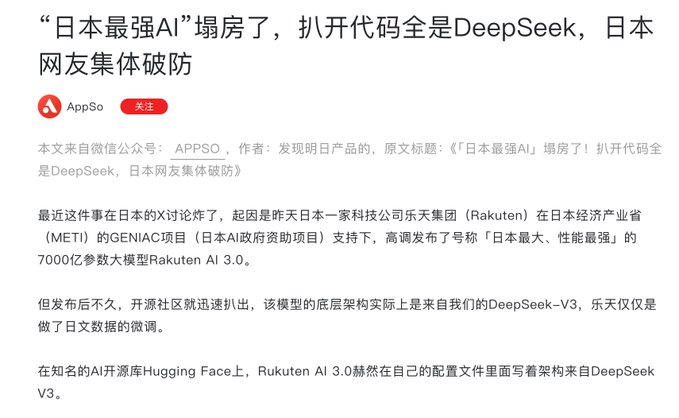
有点好笑,但似乎也有迹可循。感觉日本这十多年,是不是在科技树上加错点了...
汽车产业上,日本长期押注氢能源路线。以 Toyota 为代表,持续推动氢燃料电池车,试图建立一套不同于电动车的能源体系。但全球主流却转向纯电,像 Tesla,比亚迪这样的玩家,直接定义了产业节奏。

From Twitter
Disclaimer: The content above is only the author's opinion which does not represent any position of Followin, and is not intended as, and shall not be understood or construed as, investment advice from Followin.
Like
Add to Favorites
Comments
Share
Relevant content