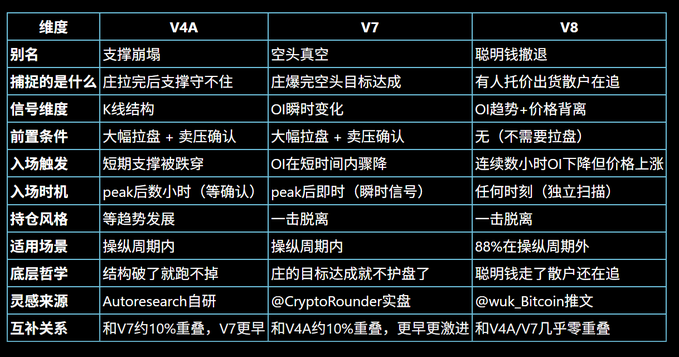
Following this quantitative research on altcoins, and coinciding with the recent surge in altcoin activity, I noticed a significant increase in discussion on Twitter. The Simplified Chinese community's understanding of altcoin alpha is far ahead of other language groups. I also received feedback from many fellow traders, and the following points inspired my testing and led to some interesting findings: 1. @Arya_web3's OI volume manipulation + cross-exchange liquidation x.com/arya_web3/status/2042909...… Most OI is artificially inflated. Inflating OI is low-cost, but the order book rarely shows large single orders. The main force behind liquidations isn't necessarily on Binance. Based on this line of thinking, I extracted two data dimensions: cross-exchange OI concentration and vol/OI. Two conclusions were drawn: - The lower the median OI percentage on Binance, the higher the degree of manipulation, and the higher the win rate of strategies like V4A based on highly manipulated characteristics (backtesting showed a 170% improvement). - A high vol/OI ratio indicates high volume manipulation. For cryptocurrencies with a trading volume exceeding 20x, V4A performed the worst. This also means that strategies that solely monitor contract trading volume or OI are inappropriate, as it's highly likely that large players are deliberately stopping trading to lure investors in. This is a very good potential screening criterion. Additionally, on-chain inflows and outflows from exchanges are also viable indicators, generally synchronized with V4A signals. 2. @wuk_Bitcoin Donato's "Price-OI Divergence" x.com/wuk_bitcoin/status/20180...… The logic is that the price is constantly being propped up, but the OI has been declining sharply and monotonously for several consecutive hours. This logic suggests that smart money or insider trading is quietly unloading shares. Data testing showed this situation is quite common with a large sample size. More importantly, it doesn't rely on manipulated coins or events; it's an independent signal that can generate positive EV (although most backtesting data shows this occurring in bear markets), with low overlap with my previous V4A strategy. However, there are limitations: 1. Requires very tight trailing rallies to close positions. 2. Lower PNL per trade after considering slippage costs in backtesting. 3. Susceptible to OI manipulation. 3. @CryptoRounder's rapid price spike + sudden drop in OI. x.com/cryptorounder/status/203...… This might be the best finding to supplement the V4A strategy. Based on V4A's manipulation coin selection, manipulation range screening, and spike top signal screening, this strategy checks for a sudden decrease in 30-minute OI (On-Interest Rate). The logic behind this strategy is that the price at this level triggers a large amount of liquidation, causing a sharp drop in OI. Because the short positions disappear, the market maker loses the will to maintain the high price and begins to fall, making it a more definitive top signal. What surprised me most was that even though I built this strategy on V4A's top confirmation and manipulation cycle confirmation conditions, the backtesting results were almost entirely different. After backtesting, Rounder's strategy triggered 2-4 hours faster than my previous pure K-line based strategy. I added Rounder and Donato's strategies to my observation list as V7 and V8. In summary, the current three strategies—V4A (with old and new coins under observation), V7, and V8—are shown in the image below. Finally, a quick advertisement: Test your coin manipulation strategy on @Hertzflow_xyz's testnet! twitter.com/thecryptoskanda/st...
This article is machine translated
Show original
Sector:

From Twitter
Disclaimer: The content above is only the author's opinion which does not represent any position of Followin, and is not intended as, and shall not be understood or construed as, investment advice from Followin.
Like
Add to Favorites
Comments
Share
Relevant content