Author: Nancy, PANews
In 2020, Bitcoin Cash (BCH) forked to create eCash; more than five years later, Bitcoin is once again involved in a fork narrative, with another hard fork project of the same name attracting attention.
Recently, Bitcoin developer Paul Sztorc announced the launch of a new Bitcoin hard fork network, eCash, which would be airdropped to Bitcoin holders. This news quickly sparked heated discussions in the community. However, eCash has been embroiled in controversy even before its launch, especially since the new chain plans to pre-allocate some tokens corresponding to Satoshi Nakamoto's address to early investors and the development team.
Another hard fork experiment is coming; eCash will launch in August this year.
On April 28, Paul Sztorc announced that he was pushing forward a Bitcoin hard fork project called eCash, which is expected to be officially launched on August 21, 2026, at a Bitcoin block height of approximately 964,000.
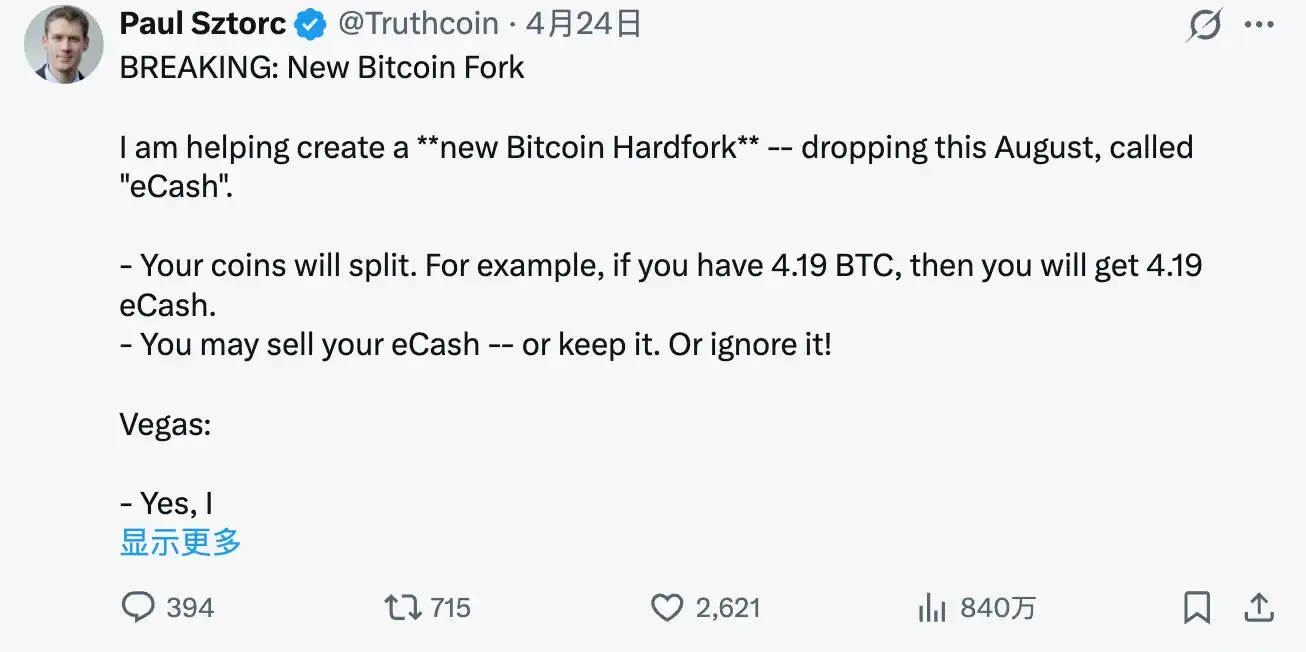
This project will fork from the Bitcoin mainnet, at which time all Bitcoin holders on the chain will automatically receive an equal amount of eCash at a 1:1 ratio. Whether exchange users will receive the airdrop will be determined by the platform itself. Holders are free to choose to sell, retain, or ignore these new coins.
Sztorc is a long-time Bitcoin developer, the originator of the Drivechains solution, and the CEO of LayerTwo Labs, a Bitcoin network sidechain development company.
eCash is positioned as a long-term solution to Bitcoin's scalability, innovation stagnation, and governance issues. According to reports, eCash's Layer 1 node software will be a near-complete copy of Bitcoin Core, continuing to use the SHA-256 hash algorithm and significantly reducing the initial mining difficulty to attract more early miners. The client code will be frozen 30 days before the fork, and multiple rounds of bug bounty programs are planned for launch this summer.
eCash's biggest highlight is its integration of seven Layer 2 Drivechains scaling networks, including a privacy chain (similar to Zcash), a prediction market Truthcoin, a decentralized exchange CoinShift, an NFT asset platform Bitassets, an identity system Bitnames, and a quantum-resistant network Photon. These Drivechains allow for high throughput, programmability, and diverse applications without modifying L1 rules, aiming to support 8 billion users globally. Furthermore, they all support merged mining, allowing miners to earn additional rewards while maintaining the main chain.
Drivechains is a Bitcoin sidechain scaling solution first proposed by Sztorc in 2015, which later evolved into BIP 300 and BIP 301 proposals. This technology allows miners to maintain sidechains using existing computing power, tightly binding sidechain security to the Bitcoin mainnet, aiming to solve Bitcoin's scaling challenges and functional expansion bottlenecks. Sztorc has been promoting Drivechains since 2015, having previously attempted to introduce it to the Bitcoin mainnet via a soft fork without success; this time, a hard fork has been chosen as an experimental ground for innovation.
Sztorc believes that a competitive ecosystem consisting of multiple L2 networks can effectively prevent excessive concentration of power among developers and give Bitcoin the potential to serve billions of users worldwide.
Unlike the Bitcoin Cash fork in 2017, eCash did not use the Bitcoin brand name, gave the market ample advance notice, and will provide a coin splitting tool to help users securely separate their assets.
Sztorc stated that the fork was not technically necessary, but rather stemmed from the current state of the Bitcoin community. He believes that Bitcoin Core developers have become conservative, self-serving, lazy, and corrupt, and miners have failed to fulfill their responsibility to maximize profits, indicating numerous deep-seated and difficult-to-fix problems within the Bitcoin culture. Therefore, he chose to restart the experiment through a hard fork.
The name eCash was chosen as a tribute to cryptographer David Chaum. In the 1980s and 90s, Chaum launched a project of the same name, eCash, exploring privacy-focused electronic payments using blind signature technology. Although his company, DigiCash, ultimately went bankrupt in 1998, this early experiment is considered one of the most important sources of inspiration for the evolution of cryptocurrencies.
The proposed allocation of Satoshi's coins has sparked controversy and has been criticized as a marketing ploy.
eCash attempted to establish an experimental network through a Bitcoin hard fork, inheriting the Bitcoin economic system while boldly promoting Layer 2 innovation. The project quickly attracted market attention after its announcement, but its token distribution mechanism also sparked fierce controversy.
Under the current plan, the eCash chain will completely replicate the Bitcoin historical ledger, including the long-dormant address balances corresponding to Satoshi Nakamoto's approximately 1.1 million BTC. However, about half of these, or 500,000 to 550,000 eCash, are planned to be redistributed to early investors and the development team for R&D incentives before the project launch, ecosystem building, and attracting contributors, preventing the new chain from becoming a zombie project due to insufficient funding.
This arrangement was quickly met with opposition from some members of the Bitcoin community. Critics argued that it violated Bitcoin's core principle of "code is law" and essentially constituted an unauthorized redistribution of the rights and interests of others' assets.
Jameson Lopp, a well-known Bitcoin developer and chief security officer at Casa, stated that this is not Satoshi Nakamoto's Bitcoin, but rather UTXOs believed to belong to Nakamoto that have been copied and modified onto a completely different network. This is a very clever and provocative marketing campaign. If Satoshi Nakamoto's assets are truly to be redistributed on the Bitcoin mainnet, the entire Bitcoin ecosystem must collectively accept the hard fork.
In response, Paul Sztorc said that it was a "decisive decision that will undoubtedly be controversial," but also a realistic and necessary choice that can effectively solve the resource dilemma when launching a new project.
He also emphasized that eCash will not affect Satoshi Nakamoto's or anyone else's Bitcoin holdings on the Bitcoin mainnet; the original chain assets remain completely unaffected. On the contrary, the plan is equivalent to gifting Satoshi Nakamoto approximately 600,000 eCash. Furthermore, any Bitcoin transfer always requires the private key and software of the Bitcoin mainnet to complete.
Currently, community attitudes are clearly polarized. Supporters believe that Bitcoin's scaling path is limited to two options: larger blocks or sidechains. The Core team has long held a conservative attitude towards both, and eCash at least provides a new opportunity for experimentation.
Opponents argue that Drivechains grants miners too much power, potentially leading to a monopoly on early block rewards and, in extreme cases, the risk of a majority of computing power misappropriating funds. They believe this scheme has been repeatedly rejected by the community in the past and is merely a repackaging of a new token, which could be imitated by other projects in the future. A more pressing issue is that historically, most Bitcoin hard forks have failed to establish long-term value.
Overall, eCash is still in the early proposal stage. Its successful launch, market adoption, and the generation of sustainable value remain highly uncertain.