Original article | Odaily Odaily( @OdailyChina )
Author|Azuma ( @azuma_eth )

The Aave bad debt crisis, which lasted for more than a week, has basically come to an end.
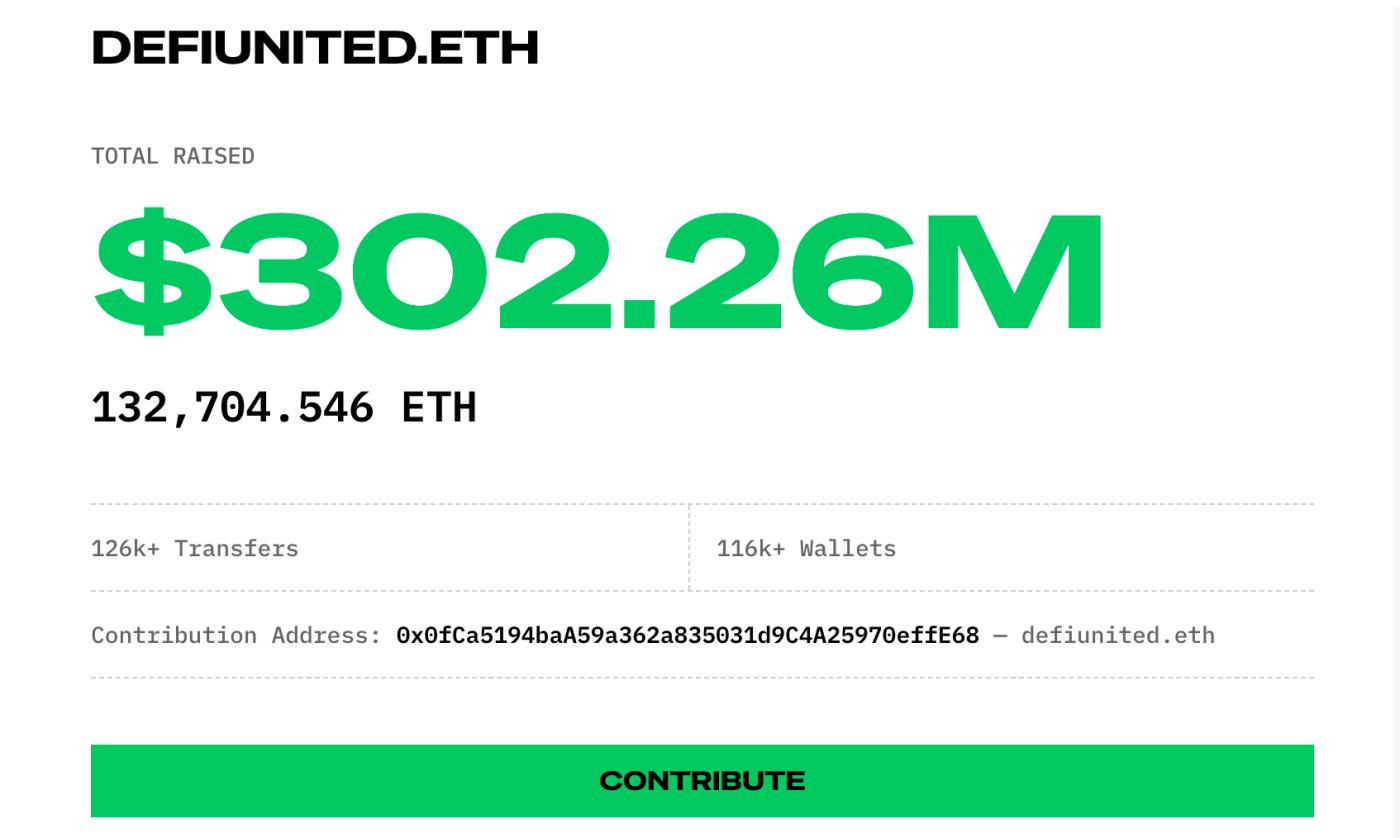
With DeFi United having raised enough funds to address the issues (132,704 ETH, worth approximately $302 million, as of this writing), Aave officially released a technical implementation plan on April 28th at noon to fix the rsETH staking situation and restore normal market operations.
- Odaily Note: For a recap, please refer to " DeFi Suffers Another $292 Million Theft, Is Even Aave Not Safe Now? "; " The Three-Way Game Under the $292 Million Hole: Who Will Pay the Price, Aave, L0, or Kelp? "; and " Aave Relinquishes the Throne of DeFi Lending Due to Its Own Stupidity ".
Background Review
The details of how Kelp DAO lost 116,500 rsETH are no longer relevant; the key point is where the stolen funds went after the theft.
After the hackers succeeded, they first distributed the 116,500 rsETH to multiple addresses. A portion of it was deposited as collateral on Aave V3 on the Ethereum mainnet and used to borrow WETH, another portion was bridged to Arbitrum and used as collateral on Aave on that network to borrow WETH, and the remaining small portion of the stolen funds was transferred through different channels.
Currently, seven addresses associated with the hacker still hold active rsETH collateral positions on Aave and Compound, representing approximately 107,000 of the original 116,500 stolen rsETH.
Solution
To achieve its restoration goals, Aave has set two objectives in its proposed implementation plan. The first is to restore the collateral support for rsETH; the second is to clear affected positions in lending markets such as Aave and Compound to recover approximately 107,000 rsETH of over-collateralized assets, thereby repairing the market damage.
Let's start with the first goal – restoring collateral support for rsETH.
Currently, rsETH is essentially insolvent. Although the underlying ETH collateral remains intact, the hackers have already escaped through collateralized loans. This shortfall has caused the exchange rate between rsETH and ETH to become "de-anchored".
Therefore, Aave mentioned that in order to restore rsETH's collateral support, the exchange rate between rsETH and ETH needs to be brought back to 1:1.07 . This will be driven by DeFi United, which has now secured sufficient ETH commitments to restore the system to full operation, but final execution still depends on governance approval, the execution timeline, and the signing of relevant agreements.
If the plan proceeds smoothly, DeFi United will fully restore rsETH's collateral support by depositing ETH into the rsETH bridging lock-up contract (RSETH_OFTAdapter 0x85d456b2…98ef3). The specific process is as follows:
- Convert DeFi United's ETH to rsETH in batches;
- Transfer these rsETH to the relevant locked contracts;
- This enables the bridging system to be safely restored and fully operational.
- LayerZero and Kelp DAO will implement additional security measures to ensure the safety of the bridge after it is restored.
Let's look at the second objective – clearing out affected positions in the lending market.
Once the collateral support for rsETH is restored, theoretically there will be no more bad debts in Aave's lending market (at which point the collateral value will be greater than the lending value). However, several abnormal collateral positions related to the hacker still need to be cleared (it is estimated that 13,000 ETH can be recovered) in order to restore the normal operation of the market.
In response, Aave stated that it will launch governance proposals on Ethereum and Arbitrum, respectively, to clean up abnormal positions through a "controlled liquidation process." The specific resolution process is as follows:
- Temporarily adjust the rsETH oracle price to trigger efficient liquidation;
- A temporary deficit may occur during the liquidation process (this deficit will be covered in subsequent steps).
- The recovered rsETH collateral will be transferred to a multisignature address managed by DeFi United.
Aave emphasizes that the above parameter adjustments are only temporary measures, intended solely for resuming execution. All adjustments will be restored upon completion and will not have a long-term impact on the Aave protocol. During the resolution period, WETH and rsETH deposits on the Ethereum mainnet, Arbitrum, Base, Mantle, and Linea will remain frozen.
Ideally, after the liquidation is completed, the rsETH price oracle will be restored; the recovered rsETH will be exchanged for ETH through the Kelp DAO standard redemption process; and this ETH will be used to fill Aave's deficit in the Ethereum and Arbitrum markets.
As for Compound, a similar cleanup approach will be adopted, and with liquidity support provided by DeFi United, it is expected to recover an additional 16,776 ETH.
Once both objectives are successfully achieved, Aave will lift the suspension and freeze on rsETH and ETH in all relevant markets, and then restore parameters such as the loan-to-value (LTV) ratio for ETH and other assets.
Problems to be solved
Aave added that while the above-mentioned plan is expected to achieve the restoration goal without social loss, the following uncertainties remain.
First, although sufficient ETH commitments have been obtained, fund deployment still depends on final protocol and governance approval; second, the cleanup of affected positions depends on the smooth passage and execution of governance proposals; third, if attackers deliberately interfere, the deficit may not be fully formed, requiring additional liquidation steps ; fourth, although LayerZero and Kelp have deployed additional security measures, residual risks still exist before production environment verification.
However, the "Kelp DAO theft and Aave bad debt" incident, which has been churning the DeFi market for a long time, seems to be coming to an end. What we need to see next is whether the solution can be implemented as expected in the real environment.
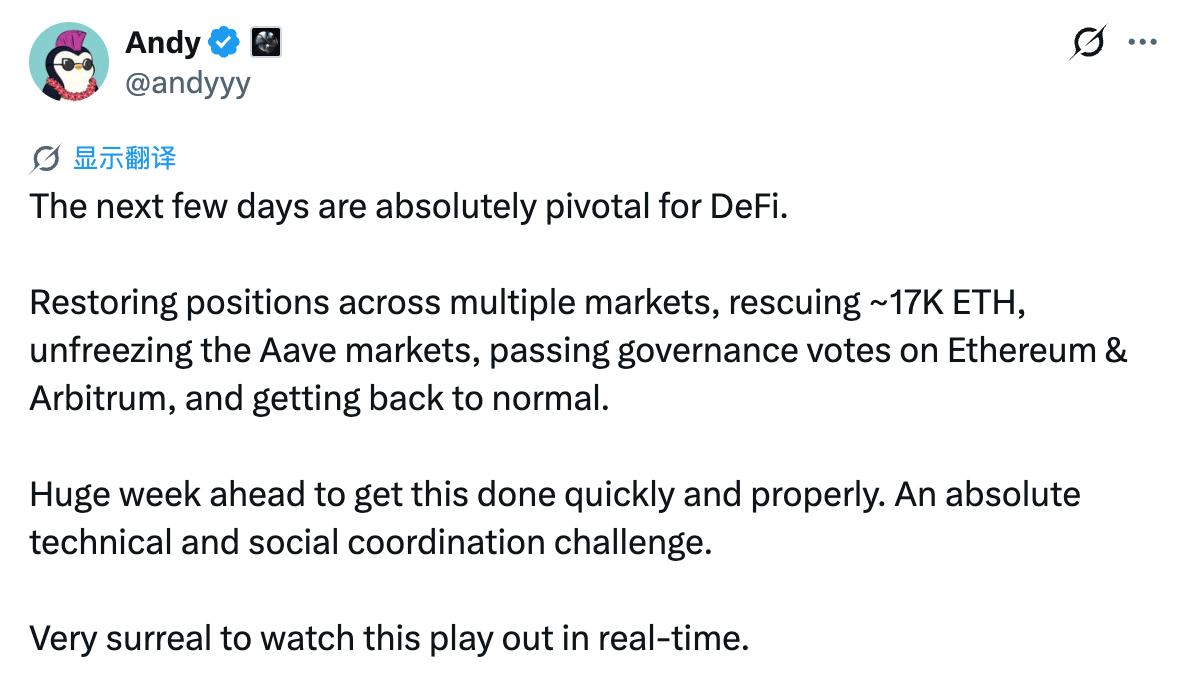
As Andy, founder of The Rollup, commented: "The next few days are crucial for DeFi, a challenging task that must be completed both quickly and reliably. It's not only a technical challenge but also a test of social collaboration . Witnessing all of this unfold in real time feels surreal."
Hopefully, good luck will be on DeFi's side.