South Korean political events have begun trading on Polymarket, a New York-based blockchain prediction market. The cumulative trading volume in the '2026 Seoul Mayoral Election Winner' market has reached approximately $33.67 million (about 46 billion won), and a new market, 'President Lee Jae-myung's Resignation in 2026', was launched on April 24th. The trajectory of South Korean politics is being transformed into financial assets tradable in global capital markets.
According to our analysis, as of May 2nd, the betting distribution in the Seoul mayoral race was as follows: 87% for Chung Won-oh of the Democratic Party and 14% for Oh Se-hoon of the People Power Party. The other 13 candidates, including Ahn Cheol-soo, Han Dong-hoon, Cho Guk, Na Kyung-won, and Kang Hoon-sik, each had a probability of less than 1%. Chung Won-oh, the head of the Seongdong District Office, defeated Park Joo-min and Jeon Hyun-hee, councilors, in the Democratic Party primaries on April 9th to become the final candidate; Mayor Oh Se-hoon was designated as the People Power Party candidate on April 18th.
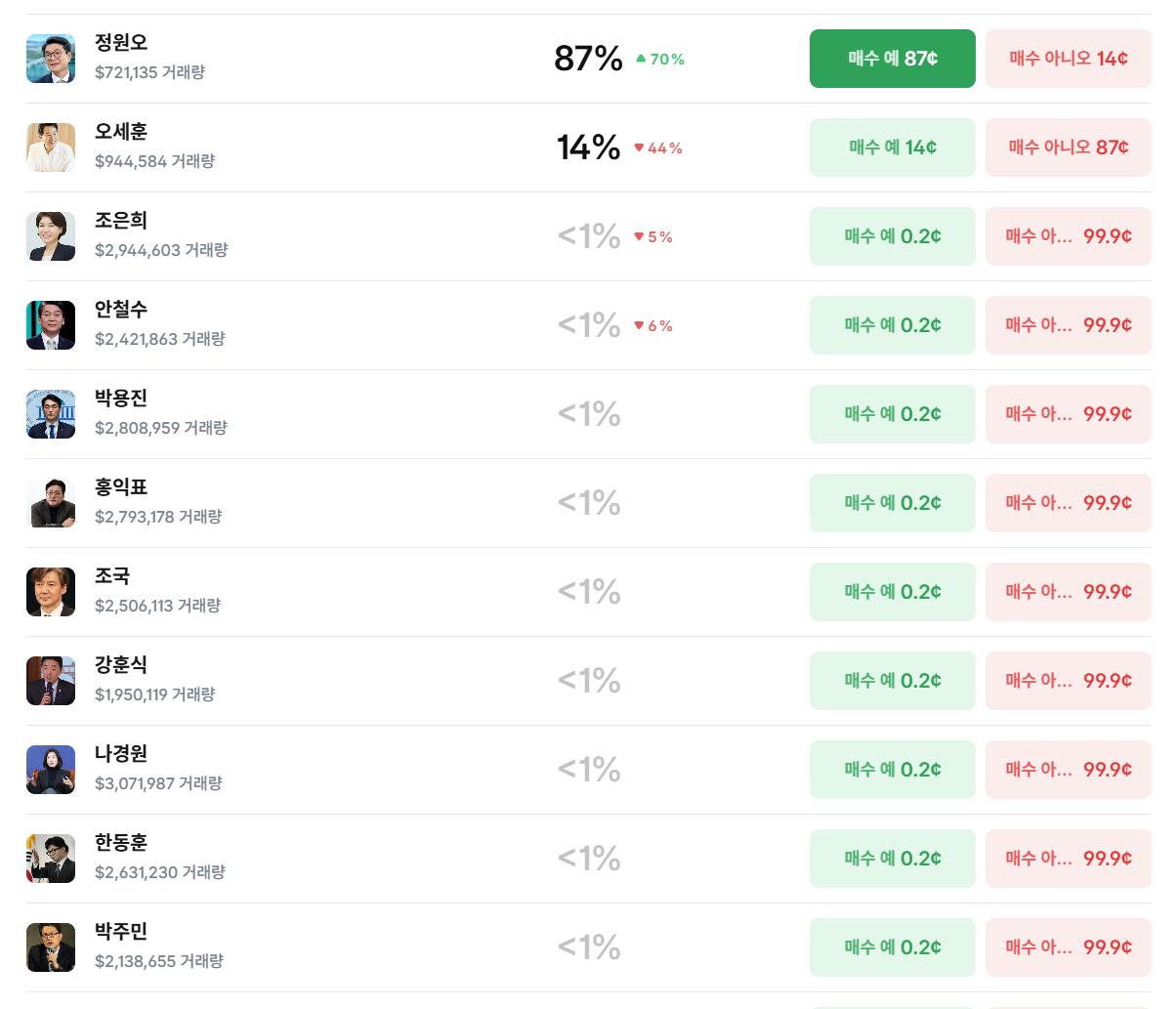
Market prices fluctuate in real time based on political events. In mid-April, a JTBC poll showed that candidate Chung Won-oh had 50% support and Mayor Oh had 34%, and the market immediately leaned towards Chung Won-oh having the upper hand; on April 14, after President Lee Jae-myung publicly praised candidate Chung Won-oh's 92.9% resident satisfaction rate, candidate Chung's probability soared from 84% to 91%. A politician's words are immediately converted into capital prices.
What is a prediction market?
Polymarket is a blockchain-based trading platform where users can bet on the outcome of future events. It uses a "Yes" or "No" contract system, with the price representing the probability collectively assessed by market participants. For example, the "Yes" contract for candidate Chung Won-woo is priced at 87 cents, meaning the market believes he has an 87% chance of being elected. If the event occurs, the "Yes" holder receives $1; otherwise, they receive $0.
The essence of this model lies in its involvement of real money. Polls incur no cost to respondents, but market participants who make incorrect judgments incur direct financial losses. Therefore, the academic community generally agrees that market prediction often provides faster and more accurate signals than polls.
In its March 2023 study on stablecoins, the International Monetary Fund (IMF) used Polymarket data as an academic tool to measure the probability of the passage of the U.S. GENIUS Act. Polymarket also achieved a decisive breakthrough in the 2024 U.S. presidential election. While major polls predicted a close race between Kamala Harris and Donald Trump, Polymarket consistently reflected Trump's advantage in its pricing, ultimately providing an accurate prediction.
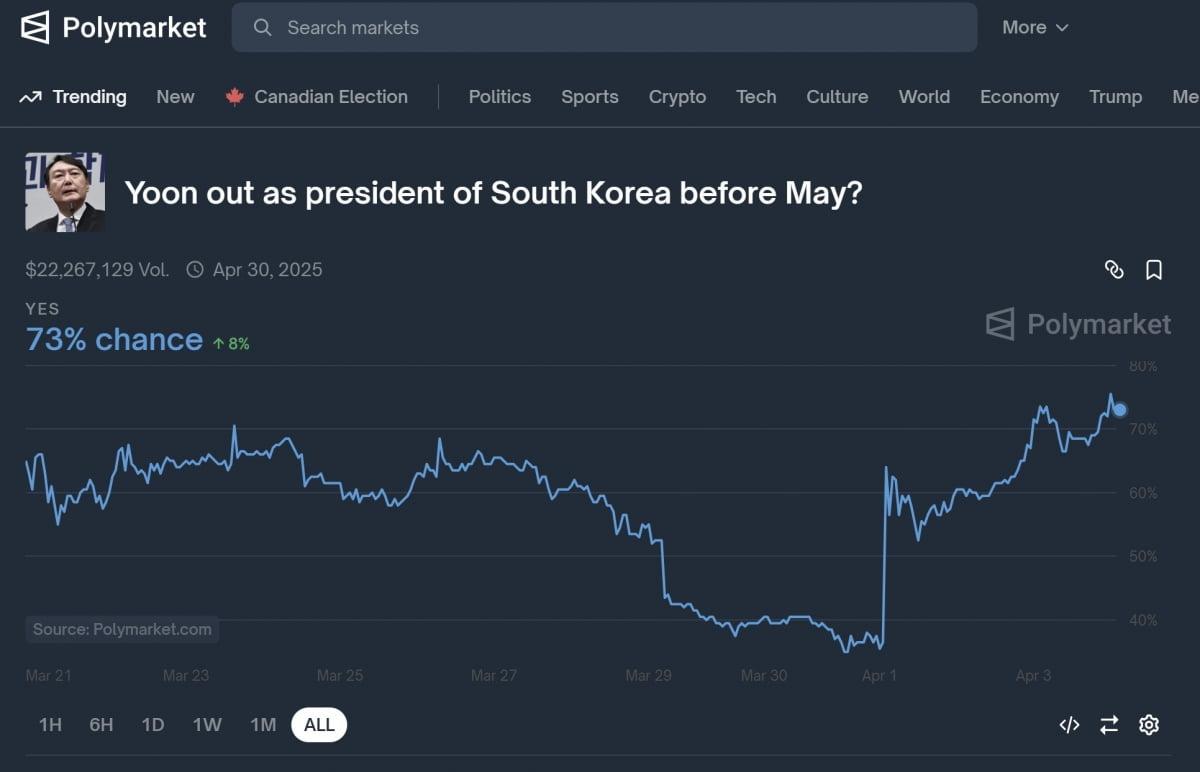
South Korean society has already experienced Polymarket's operation firsthand. Following the imposition of martial law by former South Korean President Yoon Seok-youl in December 2024, Polymarket swiftly assessed the likelihood of impeachment with a high probability, and the result was exactly as the market predicted. The newly opened market for impeachment and removal of President Lee Jae-myung signifies that the same mechanism has begun operating again against a sitting president.
Explosive growth and intense debate within the United States
Polymarket and its U.S. rival platform Kalshi have experienced explosive growth over the past year. Kalshi holds approximately 90% of the domestic market share, while Polymarket dominates the international market. The two companies are projected to spend $1 million on federal lobbying in the U.S. by 2025. Both have hired Donald Trump Jr., the eldest son of U.S. President Donald Trump, as advisors, and Polymarket has even opened an office in the heart of Washington, D.C., called "The Situation Room."
However, this growth has also sparked heated debates. The core controversies revolve around two points: insider trading and gambling regulation.
The insider trading scandal has had a huge impact on American society . U.S. Special Forces Sergeant Major Canon Ken Van Dyke was indicted by the U.S. Department of Justice for allegedly profiting approximately $410,000 on Polymarket using classified information obtained during his direct involvement in the military operation to overthrow the Maduro regime in Venezuela. His discovery was simple: the Polymarket account was created using his own email address. Considering that the vast majority of Polymarket traders use cryptocurrency wallets to conceal their identities, making them virtually untraceable, this is a rare case.
In the final moments of former President Joe Biden's term, an anonymous Polymarket trader accurately predicted four pardons Biden would announce, earning approximately $300,000. Multiple trades placed at questionable times were also confirmed in bets on the Trump administration's military action against Iran. On April 30, the US Senate unanimously passed a rule prohibiting senators from engaging in prediction market trading. Kalshi also independently identified three candidates who bet on his election, imposing fines and trading suspensions.
The issue of gambling regulation is more complex. Kalshi derives approximately 90% of its trading volume, and Polymarket approximately 38%, from sports betting. Governments in more than 20 U.S. states have designated Polymarket and Kalshi as "unlicensed sports betting" operators and issued shutdown orders. However, the two companies argue that they are "event contract" exchanges regulated by the Commodity Futures Trading Commission (CFTC) and are not subject to state gambling regulations. In April of this year, a U.S. federal appeals court ruled that New Jersey regulators had no right to block Kalshi's sports betting business, supporting the two companies' position.
The involvement of a16z... "Prediction markets are price discovery mechanisms"
At the heart of this debate, Silicon Valley venture capital giant Andreessen Horowitz (a16z) has sided with Kalshi and Polymarket. In April, a16z submitted an 18-page submission to the CFTC arguing that state regulations on prediction markets are “posing serious barriers to fair market access.”
a16z's logic comprises two aspects. First, the price system of prediction markets is a "unique form of price discovery" mechanism, capable of revealing the probability of uncertain events to the market. Second, blockchain-based prediction markets are more transparent than traditional exchanges due to the auditability of on-chain transactions. CFTC Chairman Mike Selig declared that prediction market event contracts fall under the "exclusive jurisdiction" of the CFTC, and has subsequently filed lawsuits against five state-level regulatory agencies.
On the other hand, Democratic lawmakers in the United States have taken a completely opposite stance. On April 30, a group of Democratic lawmakers led by Senator Jeff Merkley sent a letter to the CFTC demanding a "ban on event contracts involving elections, war, military operations, and government actions." Bills such as the "Prediction Markets Are Gambling Act" and the "STOP Corrupt Bets Act" have been submitted to both the U.S. Senate and House of Representatives.
Interestingly, market participants themselves estimate the probability of a federal ban on sports prediction markets in the US by 2026 to be only 11%. The market even prices itself against political threats, and this price, in turn, signals the political outcome—thus forming a self-referential structure.
Three problems facing South Korea
The presence of South Korean political events on Polymarket transcends mere curiosity. It signifies that the outcomes of South Korean politics have become the target of global capital betting. The Seoul mayoral election involved 46 billion won in betting, and the possibility of the incumbent president's impeachment or removal from office has also begun to be wagered. The betting market assesses political events with prices 24/7, and these prices, in turn, serve as a reference point for political analysis and media reporting.
Polymarket's AI summary, when discussing the sustainability of President Lee Jae-myung's term, listed "wartime" level economic control rhetoric, the bill to increase the number of Supreme Court justices to 26, and criticism of media control plans as political risk factors. Regardless of its accuracy, market assessments have become a variable that could influence the risk premium of South Korean assets in global capital markets.
As a result, South Korean society faces three fundamental problems.
First, is there a regulatory system in place to address the trading of South Korean political transactions on foreign platforms? Second, does this type of market have a legal basis for legitimate operation in South Korea? Some commentators argue that South Korea's Capital Markets Act and Criminal Code, particularly regarding gambling offenses, do not explicitly cover blockchain-based event contracts. Even in the United States, the CFTC's jurisdictional claims are still in the early stages of court verification.
Third, and most fundamentally, is the market's pricing of political outcomes a normal discovery of information, or a commodification of democracy? Economist Robin Hanson, who proposed the theory of predictive markets, argues that revealing hidden information through insider trading is a core function of markets. Conversely, critics counter that the essence of democracy is compromised when political decisions and their legitimacy become objects of capital investment.
Polymarket has transformed South Korean politics into a tradable asset. Discussions about what this transformation means for South Korean society are still in their early stages. However, capital has already begun pricing South Korean politics. The outcome of the Seoul mayoral election on June 3rd is not merely a personnel decision for a city's administrative head; it is also a financial event involving the settlement of approximately 46 billion won in global prediction markets.
The discussion may have come too late, but the results came quickly.