Why did Nvidia suddenly separate edge computing in its latest quarterly earnings report? Nvidia's latest earnings report explicitly states that the company is switching to a new reporting framework, disclosing information across two market platforms: data centers and edge computing. Edge computing includes data processing devices used for both gentle and physical AI, such as PCs, game consoles, workstations, AI-RAN base stations, robots, and automobiles. Nvidia also disclosed that Edge Computing revenue for the latest quarter was $6.4 billion, a 10% increase quarter-over-quarter and a 29% increase year-over-year; data center revenue for the same quarter was $75.2 billion, a 92% increase year-over-year. These figures are crucial: edge computing is not currently Nvidia's main revenue engine, accounting for less than 8% of total revenue; however, it has been placed on par with data centers as a "second platform." Why separate a segment with such a small share and make it grow alongside the core business? My understanding is as follows: 1. Nvidia is actively reshaping its narrative: from "selling data center GPUs" to "a full-stack AI operating system." In the past, Nvidia's valuation narrative mainly focused on its cloud AI factory. However, this new classification is equivalent to Nvidia re-dividing its business into two major worlds. This isn't an accounting technique issue, but a valuation framework issue. Previously, Nvidia's edge-related businesses were scattered across Gaming, Professional Visualization, Automotive, and OEM. By consolidating these into Edge Computing, it's essentially telling investors: these aren't fragmented businesses, but a second growth curve within the same AI era. 2. It wants to prove that the CUDA moat extends beyond the data center to the physical world. What Nvidia really wants to sell isn't a single GPU, but a platform from cloud to edge to robotics: CUDA + GPU + networking + Isaac + Omniverse + Drive + Jetson + RTX + AI-RAN. If this system only remains in the cloud, Nvidia's ceiling is its data center capital expenditure. However, if Nvidia enters the automotive, robotics, factory, edge server, AI PC, and AI base station sectors, its logic shifts from a "data center chip company" to a "general-purpose computing platform company for the AI era." Nvidia's financial reports also highlight edge computing in areas such as RTX local agentic AI, autonomous driving, Cosmos, Isaac GR00T, industrial software, and AI-RAN. This indicates that it wants to prove one thing: AI is not just about answering questions in the cloud; it also needs to see, understand, move, operate, and make decisions in the real world. 3. Alleviating market concerns about the "capital expenditure cycle of cloud vendors" Nvidia's biggest problem now is not insufficient growth, but market concerns: what will happen to Nvidia's growth rate if Microsoft, Google, Amazon, and Meta slow down their AI capital expenditures? Therefore, Nvidia needs to tell the market: my next phase is not just about hyperscalers; I also have enterprise AI, industrial AI, robotics, automotive, AI PCs, and AI-RAN. This is why it further breaks down its Data Center into hyperscale and ACIE, while also listing Edge Computing separately. It's presenting investors with a new roadmap: First growth curve: Cloud AI factory. Second growth curve: Enterprise and industrial AI. Third growth curve: Physical AI and edge AI. 4. Defining the Investment Narrative of "Physical AI" in Advance Huang has been emphasizing physical AI for the past two years. Physical AI isn't just ordinary chatbots; it's AI that can interact with the physical world, such as autonomous driving, robots, factory automation, warehouse robots, AI cameras, medical robots, drones, and smart grid inspections. Nvidia management stated in earnings calls that many industrial companies must place computing in context, where actions need to occur, and cannot rely entirely on the cloud; for example, chip factories cannot have all real-time control going to the cloud and back. Management also emphasized that the next wave is physical AI, with a large number of autonomous and robotic systems entering the physical world in the future. This is the core signal of Nvidia's separate listing of Edge Computing: It aims to transform "physical AI" from a long-term narrative into a traceable revenue stream.
This article is machine translated
Show original

qinbafrank
@qinbafrank
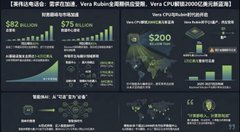
AI demand is experiencing parabolic growth, the potential market capacity for CPUs is further expanding, and edge computing is being reported independently for the first time. The most noteworthy key points from NVIDIA's earnings call are:
1. Jensen Huang stated outright: Demand


From Twitter
Disclaimer: The content above is only the author's opinion which does not represent any position of Followin, and is not intended as, and shall not be understood or construed as, investment advice from Followin.
Like
Add to Favorites
Comments
Share
Relevant content