Recently , Worldcoin has become popular again. On the one hand, AI celebrity and OpenAI CEO Sam Altman have a lot of connections with him. On the other hand, Worldcoin announced that it plans to raise another US$100 million in financing. According to PANews, this round of financing is quite popular among institutions. Already oversubscribed. In a bear market environment, it can be said to be the sweet pastry of the market.
Prior to this, a16z has led the investment with a valuation of 3 billion US dollars, token financing of 100 million US dollars of investment, and Worldcoin is already facing the moment of token distribution. The current use of 20% of the share is determined, and 10% is allocated to team members , and the other 10% is allocated to investors.
Origins: The Challenge of Web3 and Altman's UBI Dream
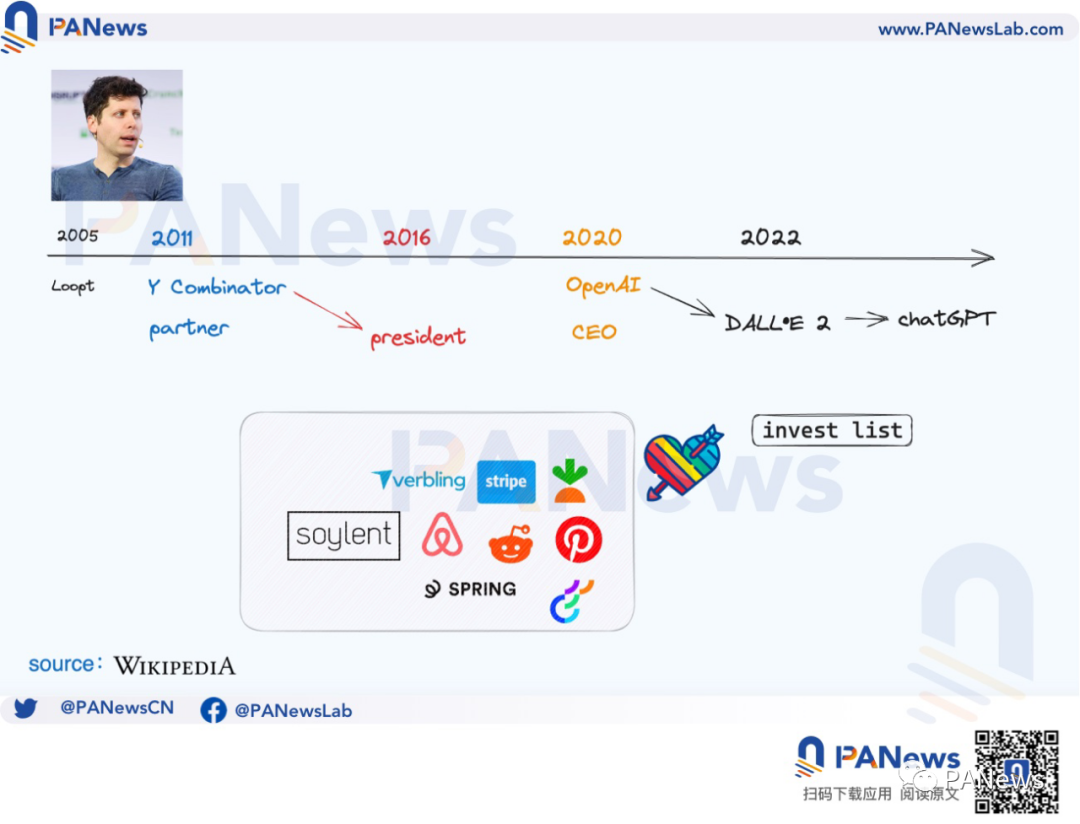
In 2019, Altman initially proposed the idea of Worldcoin, which was prepared as an ID project at this time, but in fact, Alex Blania of Caltech is its CEO, who presides over its daily operations, and Altman is its co-creator, daily work The focus is still on Open AI.
But in general, both can be regarded as the main operators of Worldcoin, because from the very beginning, Worldcoin has undertaken the important task of popularizing Web 3 to the world, which is also an important reason why it can go in the same direction as AI. In a sense, Only when Web 3 is combined with AI can it truly realize Altman's ultimate dream - UBI (Universal basic income, universal basic income).
At the beginning of 2020, the new crown epidemic spread around the world, and the European and American governments basically adopted quantitative easing policies, and actively distributed consumer vouchers, subsidies and even cash to the whole people to stabilize the society. Altman's UBI vision at this time also has fellow travelers. Around the beginning of 2020, Alex Blania and Sam Altman hit it off:
"What if there was a way to distribute shares of digital tokens to everyone on the planet for free?"
The epidemic is the real catalyst for UBI, resulting in a large-scale practice at the social level, and it also guides Altman's path selection. He also disclosed in his blog that he hopes to use AI technology to carry out research work related to fighting the epidemic.
In addition, the use of hardware equipment to ensure the authenticity of the ID is also gradually taking shape, " There is another point, you need to be in touch with the actual physical reality of this world, so you need hardware or a real ID ", which is also the theoretical source of the iris scanning device Orb .
From this timeline, Altman determined the technical routes of Open AI and Worldcoin almost at the same time, that is, the LLM large-scale model solution in the AI field and the hardware + ID route in the cryptocurrency field, and then he dominated Open AI, Worldcoin by Alex Blania to actually operate.
This is also more in line with Altman's personal style in the investment field and actual business operations, that is, while the individual is actually operating the company, the investment business will continue to develop, but the actual operation of other companies will be dominated by others, and it is less likely that Musk will be in multiple positions. The situation of the actual operator of the company.
The Combination Point of Crypto + AI
LLM is a triumph of parametric volume, and its power has conquered the world. But the path to popularization of cryptocurrencies has not been proven, but cryptocurrencies do face the same dilemma that was the most important in the early days of AI - lack of users and scenarios, and a small number of users have almost nothing to do except transactions.
Regarding this issue, Alex Blania, CEO of Worldcoin, has the following views:
Giving everyone ownership of this new protocol will be the "fastest" and "most popular path to cryptocurrency and Web3 adoption" to date, and will solve one of the main challenges of Web3: the relative scarcity of users.
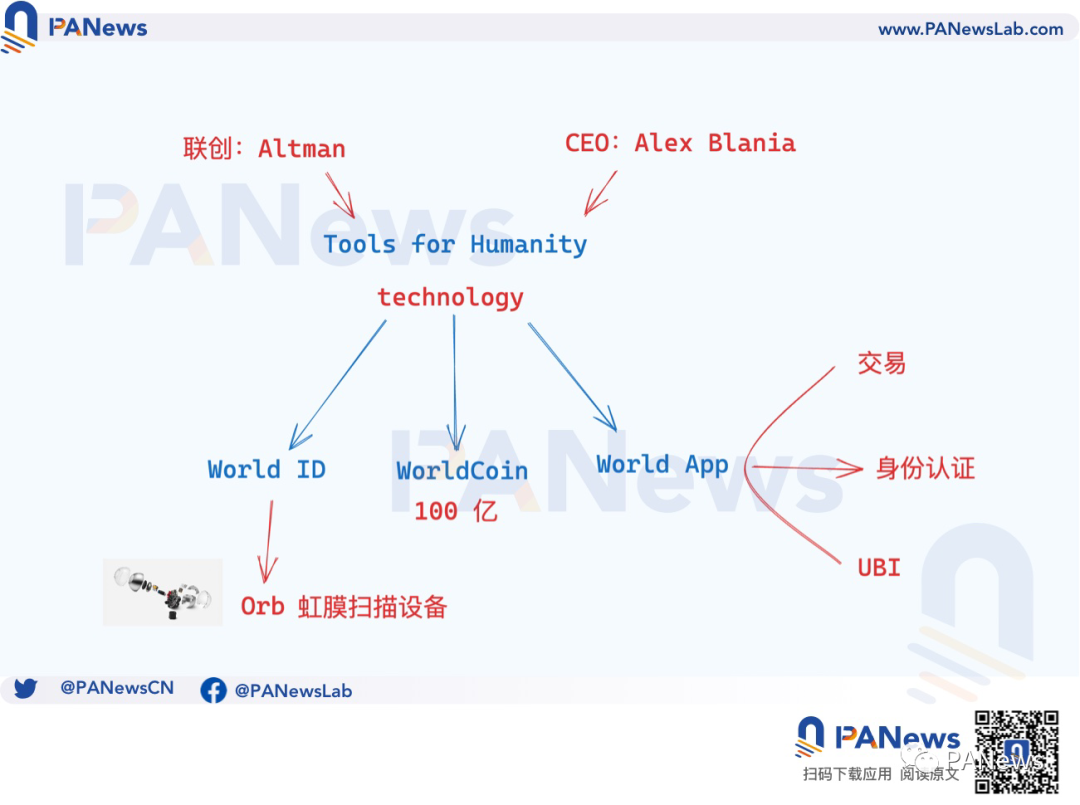
However, the logic of Crypto still needs time to be tested and implemented in specific product design. Worldcoin is developed by Tools For Humanity, and its products will be divided into three parts:
- World ID: Orb scans the iris to establish personal identity;
- Worldcoin: Built on the OP super chain, tokens will play an economic role on it;
- World App: Built-in transaction, identification and UBI specific economic functions, hoping to deposit Web 2 users here.
Articles introducing Worldcoin have accumulated in succession. This article is not intended to outline its specific details, but to reveal the logic behind it and the details of Worldcoin products.
Productivity in the AI era will lead to redundancy of social wealth. In a 2021 article, Altman argues that the wealth created by AI will be enough to feed everyone. He predicts that AI could pay every American $13,500 a year by 2031.
After the success of the ChatGPT technical route, this goal no longer seems a fantasy. The core of the problem has also become how to ensure the orderly distribution of wealth, so it is necessary to confirm personal identity. At the same time, in order to prevent common "witch" attacks represented by impostors, DID from off-chain has become just needed.
Identity verification has become the basic premise for individuals to participate in the distribution of universal welfare in the UBI era.
The middle way: premature death and hidden worries
Similar to the native economic models of Web 3 such as P2E, Worldcoin will see a steady increase in the number of users during 2021-2022, but during this period, it also encounters public opinion vortexes such as privacy dilemmas and paid promotions, and even faced a shutdown situation for a time.
However, benefiting from the explosion of chatGPT, World App's current registration number has exceeded 1.7 million, and by the end of 2022, its number of users will only exceed 1 million. But what needs to be pointed out here is that the number of app registrations is not the same as the number of iris scans. According to the data in March 2023, CEO Alex Blania disclosed that only 450,000 people in 24 countries have completed complete biometric data collection.
Privacy Dilemma Not Completely Solved
According to his own statement, the data scanned by Orb will not be stored and maliciously used by Worldcoin, and ZK technology will be gradually adopted for higher security protection. But in fact, in some areas, its operating contractors will adopt incentive measures to encourage local residents to submit data, so users will be required to provide identification to prevent repeated collection.
And there has been a data buying and selling situation. According to the company spokesperson, there has been a phenomenon of collecting local villagers' irises from Southeast Asia, selling individual encrypted users at a price of 30 dollars or less, and helping to complete app registration. The driving force behind this is Possible token AirDrop.
Even more serious is the contradiction between regulatory intervention and data processing.
Worldcoin has a registered subsidiary in Germany, and according to the principles of the GDPR regulations, any data that operates in the EU or involves EU residents is subject to the supervision of the EU, and Worldcoin's de facto global operations and EU regulations have de facto conflicts. Conflicts, such as its claim that 1% of Portugal's population has become its users, and how it handles global data is not fully clarified, according to GDPR, "Failure to adequately protect data may result in up to 4% of global revenue or 20 million Euro fine".
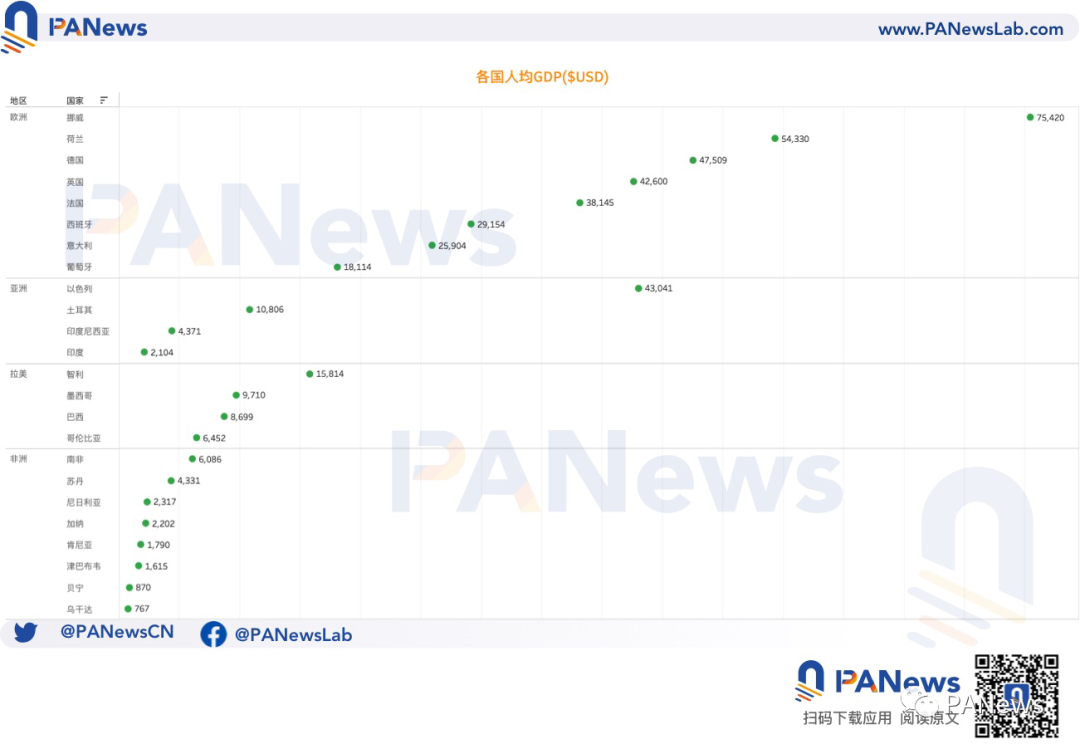
The second is the potential "digital exploitation" of the third world, which is limited by the regulatory policies of various countries. Currently, residents of China, the United States and other countries can register their apps, but they cannot pass World ID certification. According to official data, the registration place of Worldcoin Most of them are poor countries, such as Africa and Latin America. There are currently 24 countries and regions participating in the test, of which 14 are developing countries and 8 countries are located in Africa. The specific distribution and per capita GDP are as follows:
- Africa : Benin, Ghana, Nigeria, South Africa, Sudan, Zimbabwe, Kenya and Uganda;
- Latin America : Brazil, Chile, Colombia, Mexico;
- Europe : France, Germany, Italy, Netherlands, Portugal, Spain, United Kingdom, Norway;
- Asia : India, Indonesia, Israel, Turkey
At the beginning of May, some of its passwords were cracked and leaked by hackers. Although its dealers did not take security measures, if the data before the chain is not guaranteed, the privacy of the data after the chain is also compromised.
Not only is the hardware equipment prone to problems, but the underlying architecture on the chain has also undergone many changes. It does not seem to be a completely self-developed project.
The underlying architecture technology has changed multiple times
Although Worldcoin aspires to become the first encryption project for global users, its technologies are not all self-developed, but are stacked based on existing mature technologies to avoid distraction, but focus on identification and operators.
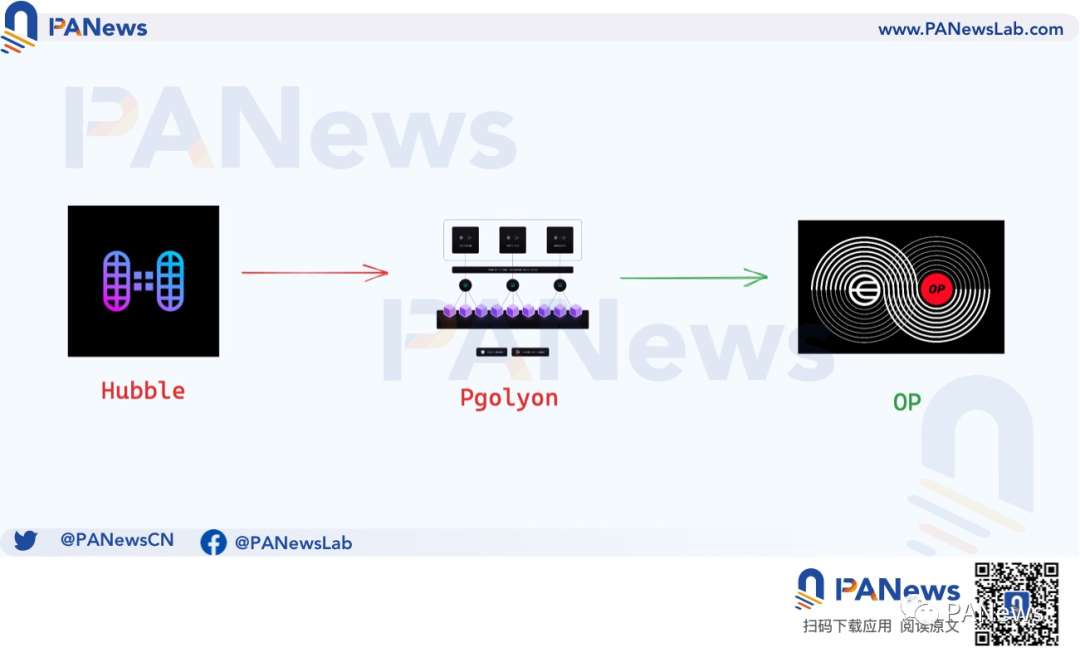
Taking the underlying architecture as an example, Worldcoin chose to cooperate with mature existing products. In the early stage of the project, it was Hubble, but it was mainly used for payment scenarios, and it could no longer meet the needs in the later stage; then it switched to Polygon, but with Worldcoin carrying There are more scenarios, and it finally turned to Optimism's super chain architecture. Worldcoin has been in contact with Layer 2 such as Optimism as early as 2020, but the cooperation was not really launched until its solution matured.
To a certain extent, Worldcoin does not focus much on cryptocurrencies and innovations. It focuses more on popularization and user acquisition. What it really cares about is how to combine existing technologies to bring billions of people around the world together. Bringing it into the realm of Web 3.
In its plan last year, it has planned to use ZKP technology for offline identity verification, which it calls PPPoPP (Privacy-Preserving Proof-of-Personhood Protocol). Mainly through the ZK calculation of offline information and uploading it to the chain to meet the needs of privacy protection, but the Hubble solution was still adopted at that time, and after turning to the super chain, its data throughput can be further enlarged, and the Gas Fee will be reduced. use.
Not only that, after the data is collected, the ZKML solution can be used to use the ZK-protected data for machine learning without infringing on personal privacy, so as to use the collected data to explore more usage scenarios.
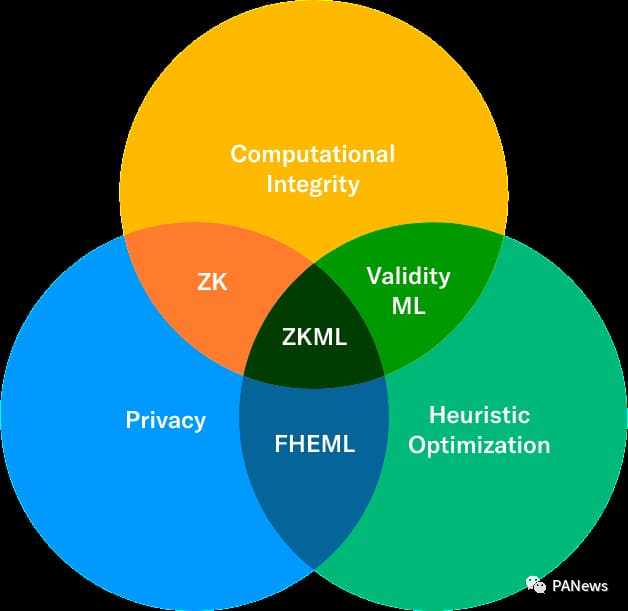
It can be concluded that in Worldcoin's plan, encryption technology, ZKP and AI technology are not mutually exclusive options, but the next-generation network technology that can be combined with each other, and the premise of all this is that enough users are needed to generate enough To enrich the usage scenarios of tokens, and ultimately support the improvement of productivity to meet the operational needs of UBI.
Conclusion: Is UBI doing anything wrong?
Different from the triumphant advance of AI, UBI and cryptocurrencies still need to face many doubts, especially whether the popularization of UBI with cryptocurrencies can be effective, which is still a difficult problem that cannot be confirmed in advance.
The logic of UBI is not complicated. At present, the total production of human society is greater than the total demand. However, due to uneven distribution, there are differences between poor and rich countries, between high-income groups and low-income groups, and even between men and women and generations. There is widespread inequality, and the idea of UBI is to redistribute wealth in society in a more modest way.
For example, ImpactMarket on Celo has tried to provide financial and educational services to residents of the third world, and to improve their livelihood and living standards in the form of Crypto UBI.
UBI does not need to forcibly change lanes from the current distribution relationship, but to give everyone equal access rights through the issuance of new tokens. Coincidentally, Chinese economist Zhai Dongsheng also imagined a Chinese version of UBI— ——"The Future Starting Point Income, A Preliminary Study on the New Redistribution Plan in the Era of Common Prosperity"
"The central government will provide financial support in the form of digital currency for Chinese residents aged 0-35 with local currency debts and taxes as financial resources, and provide one-off education or skill training subsidies for Chinese residents over 35 years old."
Whether successful or not, Worldcoin will be the first large-scale UBI experiment for all mankind, and previous attempts have generally failed to gain widespread attention. For example, Circles also belonged to the UBI category before, but its current normalized participation in governance is less than a thousand people, and it is still a small-scale attempt.
With the help of Worldcoin, this will be the first attempt to face hundreds of millions of ordinary users around the world, and most of them were not users of Web 3 before. From this point of view , at least towards the stage of real mass popularization in popularizing cryptocurrency.