By Jiang Haibo, PANews
Telegram trading robots have been around for some time. Recently, with the popularity of MEME tokens and the issuance of projects such as Unibot, this track has received attention again.
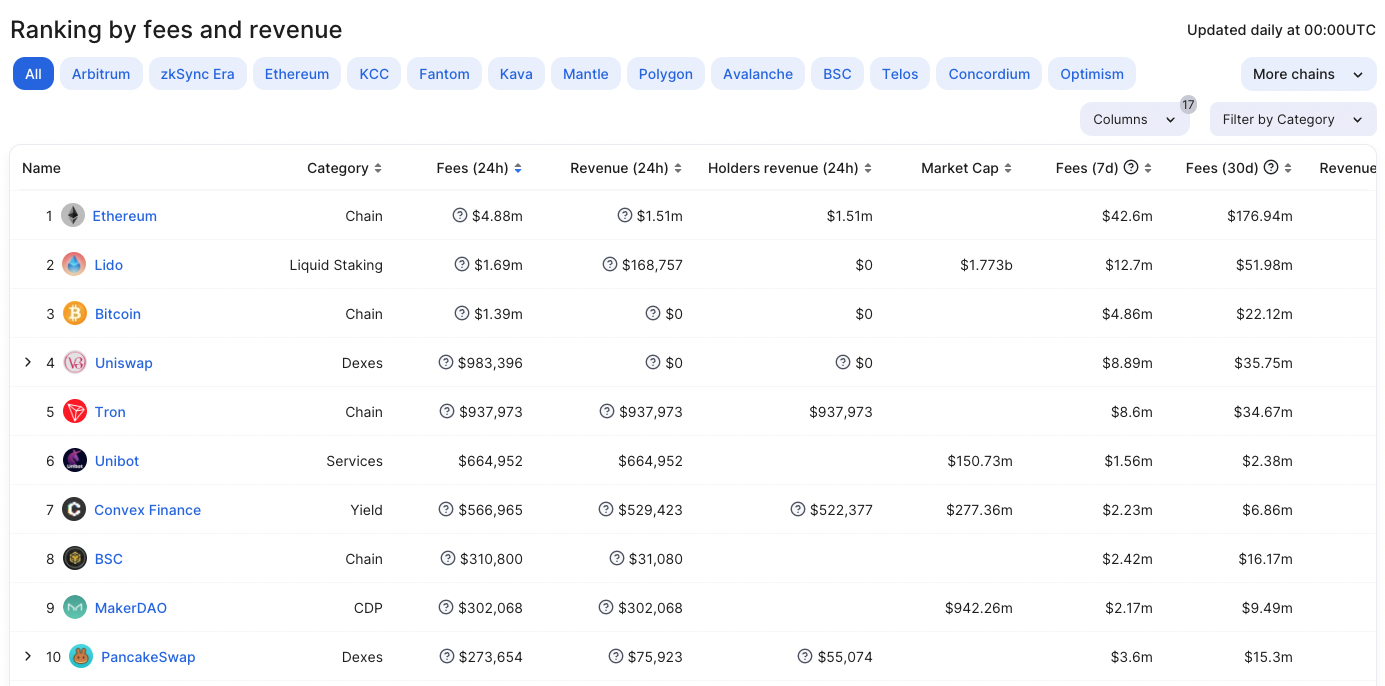
According to DeFiLlama's data, as of July 24, among all blockchain projects, the fees generated by Unibot in the past 24 hours were second only to Ethereum, Lido, Bitcoin, Uniswap, and Tron, and after excluding public chain projects, it was second only to Lido and Uniswap. Since Lido needs users to pledge ETH to generate income, 90% of the fees are allocated to users who pledge ETH, and the protocol income is only 10% of the generated fees; Uniswap’s fees are all allocated to liquidity providers, and the protocol income is zero; Unibot, as a service provider, has a 100% income relative to fees. The income of 665,000 US dollars in the past 24 hours ranked first among non-public chain projects. On this basis, Unibot distributes part of the income to holders of native tokens, while Lido and Uniswap currently have no plans to distribute income to token holders.
Unibot's service and charging mechanism
Unibot's Telegram robot can complete transactions through dialogue with users. The whole process is summarized as follows:
- Click "Start Trading" on Unibot's official website to start trading, and the Unibot dialog box of Telegram will pop up;
- Unibot generates 3 addresses for each Telegram user;
- Users can recharge Unibot addresses through wallets such as MetaMask;
- Select "Buy Tokens" from the options given in the dialog box;
- Select the wallet for the transaction and the purchase amount;
- Enter the address of the token to be purchased to complete the transaction.
Compared with transactions through decentralized wallets such as MetaMask, Unibot’s user experience is closer to that of centralized products, but safety must also be paid attention to during this process. The generated address can be replaced by refreshing, but before that, the private key needs to be saved; the export and storage of the private key should also avoid disclosure; check the entered address to prevent buying counterfeit coins. There are two ways for Unibot to generate fees, namely the transaction fee of the Unibot robot and the transaction tax of the native token $UNIBOT.
- Unibot charges a fee of 1% of the Unibot Telegram bot’s trading volume, 40% of which is allocated to holders of the $UNIBOT token, and the rest is allocated to the team and for referral rewards. Users can recommend other people to use Unibot robots to trade, and the recommender can get 25% of the referee's transaction fee.
- There is a 5% tax on transactions of $UNIBOT tokens, of which 1% of the trading volume is allocated to holders of $UNIBOT tokens, and this allocation is doubled during the first 90-day window.
- If more than 200 $UNIBOT is sold or transferred per reward period, the reward will be forfeited and returned to the reward pool.
This means that approximately 40% of the fees generated by Unibot are currently allocated to holders of $UNIBOT tokens.
According to the Dune dashboard provided by Unibot's official website, Unibot generated a fee of 337.54 ETH on July 23, which is equivalent to about $637,500 based on Binance's closing price of $1,888.73 that day. Since Unibot is a service provider, it does not need to allocate fees to liquidity providers like Uniswap and other DeFi projects. If 40% of the daily income of $637,500 is distributed to $UNIBOT holders, the P/E of $UNIBOT is only 1.5 based on the static data of $140 million in $UNIBOT market value. If Unibot's numbers hold up, the $UNIBOT token will be extremely competitive.
Robot transaction fee and $UNIBOT transaction tax ratio
According to the data in Dune, as of July 23, various fees in Unibot hit a new high. Among them, the total fee of 337.54 ETH on July 23 was 2.35 times that of 143.55 ETH on July 22, which directly stimulated the price of $UNIBOT to rise to $140 on July 24.
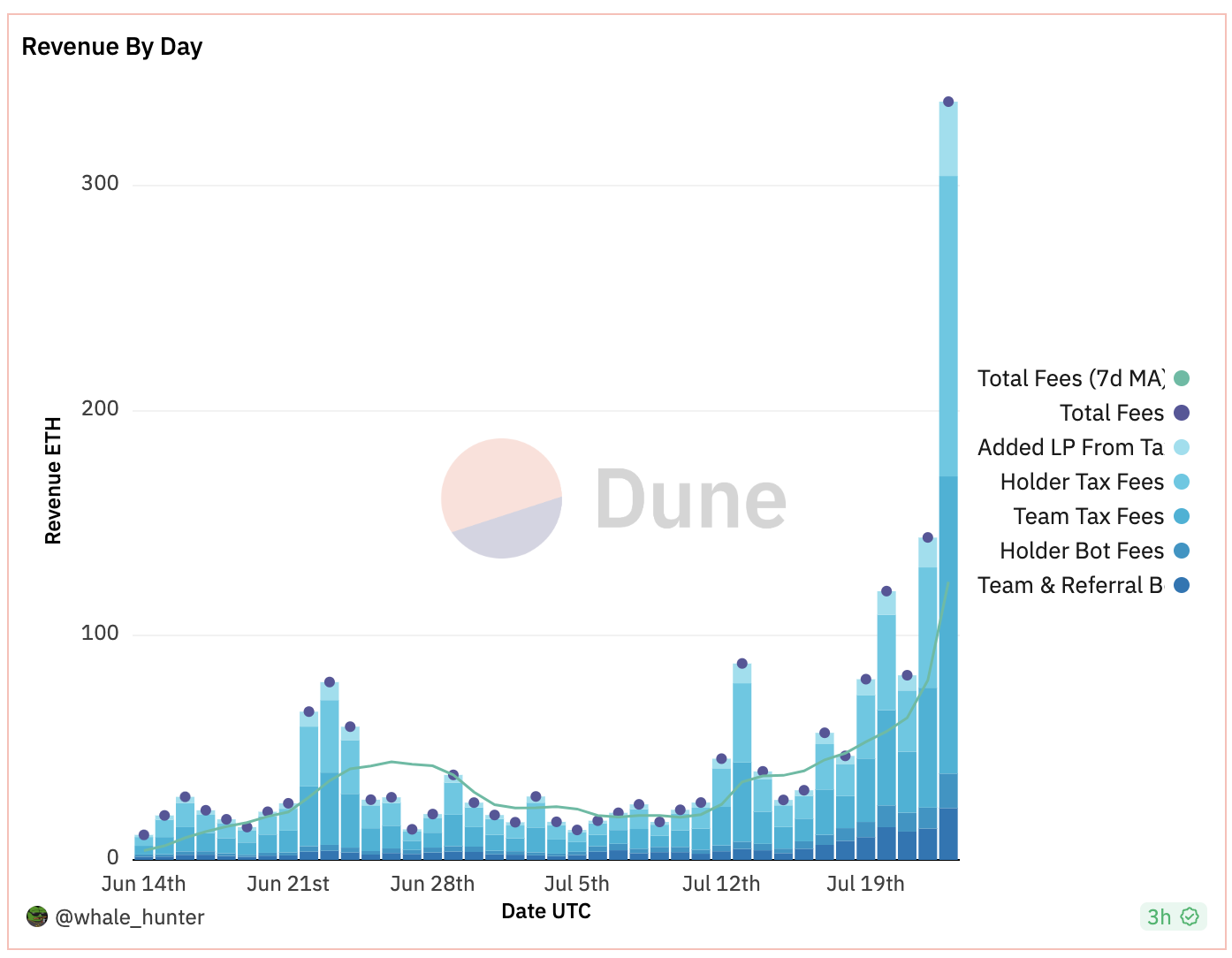
Taking the data on July 23 as an example, the fee generated by the robot transaction is 38.42 ETH, and about 300 ETH is generated by the transaction tax of $UNIBOT, accounting for about 89% of the transaction tax.
Prior to this, there were also many MEME tokens with transaction taxes, which were used to distribute to teams, token holders, destroy or add liquidity. The incentive effects of such tokens were often not sustainable.
Robot transaction fees
The transaction fee generated by the Unibot robot belongs to the "real yield", but it can be seen from the above that this part only accounts for about 11% of the total fee. The Unibot robot has generated a total transaction volume of $79.66 million in the past, with a total of about 120,000 transactions, accumulating a total of 396.92 ETH in fees.
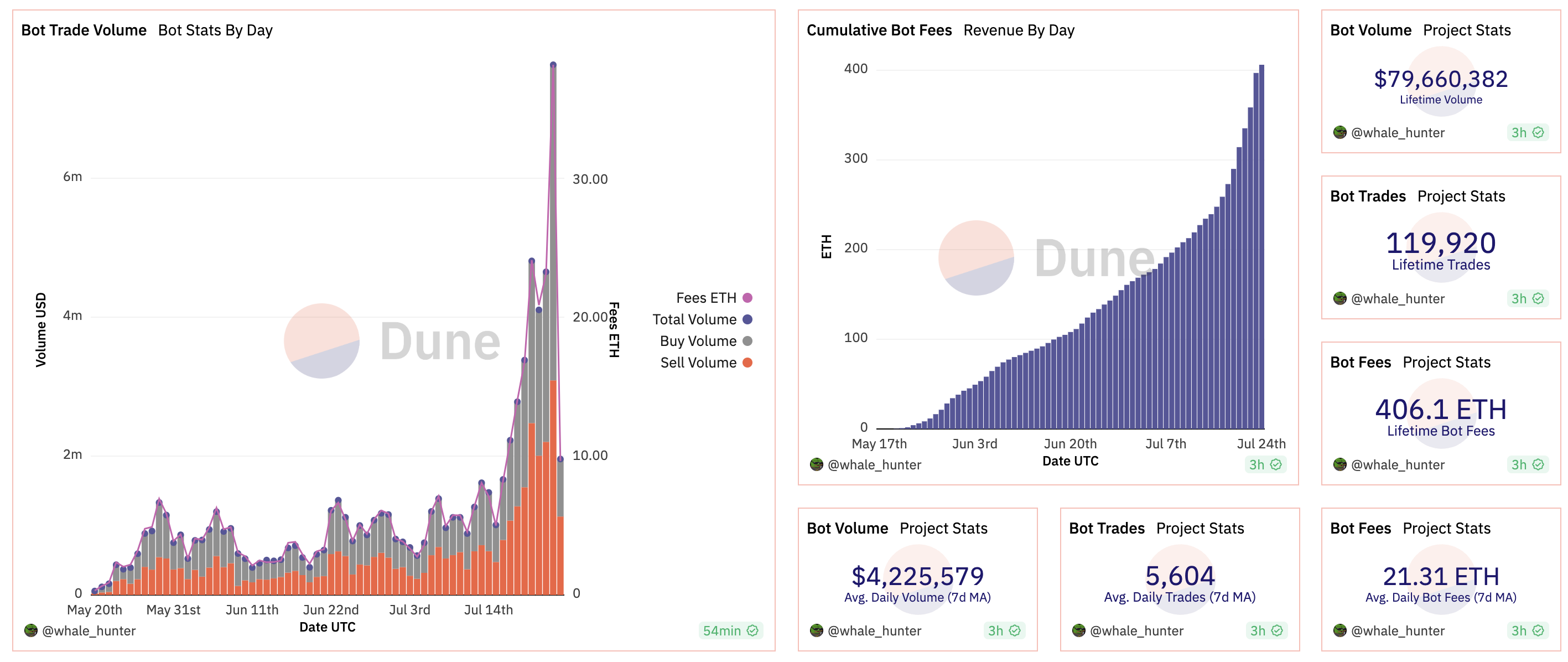
From Dune’s data, bot transaction fees are also on the rise, with fees on July 23 being 1.65 times the previous day’s fees, but not as fast as $UNIBOT’s tax.
Unibot’s source of trading volume
Also taking the data on July 23 as an example, among the top ten trading pairs of Unibot robot trading volume, the trading volume of UNIBOT-WETH trading pair has an absolute advantage, which is 7.5 times that of the second place.
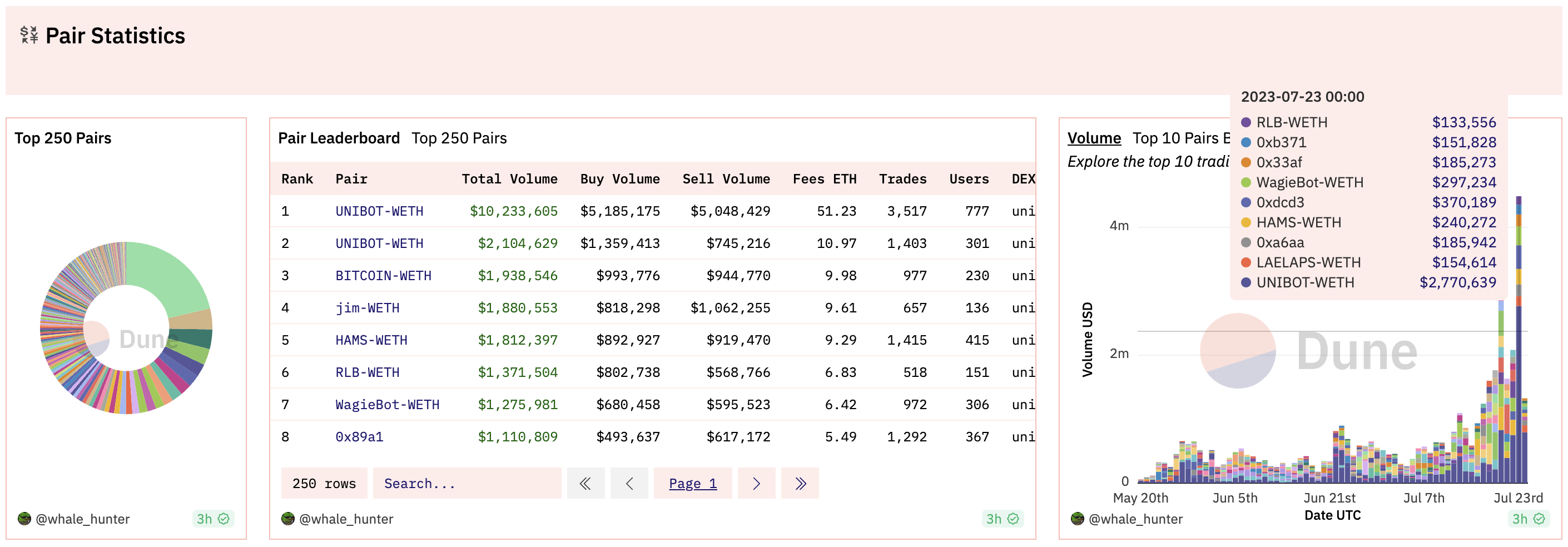
In the past 3 days of trading, 53.6% of the trading volume came from the HAMS-WETH trading pair after the main trading pair excluded UNIBOT-WETH. $HAMS is the token in the real version of the on-chain hamster competition game Hamsters.gg .
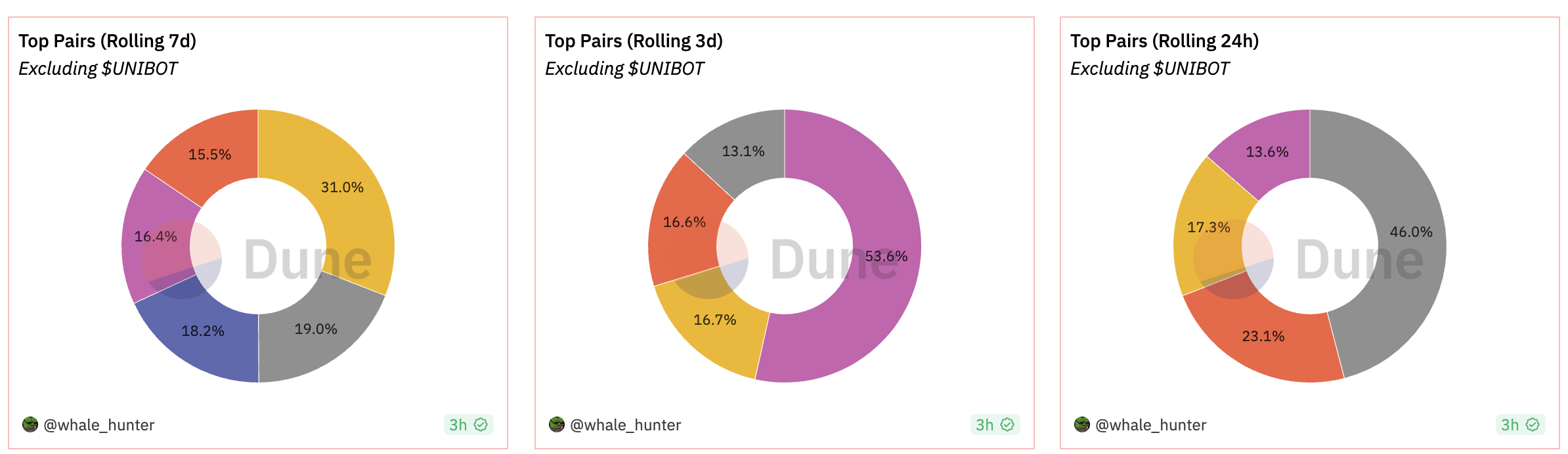
Among all the transactions of Unibot, the tokens with the highest trading volume also include popular tokens such as $BITCOIN, $jim, $RLB on Ethereum and MEME coins, but there may be doubts about whether the popularity of such tokens can continue.
summary
The current static figures for $UNIBOT are very attractive with a P/E of only 1.5. However, about 89% of it comes from $UNIBOT’s transaction tax, and only about 11% comes from the real yield generated by trading robots. Usually, the dividends provided by transaction tax projects cannot last for a long time.
A relatively high proportion of the transaction volume of the Unibot robot comes from UNIBOT itself. In addition, the transaction volume of projects such as $BITCOIN, $jim, and $HAMS on Ethereum is also relatively high in Unibot. It shows that Unibot is indeed suitable for the discovery of popular projects, but whether the hot spots of the traded projects can continue is also a question.