What you really have to be careful with - the springs in the Swiss Army Knife.
Written by: How to Fu, Odaily Odaily
In the public chain war a few years ago, one of the most important tasks for each L1 to attract developers and promote ecological prosperity was to develop new technical solutions to lower the development threshold, and at the same time allow ecological applications to interconnect and form network effects.
Today, we are watching a new round of competition centered on Ethereum and EVM compatible chains, with L2 as the protagonist of the competition.
Among them, Arbitrum, Optimism, Starknet, and zkSync, the "big four", have the best audience popularity. Every progress in technology and cooperation (of course, especially token airdrops) is the focus of attention in the industry.
At the moment when the overall technical route policy has been finalized, the "Big Four" are more adapted to the needs and habits of different development groups, with small improvements and new support solutions for "medium models", and there are few exciting "large-scale releases". ”.
And last week, Polygon Labs released a software tool called Chain Development Kit (CDK) that allows developers to develop L2 backed by zero-knowledge proofs for Ethereum. L2 deployed using its CDK will be able to connect to the shared ZK bridge, enabling interoperability. The tool will be part of the Polygon 2.0 roadmap due out next year.
This caught the attention of Odaily Odaily.
Polygon CDK is the spring in the Swiss Army Knife
Polygon CDK (Chain Development Kit, referring to the nomenclature of SDK) is an open source framework designed to assist developers in quickly deploying L2 based on Ethereum. It provides a modular environment that enables developers to create specific application chains based on specific needs, or to smoothly transition existing L1 to L2. The following figure is a schematic diagram of the Polygon 2.0 technical architecture:
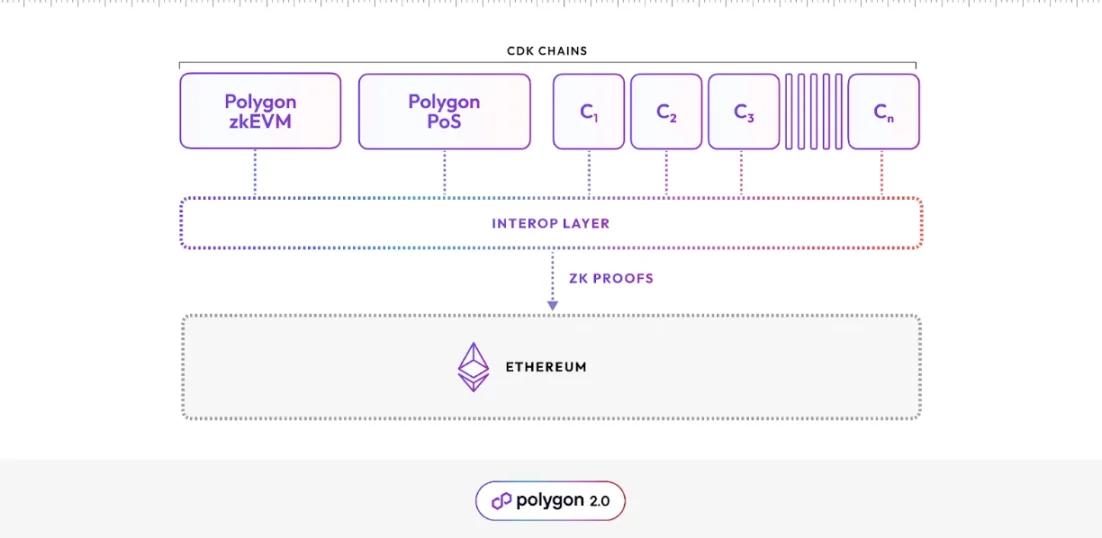
It can be seen from the figure that in the era of Polyogn 2.0, the chain developed based on CDK will be at the same level as Polygon PoS and Polygon zkEVM, and share the security of Ethereum through zk proof.
CDK is designed to provide flexibility and customizability. Developers can choose VM, operation mode, data availability solution, sorter type, Gas token, etc. according to their own needs. For example, they can choose Validium or zkEVM to ensure transaction security, degree of decentralization of sorter, DA localization, etc. (Odaily Odaily Note: Currently Polygon CDK only supports Validium mode construction.)
Officially stated that every chain created by CDK is interconnected, ensuring near-instant finality, unlimited scalability and a unified liquidity pool. This will have to wait until next year for actual verification.
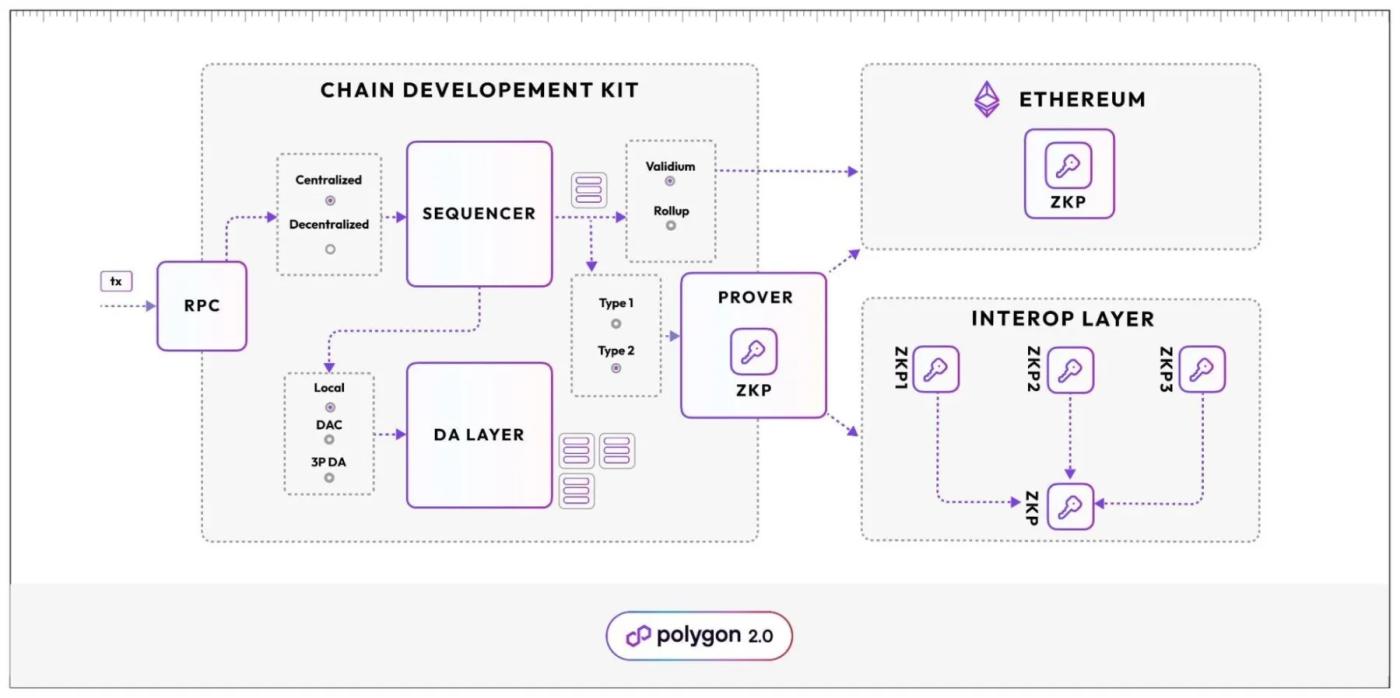
The above figure reflects the functions of different components in Polygon CDK:
Sequencer: optional centralized or decentralized.
- DA (Data Availability): The DA layer is managed by the Data Availability Committee (DAC). DAC’s mission is to ensure the safe and reliable management of off-chain data. For enhanced scalability, DAC plays a key role in moving important computing work and data storage off-chain, thereby reducing the burden on the L1 mainnet.
- Validium: A solution for processing transactions that uses off-chain data availability and computation to decouple transactions from the Ethereum mainnet. Unlike traditional Rollup, Validium does not store transaction data on the L1 network, but generates ZK proofs and publishes them as validity proofs. This approach ensures data integrity while optimizing scalability and cost.
- The release of Polygon CDK means that Polygon's multi-chain layout is about to take shape—Ethereum is the core to ensure security, and its PoS, supernet, zkEVM, and CDK L2 cover application development for various needs, and different Polygon-based chains and L2 Provide unified proof for verification by aggregating the proof layer to improve interoperability between different networks.
People often compare Polygon to a Swiss Army Knife, which integrates various blade solutions on a handle. The CDK is like a spring inside the knife that is invisible to the user.
Can Polygon CDK break out of the L2 stack?
Perhaps, someone will find that Polygon CDK and Optimism's OP Stack have similar problem-solving ideas: parallelize the application chain dedicated to the scene, and build an L2 multi-chain interactive group with Ethereum as the core. (Odaily Odaily Note: Other L2s extend to L3 with themselves as the center.)
This method has the advantages of high composability, low development difficulty, and easy formation of network effects, which is conducive to competing for the developer market.
Have you ever remembered that after OP Stack was released, it has cooperated with well-known projects such as Coinbase, BNB Chain, and Worldcoin. It can be said that in the Stack battle, the OP seized the opportunity.
The advantage of Polygon CDK compared to OP Stack is that the DA layer can choose data storage and calculation for offline operation instead of placing it in Ethereum. At the same time, DAC can ensure decentralization and security, and reduce the burden on Ethereum. In addition, choosing zk proof circumvents the OP's old problem, which is the 7-day waiting period caused by fraud-proof proofs.
Generally speaking, Polygon CDK's model draws on the different characteristics of the OP and ZK camps, and its resource integration and marketing capabilities are not inferior.
Of course, it is too early to tell who will be the final winner of the L2 battle. The technical solution is just paving the way, and the image of a big city depends on landmark buildings (explosive projects), just like Terra back then, which drove the development of the Cosmos ecology. Last month, the popularity of the launch of the Base mainnet allowed OP Stack to gain a wave of attention in this city-state game. It’s worth looking forward to what kind of beast Polygon’s CDK can support.