A successful Rollup can be very profitable
- zksync’s cumulative revenue through Rollup reaches US$20 million (excluding costs)
- Arbitrum has revenue of approximately $11.87 million
- Optimism has revenue of approximately $8.9 million
- Base revenue is approximately $5.14 million
How does Rollup generate revenue?
How Rollup generates revenue will be discussed in five aspects:
- What is Rollup
- Three players in rollup economics
- Rollup cost
- Rollup income
- Rollup Economics Summary
Let’s start by taking a closer look at Rollup, the blockchain scaling solution.
What is a rollup?
First of all, Rollup is a scaling solution. The basic idea is to move some transaction data out of the main chain (such as Ethereum), then process it on the side chain or Layer 2, and only submit the final results to the main chain when needed. .
This approach can reduce the transaction load on the main chain. There are currently two popular types of Rollup: Optimistic Rollup and ZK Rollup.
Extended reading: Analysis of the advantages and disadvantages of ZK-rollup and Optimistic-rollup, why is the zkSync fee still high?
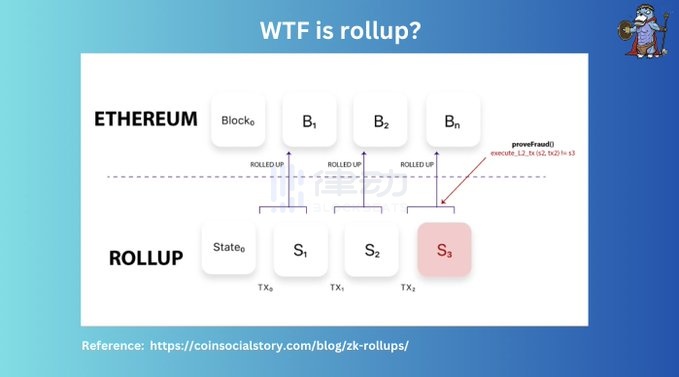
Although they differ in their proof methods, they all have a common goal: to achieve a balance between rollup costs and revenue. To understand how they do this, we first need a basic understanding of rollup economics.
Three players in rollup economics
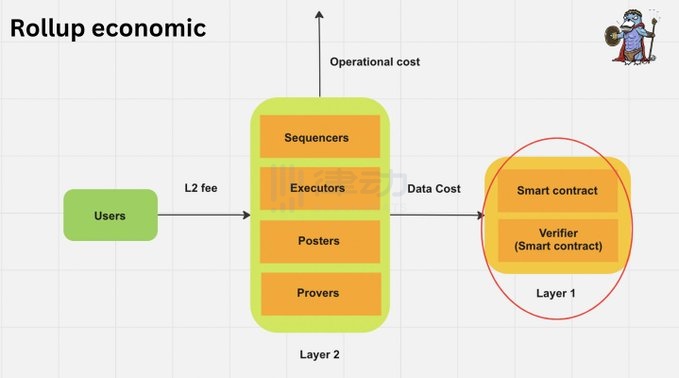
First of all, there are three main players in Rollups: users, operators, and Ethereum/base layer. Each of these actors represents a part of the flow of value within Rollup.
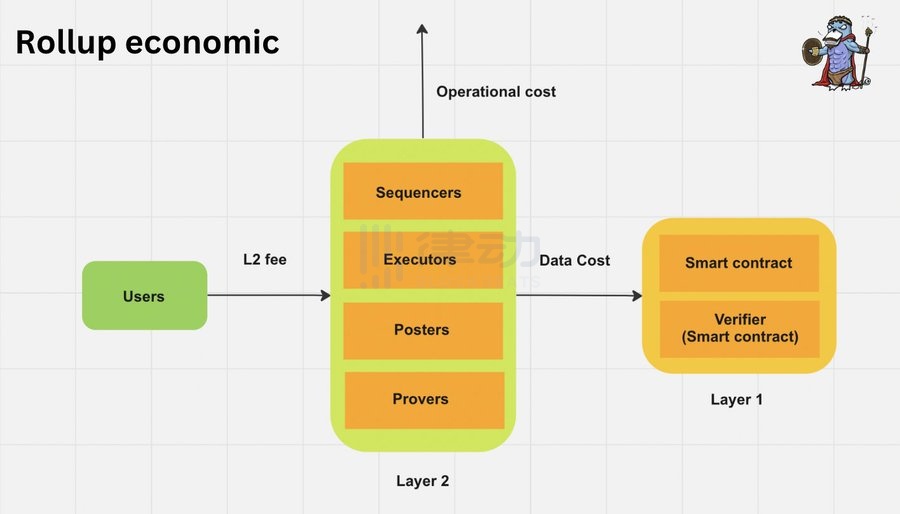
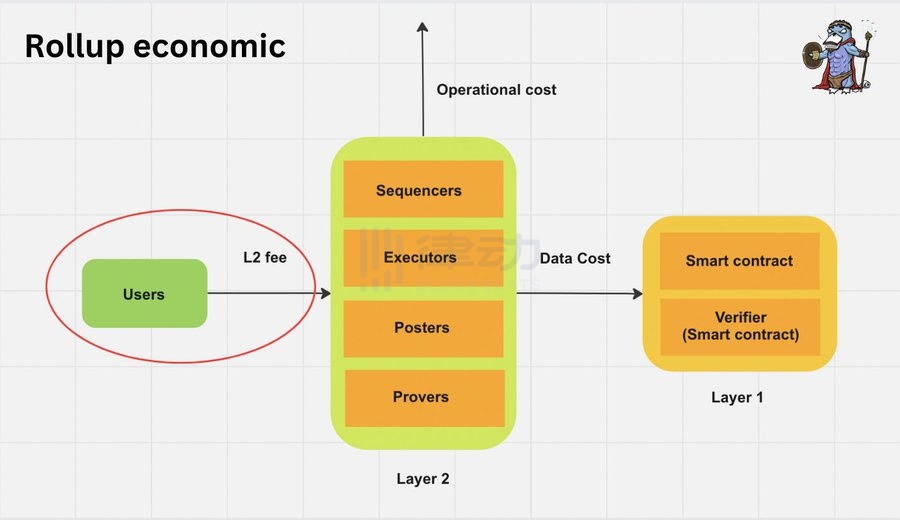
The survival of Rollup depends on users. Users pay Gas fees to execute transactions on Rollup/Layer 2. These fees are one of the main sources of Layer 2 revenue. Details about income are discussed in detail later.
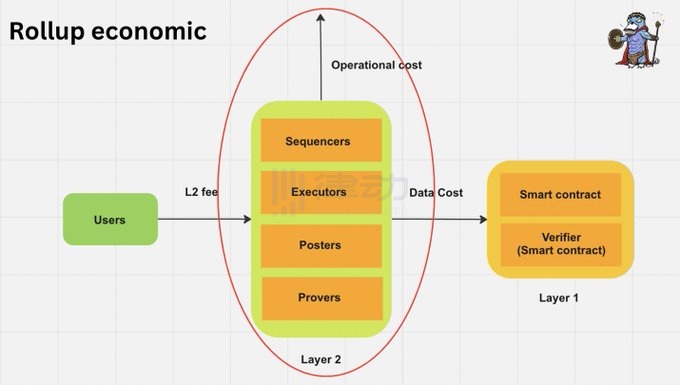
The fees paid by users will flow to Rollup operators, who are responsible for sorting, bundling, batching or calculating transactions that require proof of validity.
Finally, the compressed transactions or messages from the rollup need to be settled on the base layer, which is the most expensive part of all steps. At the same time, implementing a system inevitably incurs costs and revenues that incentivize each party involved to work.
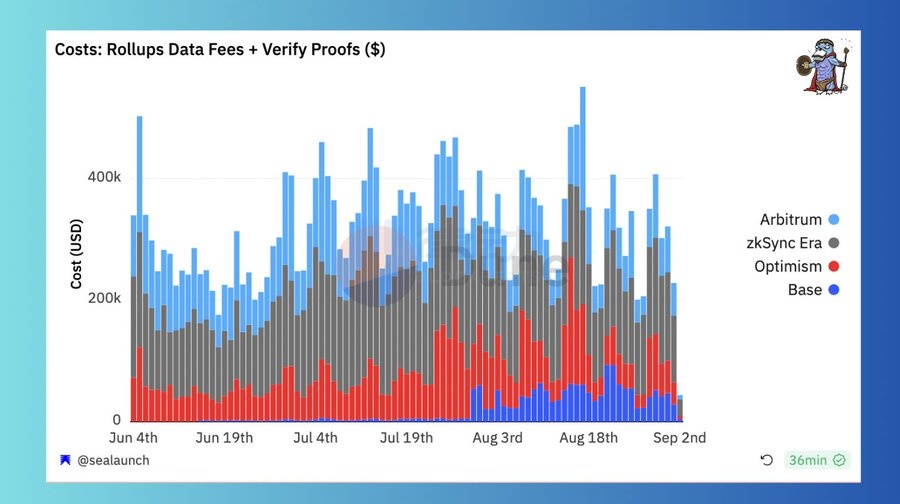
In just 3 months, zksync paid more than $13 million in data availability (DA) and verification costs, followed by Arbitrum, which paid $8.3 million, and Optimism, which paid $6.5 million. But where do these costs come from? Three main factors contributing to these costs include:
- Operator costs
- Data availability costs (DA)
- Proving costs
Rollup cost
Operator costs: costs related to batch transaction processing, transaction verification, block generation, etc. Since most rollup operators are now centralized, these costs are borne by the agreement itself or by the partners.
Material Availability Cost: DA cost is the cost of bulk submission. Once the operator accumulates enough data, it will release the data to the base layer in the form of "CallData". The cost of releasing the data is borne by the base layer, and the market price of the data is governed by EIP-1559.
Validation cost: In zkrollup, nodes on L2 need to submit a validity certificate to prove the correctness of the changes. This process incurs a verification cost every time the state needs to be changed.
Rollup income
Now that we understand the main costs of Rollup, there must be corresponding revenue to offset these costs. Rollup's revenue relies on two main areas:
- transaction fee
- Token issuance
Transaction fees: Whenever a user makes a transaction on Rollup, a certain fee will be charged from the transaction. In addition, Rollup can generate revenue through congestion fees (in the sequencer) and MEV (maximum extractable value for miners) extracted from transactions.
Token Issuance: Launching native Layer 2 tokens can be an important source of revenue for the team. Tokens help pay for infrastructure costs while providing mutual incentives between operators and investors, and also promote decentralization in shared services (the future of Layer 2).
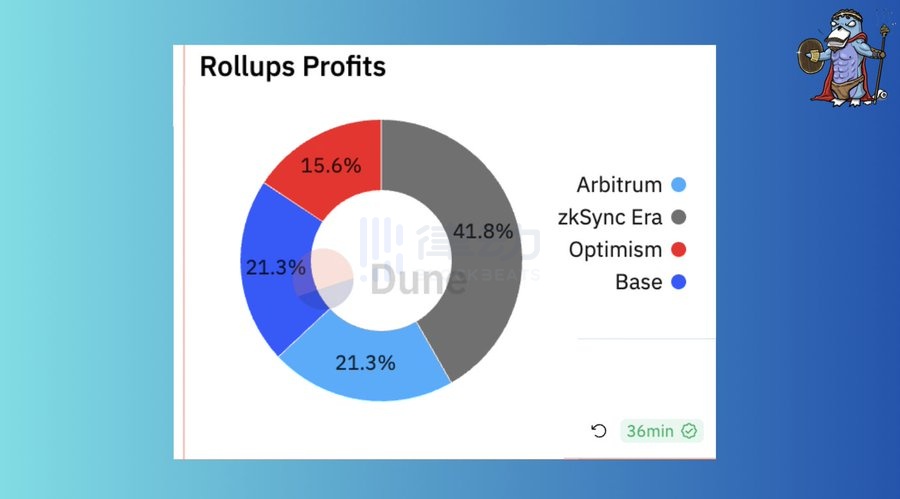
Excluding token issuance and financing income, zkSync can still earn approximately US$20 million in cumulative revenue from transaction fees, with a profit of US$6.87 million after deducting costs, ranking first. Meanwhile, Base and Arb both tied for second place with profits of $3.5 million each.
Rollup Economics Summary
Rollup involves three main players: users, operators and base layer (L1).
The costs of implementing this system include operator costs, data availability costs, and verification costs (which account for the majority of zkRollup). To offset these costs, Rollup relies on transaction fees and token issuance for revenue.
A deeper understanding of the flow of value between users and operators can be summarized in the following equation:
- User pays fee = L1 data availability cost + operator cost + L2 congestion charge
- Operator cost = L1 data availability cost + maintenance operator cost
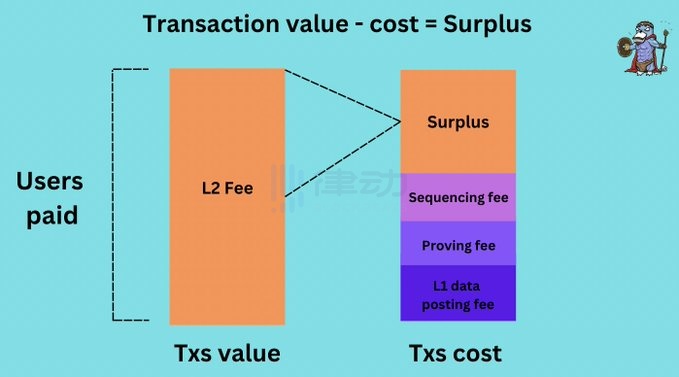
- Operator revenue = L2 user fee + MEV in sequencer
- Operator profit = revenue – cost
Through these basic mathematical calculations, we can estimate the profitability of operators in different rollups.
Given this, maintaining a budget balance or surplus remains the primary goal of each L2. As a result, many L2s are experimenting with different economical designs, including:
- Reduce transmission costs to L1 through strategic methods
- Optimize L2 congestion charge
end
So far we have only scratched the surface of Rollup. There is much more to discuss about Rollup Economics. For a deeper understanding, it is recommended to read "Understanding rollup economics from first principles".