Author: 0x91e2,1kx ; Translation: Jinse Finance 0xjs
Today, mostNFTs represent static assets. The immutability of its media and metadata is enforced either through social protocols or through code. This is sufficient for storing cultural artifacts that are designed to be immutable (static art, music, writing, collectibles), but there is also a vast open design space for experimenting with dynamic on-chain assets that are based on immutable A rule constantly evolves its appearance, metadata, or status.
Dynamic nature makes NFT no longer just a static link and medium, but more like software that responds to external factors. This creates new layers of interaction around digital goods and media, enabling greater individual and collective expression, dynamic utility, and continued innovation around digital objects.
Dynamic NFTs can be programmatic (reflecting algorithmic input) or interactive (reflecting user input). Dynamics is a capability that spans verticals based on the intended use case.
We have witnessed a range of dynamic NFT experiments in art, gaming, identity and prestige, the metaverse, and community and brand engagement.

Performing or conceptual art
Dynamic collectibles can be considered a subset of generative art, which also includes "parametric input" multiplayer art, where the minting time or minter address is used as a source of entropy, but the NFT itself is not updated after minting. Dynamic art NFTs bring ongoing pleasure to collectors and serve as a new medium for collective storytelling between artists and collectors.
With time, moon phase, on-chain state or off-chain conditions (e.g. Alexis Andre’s 720 Minutes, crashblossom’s BURNER, Takens Theorem’s Gaussian Timepieces, Ed Forneiles’ Finiliars, Matt Kane’s Gazers, Harm van den Dorpel’s Mutant Garden Seeder ) and the art of automatic evolution.
Art that evolves with shifting chains and ownership (e.g. Animal Coloring Book, dom.eth’s Corruptions, Joan Heemskerk’s Chameleon, Entropes, OG Crystals, w1nter.eth, and Tyler Anglert’s Watchfaces).
Art where the collector can directly influence the visual (such as divergence's Brotchain, Mathcastles' Terraforms, John Palmer's Shields, Async Art's Forever Supper or Classic, where the collector can change the layers shown in the main artwork).
The art of cyclically releasing style options, with each release containing a new limited-edition style that collectors can choose to “convert” their NFT to (e.g. Openen).
Audiovisual art generated in real time and never repeated (such as 404.eth’s In Noise We Trust, and DEAFBEEF’s various works).

game
In addition to being upgradeable assets in games, dynamic NFTs can also serve as a canvas for gameplay, reflecting the state of the game in its medium and metadata. In conjunction with digital physical goods, NFT can be updated based on real-world activities to unlock new consumer experiences.
Axies who win ranked battles earn Axie-bound experience points (AXP), which can be used to "level up" Axies. Doing so will synchronize off-chain game progress onto the chain, increase Axie's level cap, and allow players to upgrade Axie components.
Citadel Ships can be upgraded to increase their power, speed and fuel efficiency. Each upgrade tier requires a different amount of time and raw materials (ore) to complete. Part of the game involves pilots planning their trip to an asteroid field to mine, with every action and game state reflected on the chain.
“Moves” are on-chain transactions that affect the world, such as Straylight.
Battle arenas where gameplay leaves a mark on the medium, such as Chainfaces Arena.
Infections as a transmission mechanism, such as FoliaVirus, Viper.
Collection, breeding and merging mechanics produce rarer versions such as Avastars, VV Checks.
An auto-playing game using on-chain AI where collectors can hunt for the highest-scoring NFTs, such as Miragenesi’s ArcadeGlyphs.
Real-life games and sports activities upgrade NFT, such as STEPN and Loot LARP.
Treat scores as NFTs where the grade depicted changes as new records are broken, such as the 1kx Score NFTs that can be minted on Onchainscores, Optimizor, and the Play to Learn page.
Find rare avatars and community involvement like Manny's Game
NFTs will eat, infect, and promote each other to become stronger, such as Etholvants & Booster Syringes

status and reputation
Dynamic NFTs can also proxy some identity and associated reputation in the community, which develops with continued contributions and governance activities. This promotes intentional interaction within and outside the community and provides a foundation for building social games.
On-chain activity across applications directly affects NFT characteristics, such as Zerion DNA, Philand City depicts wallet activity, and each city asset can be earned through tasks.
Lens v2 includes out-of-the-box support for the Tokenbound (ERC-6551) standard, providing each Lens Profiles NFT with its own smart account. This decouples the archive from the holder, accumulating access, assets and reputation into the NFT itself.
Social Contracts by Burak Arikan tracks its collectors’ holdings and their shared connections with other collectors, generating a collection graph to predict future acquisitions.
JPG Canonicons artworks represent a unique and cumulative expression of individual participation in Canons curation. Similarly, Deca Decagons are leveled up by spending Deca Experience Points (DXP) earned by completing daily tasks on the platform, which can be spent in-game to open packs containing DUST or brand-sponsored rewards for the current quarter. A leaderboard for the DeGods who earned the most points.
Mercle and Metagame avatars enable gamification and feature unlocking based on one’s actions and role in the community

metaverse
Holders can directly influence and cover the land of on-chain media, such as Mathcastles’ Terraforms.
Land evolves as holders and visitors interact through art curation, such as MOCA ROOMS, or land construction and gameplay, such as Upstreet, Hyperfy, Otherdeeds, Voxels.
Virtual fashion NFTs that can be converted between 3D wearables and artworks, such as RSTLSS.

Community and brand engagement
Large brands are experimenting with using dynamic NFTs to engage with mainstream audiences, adding utility by connecting assets with external data or through ongoing campaigns.
DeGods releases new PFP collectible art and features every season. Holders spend DUST to upgrade their NFTs and can choose which metadata is displayed. Staking DeGods will accumulate more DUST and DePoints for the holder to the staked NFT. DePoints can be spent in-game to open packs containing DUST or brand-sponsored rewards, including a leaderboard for the DeGods earning the most points during the current quarter.
The LaMelo Ball Collectible Sports Cards feature "upgrades" based on the results of real-life basketball data, such as the announcement of his rookie season. The dynamic integration of collections with statistics and milestones will change as a player's career progresses.
adidas ATLS are the PFPs from Adidas' Into the Metaverse collection. Over time, new chapters will be revealed through an interactive storyline, introducing new features to the tokens.
Lacoste UNDW3 tracks community engagement in "Quests," a new experience centered around conversation, gamification, puzzle solving and co-creation.

How do current dynamic NFTs evolve?
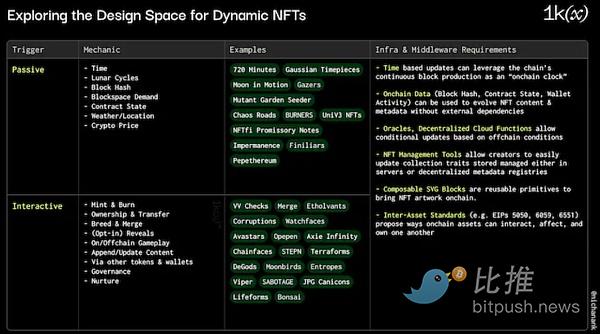
Passive - self-updating, objective
Time: Art that automatically evolves based on time by Alexis Andre's 720 Minutes, Takens Theorem's Gaussian Timepieces, and more.
Moon Phase Cycle: Art that evolves based on the moon phase cycle by Matt Kane’s Gazers, Miragenesi’s Moon in Motion, and more.
Block Hash: The art of mutating using the similarity of the current block hash by Harm van den Dorpel’s Mutant Garden Seeder, Chainleft’s Chaos Roads, and others.
Contract status: Uni v3 position, PartyDAO membership card, pepethereum uses data from Uniswap pool to react to ETH price fluctuations
Off-chain data/Oracle-based: includes crypto and gas prices (e.g. Finiliar, crashblossom’s BURNER), and weather conditions-based (e.g. Josh Pierce’s Impermanence).
Based on ownership/transfer: e.g. Animal Coloring Book, Watchfaces, OG Crystals, Corruptions.
Interactive - directly affected by the owner, subjective
Mint/Destroy: Arts like VV Checks, etholvants, merge, etc. that are affected by minting or destroying.
Add/update content, features, layers: such as DeGods, Moonbirds, Terraforms, Upstreet, Forever Supper, etc.
Voluntary disclosure: such as Open.
Game process: such as Axie Infinity , Chainlife, 0xEssentials, etc.
Community Engagement: Art influenced through community engagement such as JPG Canonicons, Lacoste UNDW3, Collective Strangers Cameras, etc.
Interaction with other NFTs and wallets: e.g. Entropes & Spells, Etholvants & Booster Syringes, Viper. Kim Asendorf’s SABOTAGE has a 1/1 “editor” NFT that allows its holder to alter an entire collection of artwork.
What's changing?
content
The medium of NFT is rendered purely based on on-chain data and automatically evolves based on parameters such as time, block hash, and wallet address to deterministically affect the artwork. In addition to on-chain art and games that typically require custom implementation for each collection, media NFTs that reflect on-chain status can be used to represent DeFi positions (Uni v3 positions, Web3 savings cards), governance rights (PartyDAO membership cards, Juicebox card) or a community membership card (JPG Canonicons, Deca) with some accumulated prestige.
Tokenizing protocol positions into NFTs enables these positions to be traded as assets themselves, turning them into building blocks for new products and services. For example, Metastreet places third-party NFT promissory notes into the Automated Tranche Maker protocol’s collateral pool.
Make the media reflected in the contract state, making the contract state readable to wallets and end-users of the market. The skeleton SVG code is deployed once as part of the NFT contract, and the rest of the image is programmatically updated based on on-chain data.

Metadata
Game items seem like a natural choice for variable metadata, as players can develop or improve assets through gameplay. The advantage of doing this via NFTs rather than virtual items on a central server is that metadata can be tracked and stored on a decentralized infrastructure, so gameplay records persist as items are traded.
supply
Through the casting and burning mechanism that will promote subclassed assets to higher "levels", new assets are generated that can only be derived from certain combinations of lower levels (such as VV Checks) or inherit characteristics from their parents ( Such as CryptoKitties, Avastars).
Neolastics and Clovers are generative art projects that introduce dynamic supply and autonomous economics. With Neolastics, anyone can mint new tokens, and according to the bonding curve, the supply increases with each subsequent minting price. 99.5% of the cost of each mint goes into the community reserve, which acts as a predictable floor and ready buyer when anyone chooses to burn their Neolastic.
Dynamic supply mechanics can also be introduced via in-game receivers and taps. In Citadel, new ships are introduced into the game through a weekly sealed-bid (blind) Dutch auction system. Ships can be destroyed as players travel to more dangerous areas of the game, risking ship destruction for greater rewards. Inflation rates are within a narrow range of the number of new ships offered at auction, while ship destruction tends to be based on a percentage of the total supply. As the total supply increases, the total number of ships burned will increase until it is relatively equal to the number of new ships introduced in the auction.
On-chain functions
Interesting games can be designed to keep certain abilities or functions on the NFT contract dormant until certain conditions are met. For example, a dynamic collection, where the supply is initially reduced only by merging two tokens together, might include a function called "birth" that can only be used after reaching a certain size through the merge (reflected in the contract state ) called on the NFT. The generated and parent tokenIDs can be used as seeds for deterministic renderers to create infinite, visually distinct game rounds, such as VV Checks.
NFTs can also change over a period of time before they are "locked" and become immutable.
How can creators create dynamic NFT collectibles today?
Dynamic Art Platform
Async Art and OG Protocol introduce novel mechanisms, such as Master/Layer NFTs and metadata update pipelines, specifically designed to help artists launch multi-player collectibles and dynamic NFT projects.
Transient Labs has been pioneering experiments in interactive and renewable media art. In ERC-721TL, they outline a way for both creators and collectors to have input on metadata updates, allowing collectors to approve or reject any metadata changes proposed by artists. The standard also provides Story Inscriptions, allowing creators and collectors to leave behind their narratives, exhibition provenance and sales history by attaching on-chain text to NFTs. Hidden Stories by Michelle Viljoen is a demonstration of this standard.
Oracles, decentralized cloud functions and specialized middleware
Can be used to provide off-chain data to smart contracts, allowing the NFT to respond to off-chain events. For more complex interactions, such as UGC in virtual lands, NFT stands for world coordinates and write access. However, the content itself is typically processed and stored on hosting servers, and only references to these hosting services are stored on the tokens.
Chainlink data sources can provide information such as cryptocurrency prices and weather, making NFTs "environmentally aware." Through integration with Space & Time, developers can execute scripts that query game servers and push them onto the chain using Chainlink functions.
Using Gelato Web3 Functions or Lit Actions, developers can write any logic to conditionally update NFTs based on off-chain events or at specific intervals. Gelato nodes run functions continuously and can trigger metadata changes when certain conditions are met. Similarly, Lit operations are performed on Lit's threshold cryptographic network, with each node independently verifying the results and signing the transaction when the 2 ⁄ 3 threshold is reached, for automatic on-chain updates. For example, obtain real-time game data from a sports API and upgrade the NFT's skill characteristics when athletes win games.
Mentaport provides an SDK for “location-aware” smart contracts that support time- and location-based feature access, minting, and dynamic updates, which is useful for time-limited IRL campaigns and proof-of-access mechanisms.
Integrated NFT management platform
Sparkblox, Evalon and Metafuse offer all-in-one solutions to launch and manage interactive NFT collections, enabling holders to interact with assets or dynamic NFTs developed based on real-world data and connected APIs.
Kairos provides a GraphQL API for programmatically creating, minting, selling NFTs, optionally providing updateable metadata, and dynamic NFT developer tools, where metadata and images are saved in Kairos servers.
Paima allows game developers to create stateful NFTs that can level up, gain experience, acquire gear, and evolve over time. Paima's NFT compression protocol mints a minimal set of NFTs on L1 and evolves them based on the game state on L2.
Lync provides game developers with out-of-the-box tools that integrate web3, including cross-chain wallet SDK, market SDK, and NFT management tools, in which Chainlink Automation can be used to trigger updates of in-game assets.
The Syndicate Metadata API provides creators with the option to store NFT metadata and batch update collectible characteristics.
Decentralized metadata registry
Playground is building the infrastructure to connect brands to the existing NFT community by publishing features to collectibles. By pointing a collection's tokenURI to Playground's metadata registry, collection administrators can choose to make their collections eligible to receive features of their NFTs, providing holders with benefits such as exclusive rewards and discounts.
Standards and on-chain primitives
EIP-4906: The Metadata Update extension provides a standard MetadataUpdate event, allowing third-party platforms to easily update the metadata of NFTs. OpenSea supports this and is great for NFTs that are updated by calling the contract, but this is not feasible if the changes are recurring. Juicebox uses cron jobs for the latter use case.
Transient Labs’ ERC-721TL provides creators and collectors with a way to append writes to on-chain NFTs (story inscriptions), a proposal mechanism for metadata updates (Synergy), and a Gas-optimized implementation of batch minting and airdrops.
EIP-721k: Dynamic on-chain images and metadata Build, render and evolve NFTs using composable on-chain SVGModule and DataStream. NFT encodes dynamic instructions forwarded to the SVGElements and DataStreams modules. The SVG rendering engine uses a common registry to build sub-elements, building SVG by encoding/decoding input from multiple external smart contract sources in real time. This allows NFTs to be gradually updated and improved. When the NFT reaches product-market fit, expansion packs and other game features can be easily introduced.
EIP-7496 defines methods for setting and getting dynamic on-chain characteristics related to NFTs. By defining these characteristics on-chain and standardizing how they change, they can be used and modified by other contracts.
EIP-6551: Tokenbound accounts have received a lot of attention this year, and although it does not solve the dynamic problem of NFTs themselves, it enables NFTs to hold other assets and become their own on-chain identity. Tokenbound accounts are backwards and forwards compatible with any NFT collection out of the box. Any smart account implementation can be deployed to NFTs and start holding assets.
A set of standards proposed by RMRK for multi-asset, Nestable, Composable, Emotable and Soulbound NFTs.
merklejerk's Zipped-contracts are a great trick to cheaply deploy contracts that are always called off-chain in an eth_call context. The contract is zipped off-chain, and the runtime contract decompresses the zipped contract, deploys it, and then forwards the original call to the deployed instance. The result is bubbled inside the revert() payload to undo the deployment and avoid permanently modifying the state. This approach saves about 50% of gas and is useful for text-intensive primitives such as composable SVG metadata.
Hot-chain-svg by w1nter.eth is a toolkit for building on-chain SVG projects, with a barebones rendering engine and hot-reload capabilities for developers to quickly and intuitively quality-check their NFT content.
Onchain typefaces and design systems are the building blocks for one-time deployments and bring together more complex on-chain mediums, although it may be a while before we see enough deployments to give creators a good range of options.
in conclusion
Dynamic NFTs are an exciting category-agnostic form factor for digital objects. Although the supporting infrastructure is still in its infancy, its ecosystem has been actively innovating technology, bringing generative media and metadata on-chain, and building composable primitives that can be reused by other projects.
Early-stage dynamic NFT projects require deep technical skills and customized implementation. But as middleware and creator tools become more powerful. We expect dynamic NFTs to be as ubiquitous as "normal" NFTs and offer a variety of use cases.
Some open questions…
How will front-ends such as marketplaces, portfolio trackers, and wallets add support for NFTs evolving in real time?
How can we improve decentralized solutions for rendering or running generated code?
How do publishers and collectors manage permissions and scope of changes to specific NFTs?
How versatile is the dynamic NFT infrastructure? Current foundry engines and storefront builders offer an eclectic range of tools to launch collectibles across media formats. But as the dynamics of different environments vary even more, what does a dynamic module look like?
The success moment for NFTs was arguably not ERC721 itself, but the meteoric rise of CryptoKitties, which became the standard's successful introduction to the market. Even before Ethereum itself, Colored Coins, Quantum, and Counterparty NFTs have shown us that technological innovation alone is not enough to trigger widespread experimentation based on the technology. Instead, it was versatility, strong community spread, and killer apps that turned the standard into a Schelling point for builders for years to come. For dynamic NFTs, the primitives already exist.