Author: Coinbase Research Translator: Shan Ouba, Jinse Finance
Ethereum’s Proof of Stake (PoS) consensus mechanism is the largest economic security fund in crypto, totaling nearly US$112B. But validators who secure the network don’t just earn base rewards through locked ETH. Liquid Staking Tokens (LST) have long been a way for participants to bring their ETH and consensus layer earnings into the DeFi space—to be traded in other transactions or re-hypothecated as collateral. Now, the advent of rehypothesising has introduced another layer in the form of Liquid Rehypothecation Tokens (LRT).
Ethereum’s relatively mature staking infrastructure and excess security budget have enabled EigenLayer to grow into the second largest DeFi protocol in the ecosystem ($12.4B in total value locked (TVL)). EigenLayer enables validators to earn additional rewards by re-staking ETH to secure Active Validation Services (AVS). As a result, intermediaries in the form of liquid re-staking protocols have also become more common, driving the proliferation of LRT.
That said, we believe re-staking and LRT may present additional risks from both a security and financial perspective compared to existing staking products. These risks may become increasingly opaque as the number of autonomous systems grows and light rail operator strategies diverge. Nonetheless, re-staking (and staking) rewards are laying the foundation for a new type of DeFi protocol. Separate discussions around reducing staking issuance to a minimum viable issuance (MVI) could also further increase the relative importance of long-term re-staking yields if these proposals are implemented. As a result, the hyper-focus on re-staking opportunities is becoming one of the biggest crypto themes of the year.
Ethereum’s re-staking fundamentals
EigenLayer's re-pledge protocol went live on the Ethereum mainnet in June 2023, and AVS will be launched in the next phase of its multi-phase deployment (Q2 2024). In effect, EigenLayer's concept of "re-pledge" establishes a way for validators to secure new Ethereum features such as data availability layers, rollups, bridges, oracles, cross-chain messaging, etc., and potentially earn additional rewards in the process. This represents a new source of revenue for validators in the form of "security as a service". Why has this become such a hot topic?
As the largest PoS cryptocurrency, ETH currently has a massive economic foundation to protect its network from malicious majority attacks. However, at the same time, the continued growth of validators and staked ETH has arguably exceeded what is needed to protect the network. At the time of the merge (September 15, 2022), 13.7 million ETH was staked, roughly enough to secure the network's TVL of 22.1 million ETH at the time. As of our upcoming news, there are currently approximately 31.3 million ETH staked, a threefold increase in ETH terms, but Ethereum's TVL in ETH terms is actually lower ( lower than at the end of 2022) at 14.9 million ETH (see Figure 1).
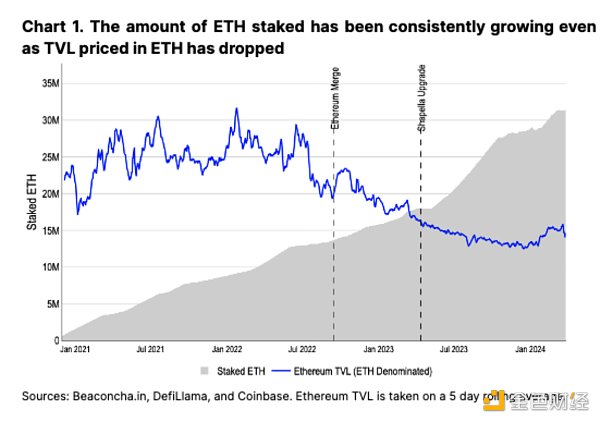
Over-staked ETH and the security, liquidity, and reliability of the underlying assets make it uniquely positioned to help facilitate the security of other decentralized services. In other words, we believe re-hypothecation as a concept is largely inevitable, as an extension of the inherent value of ETH. However, there is no such thing as a free lunch. To ensure the correctness of these services, re-hypothecation is used for behavioral verification and may be subject to seizure or slashing penalties, similar to traditional staking. (That said, slashing will not be enabled when the first set of AVS launches in Q2 2024.) As with staking, re-hypothecation operators receive additional ETH (or AVS tokens) for their services.
Discussion on re-pledge
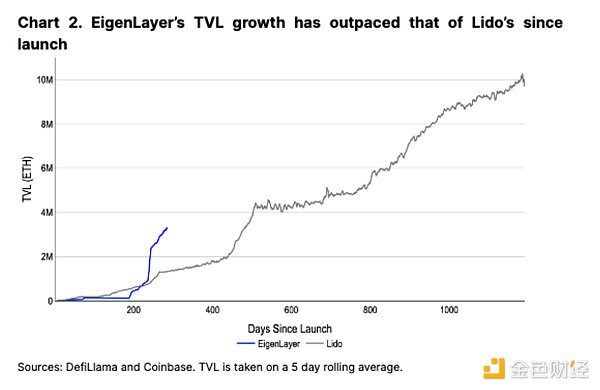
EigenLayer’s TVL growth to date has been astounding, second only to Lido (Ethereum’s leading liquid staking protocol). EigenLayer has achieved this while retaining deposit caps for most processes and before launching any live AVS. That said, it is difficult to decouple the ongoing need for re-staking from user interest in short-term credits and airdrop mining. While the amount of ETH re-staked may continue to grow as the protocol matures, we believe that TVL could see a short-term decline when credits mining ends or early AVS rewards are lower than expected.
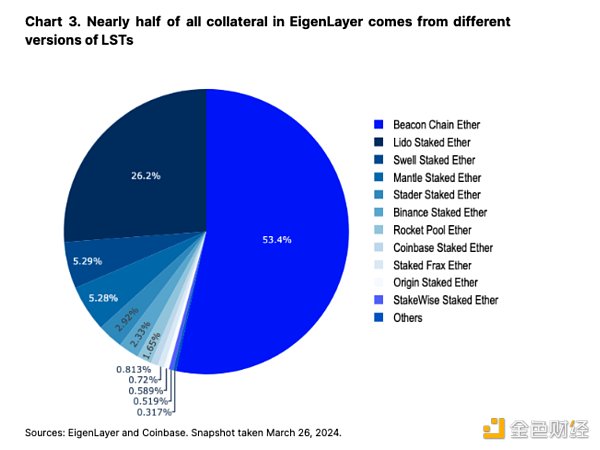
EigenLayer builds on the existing staking ecosystem by staking various underlying LST pools or natively staking ETH (via EigenPods). Programmatically, validators point their withdrawal addresses to EigenPods to earn Eigen points, which are redeemable for protocol rewards in the future. LST locked in EigenLayer (1.5M ETH) accounts for about 15% of all LST, while the total ETH locked in EigenLayer accounts for nearly 10% of all ETH used for staking (3M, a total of 31.3M ETH). (LST itself accounts for 43% of all staked ETH in the ecosystem.) In fact, we believe that the recent interest in new validators joining is caused by re-staking after staking demand stabilized after October 2023. In February 2024, more than 2 million ETH was staked, coinciding with the suspension of the EigenLayer deposit cap. In fact, some LST providers are increasing their target APYs as a way to leverage interest in rehypothecation to attract new users to their platforms.
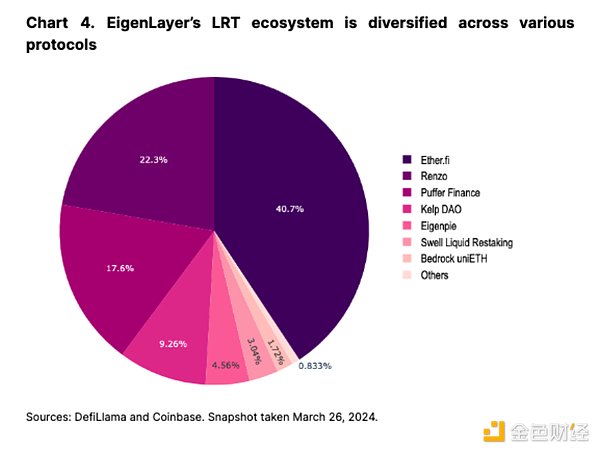
Drawing on the popularity of LST, a rich LRT ecosystem has developed, with more than half a dozen protocols offering versions of liquidity re-collateralization tokens with various points and airdrop schemes. Of the 3M ETH protected in EigenLayer, approximately 2.1M (62%) is wrapped in secondary protocols. We have seen similar patterns in the liquidity staking market before and believe that diversification of alternatives will be important as the industry develops.
In the long term, if native stake issuance decreases due to increased stake participation (yields decrease as more validators join), re-staking may become an increasingly important path to ETH yield. Separate discussions on reducing native staked ETH emission may further increase the relevance of re-staking yield (although this is still early in the discussion phase).
That said, AVS yields are expected to be relatively low upon launch, which could pose challenges for light rails in the short term. For example, the largest light rail, Ether.fi, charges an annualized platform fee of 2% of its TVL for “treasury management.” However, not all light rails have the same fee structure, so there is room for competition in this regard. But if we use this 2% fee as a standard for calculating breakeven costs, AVS would need to pay about $200M per year for EigenLayer’s security services (based on $12.4B re-hypothecation value) to break even—more than Aave or Maker charged in the past year. This raises the question of how much business AVS needs to generate to increase overall returns for ETH stakers.
The emergence of active authentication services
As of today, no AVS have been launched on mainnet. The first AVS to be released (early Q2 2024) will be EigenDA, a data availability layer that can play a similar role to Celestia or Ethereum's blob storage. Following the success of the Dencun upgrade that reduced layer 2 (L2) fees by over 90%, we believe EigenDA will become another tool in the modular tool arsenal to enable cheaper L2 transactions. However, building or migrating L2 to utilize EigenDA is a slow process and may take several months to generate meaningful revenue for the protocol.
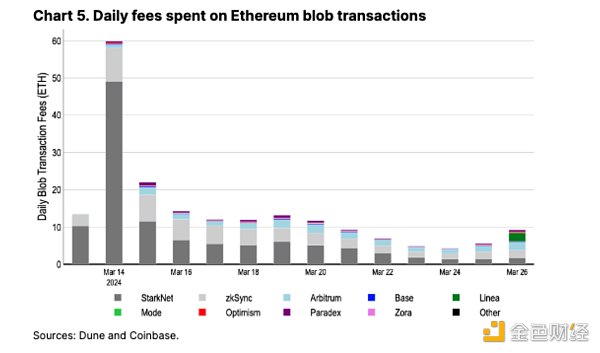
To estimate the initial returns of EigenDA, we can compare to Ethereum blob storage costs. Currently, approximately 10 ETH per day is used for blob transactions from many major L2s, including Arbitrum, Optimism, Base, zkSync, and StarkNet (see Figure 5). If EigenDA sees similar usage levels, the annualized rate of re-staking rewards will be approximately 3.5k ETH per year, equivalent to approximately 0.1% of additional rewards, based on our conservative estimates. We believe that while adding multiple AVS may quickly increase returns, fees may be lower than expected in the first few months.
Other AVS built in the EigenLayer ecosystem include interoperability networks, fast final layers, location proof mechanisms, Cosmos chain security bootstrapping, etc. The opportunity space for AVS is extremely broad and growing. Restakers can selectively choose which AVS they want to secure with ETH collateral, although this process becomes increasingly complex for each new AVS.
Potential problems
This raises the question of how different LRTs will handle (1) AVS selection, (2) potential slashing, and (3) eventual token financialization. In traditional staking, the one-to-one mapping between validator responsibilities and income is clear, making LST a relatively simple matter all things considered. But with re-staking, the many-to-one structure adds some non-trivial complexity (and diversity on the part of LRT issuers) to how gains (and losses) are accumulated and distributed. LRTs pay not only the base ETH staking rewards, but also the rewards for earning a set of AVS. This also means that the potential returns paid by different LRT issuers will vary.
Currently, many light rail models are not fully defined. However, since there is only one LRT per project, all token holders in a given protocol may be subject to uniform AVS incentives and slashing conditions. The design of these mechanisms may vary by light rail provider.
One suggestion is to take a tiered approach, where LRT issuers could adopt a range of “high” and “low” risk AVS, although this would require the establishment of yet-to-be-defined risk criteria. Furthermore, depending on the architectural design, the final reward to token holders might still pay the sum of all AVS, which we believe defeats the purpose of a risk-tiered framework. Alternatively, a decentralized autonomous organization (DAO) could decide which AVS to choose, but this raises questions about who the key decision makers in these DAOs are. Otherwise, LRT providers could act as an interface to EigenLayer and allow users to retain decision-making power over which AVS to adopt.
New risks
However, at launch, the re-pledge process should be relatively simple for operators, as EigenDA will be the only AVS that will need to be secured. However, a feature of EigenLayer is that ETH staked to one AVS can be further re-staked to other AVS. While this can increase returns, it can also exacerbate risk. Submitting the same re-staked ETH to multiple AVS presents challenges when it comes to untangling the hierarchy of slashing and claiming conditions between services. Each service will create its own custom slashing conditions, so a situation could arise where one AVS slashes re-staked ETH for misconduct, while another AVS wants to reclaim the same re-staked ETH as compensation to a damaged participant. This could lead to eventual slashing conflicts, although as mentioned earlier, EigenDA will not have slashing conditions when it first launches.
Further complicating this setup is that EigenLayer’s “pool security” model (where AVSs leverage a common pool of staked ETH to secure their services) can be further customized through “attributed security”. That is, individual AVSs can acquire (additional) re-collateralized ETH that is used only to secure their specific service - a form of insurance or safety net for the premium paid by the AVS. As a result, as more AVSs are launched, the role of the operator becomes more technically complex, and the slashing rules become more difficult to follow. In addition to this re-collateralization complexity, the expansion of LRT abstracts away many potential strategies and risks from token holders.
This is a problem because we think people will ultimately go to where these LRT providers offer the highest returns. As a result, LRTs may be incentivized to maximize their yields in order to gain market share, but this may come at the expense of a higher (albeit hidden) risk profile. In other words, we think it is risk-adjusted returns, not absolute returns, that are important, but it may be difficult to be transparent in this regard. This could lead to additional risk as the LRT DAO would be incentivized to maximize multiple re-collateralizations to remain competitive.
Additionally, LRT could also create downward selling pressure on non-ETH AVS rewards if LRT payouts were made entirely in ETH. That is, if LRT needed to convert native AVS tokens to ETH (or ETH equivalent) in order to redistribute rewards to LRT token holders, the value of rehypothecation could be limited by recurring selling pressure.
In addition, LRT also has non-negligible valuation risks. For example, if the pledge withdrawal queue is extended (validator churn limit is reduced from 14 to 8 after Ethereum Dencun fork), LRT may temporarily deviate from its underlying value. If LRT becomes a widely accepted form of collateral in DeFi (such as LST in lending protocols), this may inadvertently exacerbate liquidations, especially in low liquidity markets.
This assumes that these DeFi protocols are able to properly assess the collateral value of LRT in the first place. In reality, LRT represents different portfolio holdings, and the risk profile of these holdings may change over time. New constituents may be added or removed, or the returns or solvency risks of the AVS themselves may change. Hypothetically, we may see a situation where a market downturn could affect multiple AVSs simultaneously, destabilizing the LRT and amplifying the risk of forced liquidations and market volatility. Recursive lending would only amplify these losses. On the other hand, protocols that are able to decompose LRT into its principle and return components could help mitigate this risk to some extent,
Finally, as Ethereum co-founder Vitalik Buterin has highlighted, in some cases, a major failure in the re-hypothecation mechanism could threaten Ethereum’s underlying consensus protocol. If the amount of ETH re-hypothecated is large enough relative to all staked ETH, there could be an economic incentive to enforce bad decisions that could destabilize the network.
in conclusion
EigenLayer's re-collateralization protocol is expected to become the cornerstone of a variety of new services and middleware on Ethereum, which in turn can generate a meaningful source of ETH rewards for validators in the future. From EigenDA to Lagrange's AVS can also greatly enrich the Ethereum ecosystem itself.
That said, adopting LRT wrappers around underlying protocols may lead to hidden risks due to opaque redistribution strategies or temporary misalignment of the underlying protocol. How different issuers choose which AVS to secure and allocate risks and rewards to LRT holders remains an open question. Additionally, initial yields on AVS may not meet the extremely high expectations set by the market, but we expect this to change over time as AVS adoption grows. Nonetheless, we believe re-hypothecation supports open innovation on Ethereum and will become a core part of the ecosystem infrastructure.