avatar
Sea 🐸
44,680 Twitter followers
Follow
独立韭菜 $BTC ₿ $PEPE 🐸 $ETH Ξ ◦ 🎙️ 访谈播客 @SeaTalk_ ◦ 支持 130+ 公链的 OKX 钱包 https://t.ly/PpEPc ◦ 2.6 亿人在用的币安交易所 https://t.ly/3sg8u ◦ 内容都不是投资建议
Posts
avatar
Sea 🐸
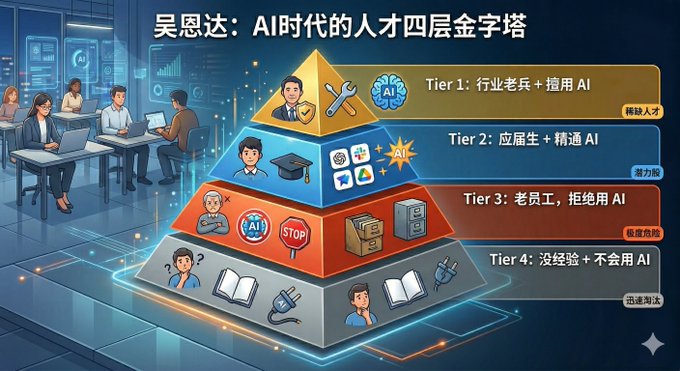
At a forum last month, Andrew Ng proposed a four-tiered talent pyramid for the AI era: Tier 1: Industry veterans + AI experts These individuals understand the business, possess architectural skills, and can execute tasks rapidly using AI. They are currently the most expensive due to their scarcity. Tier 2: Recent graduates + AI experts These are typical "potential stars." While lacking business experience, they are highly proficient in AI tools. Their productivity far surpasses that of experienced employees who don't use AI. They offer high cost-effectiveness, making them popular with both large companies and startups. Tier 3: Experienced employees who refuse to use AI Ng's exact words were, "I will never hire someone like that again." The idea that "experience alone is enough" will be a death knell in the AI era. This group is the most vulnerable to being left behind. Tier 4: Inexperienced + unable to use AI These individuals know nothing and are unwilling to learn AI. They are the ones who will be left behind by the times the fastest, with no value even in training. Universities today are still training graduates to adapt to the workforce in 2022. In just four years, the world has changed dramatically. AI has given ordinary people greater productivity. Even if you're not an engineer, you must possess technical skills. Andrew Ng also said he prefers to hire finance and HR managers who can program, because this way they can build business systems themselves, rather than waiting for the IT department to spend weeks coordinating.
avatar
Sea 🐸
03-19
Every now and then, whenever the market isn't doing well, someone will write a long article reminiscing about SBF, saying how great the crypto would be if he were still around. The logic is flawed. First, SBF made a large number of overseas investments, and those investments were essentially funds he misappropriated from FTX user assets. Alameda Research misappropriated a total of $11.3 billion. This is like using stolen money to buy lottery tickets. Even if Anthropic's valuation later skyrocketed, it doesn't change the fact that it was illegally misappropriated, and it has no moral justification. Secondly, SBF invested in over 470 projects, totaling $5 billion, the vast majority of which went to zero, including various DEXs and liquidity pools. The $500 million invested in Anthropic, had FTX not collapsed, would likely be worth over $30 billion today. But does this mean he was a visionary "investment genius"? Not necessarily. More likely, SBF was holding billions of dollars in misappropriated funds at the time, casting a wide net and simply stumbling upon some projects that later turned out to be successful. This is survivor bias. Third, even if SBF/FTX remains a major shareholder of Anthropic, what does that have to do with the crypto? Why the assumption that AI giants like Anthropic will propel the crypto to new heights? What's the logic behind this delusional fantasy? It's pure wishful thinking on the part of the crypto. There are crypto projects everywhere now trying to capitalize on AI, but how many truly groundbreaking AI projects have actually indicated they need cryptocurrencies? Perhaps what people miss is not SBF, but the barbaric era when anyone could get rich by violently pumping the price and aggressively All In Altcoin.
ANTHROPIC
1.09%
avatar
Sea 🐸
03-18
Thread
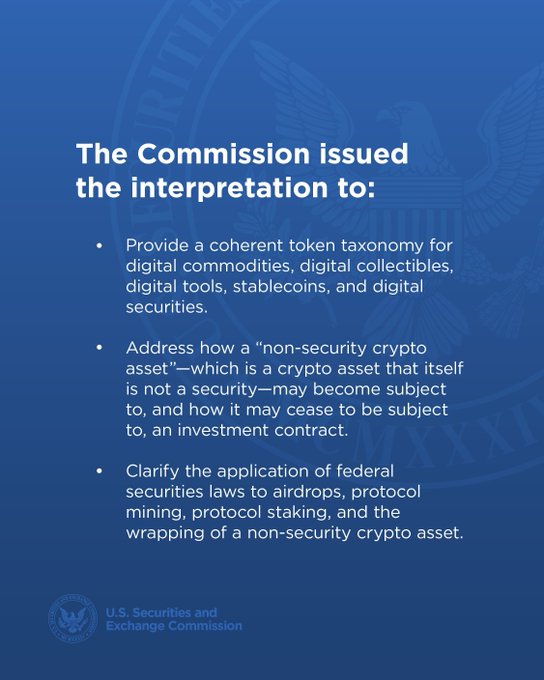
Early this morning, the U.S. Securities and Exchange Commission (SEC) and the Commodity Futures Trading Commission (CFTC) jointly released a document with significant implications for the future regulation of crypto. A quick look at the document reveals that this document categorizes crypto assets into five types: 1/ Digital Commodities ◦ These are assets closely tied to the programmatic operation of a functional cryptographic system. Their value is determined by supply and demand and the system's operation, not by anticipated profits generated from the managerial efforts of others. ◦ They are not securities ❌ and are regulated by the CFTC. ◦ Their characteristics are: 1) No intrinsic economic rights: They do not generate passive income, nor do they grant holders ownership of the future revenue, profits, or assets of a commercial entity; 2) System necessity: They are essential for participating in or using the relevant cryptographic system, such as as gas fees for transactions; 3) Functional purpose: They are used to incentivize transaction verification, maintain network security, promote network effects, or participate in system governance. Typical examples include: BTC, ETH, APT, AVAX, BCH, ADA, LINK, DOGE, LTC, DOT, SHIB, SOL, XRP, and other public blockchain tokens. 2/ Digital Collectibles ◦ These are crypto assets designed for collection or use, such as NFTs (Non-Finite Tokens) like artwork, music, videos, sports cards, and game items, or meme coins and characters. ◦ Characteristics: No economic attributes; no passive income generation; value is primarily driven by supply and demand. ◦ Generally not considered a security ❌, regulated by the CFTC. An exception is if NFTs are fragmented and assigned rights, which may constitute "relying on the administrative efforts of others to generate profits" and be classified as securities. 3/ Digital Tools ◦ These are crypto assets that perform practical functions. Their value does not derive from investment expectations but from the practical functionality they provide. ◦ Not considered a security ❌, regulated by the CFTC. ◦ Characteristics: Function-oriented, such as membership, conference tickets, ownership certificates, etc. (possibly manifested as NFTs); even non-transferable; does not generate income or economic rights. For example, ENS identity domains. 4/ Stablecoins ◦ Are crypto assets that maintain a stable value relative to underlying assets such as the US dollar. ◦ Compliant stablecoins issued by "approved issuers" are not securities ❌, and are regulated by federal payment stablecoin regulators; an exception is whether they involve profit expectations or dividends to determine if they meet the definition of securities. ◦ Characteristics: Primarily used for payment or settlement; under the GENIUS Act, compliant issuers are prohibited from paying any interest or income to holders. 5/ Digital Securities ◦ Are financial instruments within the legally defined scope of "securities," but represented by crypto. Their ownership records are maintained, in whole or in part, on the blockchain. ◦ Are securities ✅, requiring registration with the SEC and regulated by the SEC. The key features are: stablecoins can be issued natively on-chain or are tokenized versions of traditional securities; for tokenized stablecoins, the rights of the holders (such as voting rights) may differ from those of the underlying securities; they may also possess functions similar to digital commodities without altering their security attributes. Previously, market participants had long criticized the SEC for its enforcement-style regulation, lacking a clear regulatory framework and hindering innovation in the crypto industry. Starting in 2025, the new SEC Chairman, Paul S. Atkins, announced the launch of Project Crypto; subsequently, the US passed the GENIUS Act, providing a legal framework for stablecoins. The classification guidelines released today, compared to what Michael Saylor mentioned in a previous interview (x.com/Sea_Bitcoin/status/19327...…)分类更细,更有操作性。也标志着加密货币监管从「不透明的强力执法」转向「可预测的规则框架」。), mean that for project teams, a clearer classification translates to greater room for innovation, allowing them to work more freely and significantly reduce costs; for individual investors, it provides clearer information about the corresponding risks and regulations for their assets and projects. Those interested can view the full PDF file: sec.gov/files/rules/interp/202...… twitter.com/Sea_Bitcoin/status...
LINK
5.76%
avatar
Sea 🐸
03-14
Former British Prime Minister Boris Johnson published an article stating that Bitcoin is a Ponzi scheme. Generally, Ponzi schemes have five typical characteristics: 1/ High-yield promises: such as "30% monthly return" or "guaranteed principal and interest" 2/ Using new money to pay off old money: using money from new investors to pay interest and principal to earlier investors 3/ Mystique: using various obscure new concepts to deceive people, creating the illusion of a "profitable opportunity known only to insiders" 4/ Thresholds and barriers: various rules and thresholds for withdrawals, preventing you from leaving 5/ Networking: often combined with pyramid schemes, encouraging the recruitment of relatives and friends, otherwise there will be no cash flow. From these five dimensions, Bitcoin appears as follows: 1/ No promised returns: Satoshi Nakamoto will not promise you a rate of return. The price of BTC is determined by market supply and demand; it is a digital commodity. 2/ No central authority: the money you receive from selling BTC is paid by another buyer in the open market. This is based on transaction logic, not the misappropriation and redistribution of funds. 3/ Open and Transparent: Bitcoin's issuance/halving rules (x.com/Sea_Bitcoin/status/20310...…)、转账记录、总量限制全都公开透明,任何人都可以查阅开源代码。 4/ No Barriers: With the private key in hand, no one can stop you. Centralized exchanges (banks) may fail, but this is not a problem with Bitcoin itself. 5/ No Referral Rewards: You introduce Bitcoin to your cousin in the village (x.com/Sea_Bitcoin/status/20283...…),中本聪不会给你一分钱奖励。 Therefore, Bitcoin is not a Ponzi scheme. Especially, it lacks the crucial elements of "manipulated distribution" and "fraudulent promises." Bitcoin is an open, transparent, decentralized, and global monetary network driven by code and market demand. twitter.com/Sea_Bitcoin/status...
BTC
3.01%
loading indicator
Loading..