avatar
The ticker is ETH
Follow
Posts
avatar
The ticker is ETH
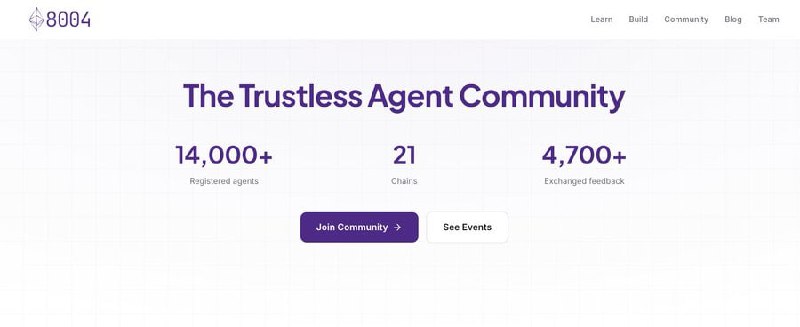
Today's Ethereum News (2026-02-11) 💰 ETH: $1,948 | 📊 ETH.D: 10.0% ⚙️ Protocol Updates - Sherlock selected for the Fusaka upgrade security audit. This aims to strengthen protocol security. - Quick Slots, which shortens slot times in the Hegota upgrade, is proposed. This is expected to improve the user experience. - The 230th ACDE meeting discussed the direction of the Glam and Hegota upgrades. These are key issues on the execution layer. - The 70th ACDT meeting addressed the Fusaka testnet update, gas limit, and state bloat issues. - A stateless implementation meeting was held. Technical progress toward lightweight Ethereum nodes was shared. 📋 EIP Trends - ERC-8128 proposed. This standard, HTTP request authentication using Ethereum signatures, enhances security. - ERC-8004 mainnet launched. This is a universal standard for verifying the identity and reputation of AI agents. - EIP-8141 updated. It relaxes the top-level frame requirement for authorization calls to provide greater flexibility. - A new EIP proposes precompiling multi-KZG point evaluations to improve data proof efficiency. - The introduction of the MUTABLE opcode is proposed. This security feature prevents unintended state changes in smart contracts. 🔬 Research Highlights - The DeCeFi paradigm was proposed. This architecture allows smart contracts to directly access the liquidity of centralized exchanges. - Research on quantum resistance was highlighted. Methods to protect the Ethereum network against quantum computer threats were discussed. - Vitalik Buterin shared the L2 vision, emphasizing the need to enhance the scalability and interoperability of the Layer 2 ecosystem. - The Ethereum Foundation announced the 2026 Postdoctoral Research Program, supporting research converging AI and cryptography. - No updates today. 🐦 Community Discussion - Ethereum: Robinhood Chain public testnet launched. Arbitrum-based financial L2 platform. - Ethereum: Stripe launches machine-to-machine (M2M) payment service on the base network. - Vitalik Buterin: Opposes updates without user permission, emphasizing system transparency and control. - TimBeiko: Retweeted discussion on reducing slot times in the Hegota upgrade, expressing hope for faster transaction processing. - Ethereumfndn: Fidelity stablecoin launches on the Ethereum mainnet, accelerating institutional capital inflow. 💡 Today's Key Points - Discussions on reducing slot times through the Hegota upgrade are in full swing, signaling a revolution in user experience. - The implementation of the ERC-8004 mainnet, the AI agent identity standard, establishes the foundation for an on-chain AI ecosystem. 📌 Sources (including those without content) - X: ethereum, ethereumfndn, VitalikButerin, drakefjustin, TimBeiko, tkstanczak - ethresearch - Ethereum Magicians - Ethereum Blog - Vitalik Blog - GitHub EIPs
ETH
0.97%
avatar
The ticker is ETH
Today's Ethereum News (2026-02-10) 💰 ETH: $2,021 | 📊 ETH.D: 10.0% ⚙️ Protocol Updates - A FOCIL development update meeting is scheduled. This technology increases network stability by increasing the validator's block selection delay. - A meeting is scheduled regarding quantum-resistant transaction signing. This meeting will discuss ways to strengthen security against future quantum computer attacks. - EIP-7928 client optimization work is in progress. Key topics include how to quickly handle invalid blocks and testing updates. 📋 EIP Trends - The ERC-8004 proposal is gaining attention. It establishes a verifiable identity and reputation system for AI agents, enabling them to be used across multiple chains. - EIP-8142 has been proposed. This update simplifies the design by removing the blob gas usage modification. 🔬 Research Highlights - Vitalik Buterin shares his philosophical reflections on the intersection of Ethereum and AI, emphasizing that the two technologies should evolve in a complementary relationship. - The 1TS Initiative, supporting security alliance activities, is announced. This foundation-level support aims to enhance the Ethereum ecosystem's resilience to security attacks. 🐦 Community Discussion - Vitalik Buterin: Emphasized the importance of philosophical alignment when combining AI and Ethereum. - tkstanczak: Emphasized the accelerating adoption of Ethereum by institutions. - ethereum: Shared news of ERC-8004 adoption for AI agent identity verification on major Layer 2 platforms, including Linea, MegaETH, and Optimism. - ethereumfndn: Recruiting new talent to expand the DevCon team in India. - TimBeiko: Shared insights on network proof-of-work. 💡 Today's Key Points - The integration of AI and blockchain is accelerating with the introduction of ERC-8004, the AI agent identity standard, to major Layer 2 platforms. - Technical discussions to enhance quantum resistance and protocol stability are taking shape. 📌 Sources (all sources are listed, even those with missing content) - X: ethereum, ethereumfndn, VitalikButerin, drakefjustin, TimBeiko, tkstanczak - ethresearch: No updates today - Ethereum Magicians: Discussion of FOCIL, PQTS, and EIP-7928 - Ethereum Blog: No updates today - Vitalik Blog: Research on the intersection of AI and Ethereum - GitHub EIPs: EIP-8142
ETH
0.97%
avatar
The ticker is ETH
02-07
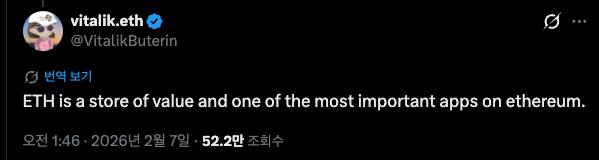
Vitalik: Now, is it okay for the price to rise? “$ETH is a store of value and one of the most important applications on the Ethereum network.” Vitalik has clearly separated the Ethereum network from the Ethereum coin, $ETH, since its inception. He has repeatedly stated in the past that, “$ETH price increases could be problematic as they increase the cost of using the Ethereum network.” This time, Vitalik has described $ETH as both a “store of value” and an “application with utility.” Currently, $ETH’s primary utilities are as follows: - Collateral asset for securing the PoS Ethereum network - Fees (Gas) for network usage - A central asset for the on-chain economy of Ethereum and the entire Ethereum ecosystem (L2, EVM chains, etc.) Notably, this is the first time Vitalik has explicitly referred to $ETH as a "Store of Value." This implies that even if the price of $ETH rises sufficiently, it will no longer lead to structural problems for the Ethereum network. The following structural changes likely underlie this shift in perception: 1. A dramatic decrease in verification costs after the ZK transition The cost of network verification is expected to decrease dramatically after the introduction of ZK technology, and the minimum entry requirement for validators is also likely to be significantly lowered (32 ETH → 1 ETH) in the long-term roadmap. This means $ETH This means that rising prices no longer directly hinder the decentralization of the Ethereum network. 2. Continuously Expanding L1 Block Space Ethereum's L1 block size is rapidly expanding, which suggests that network usage costs have fallen sufficiently to support the $ETH price increase, and are likely to fall further in the future. 3. Purpose-Specific and Performance-Specific Scaling through L2 Specific purposes that are difficult to achieve on L1 (such as censorship, privacy, and ultra-high-speed transactions in milliseconds) can be sufficiently scaled through L2. In other words, the structure where rising ETH prices directly led to decreased network usability has already been resolved. 4. The Misconception of an "Infinite Issuance Asset" Many people still perceive $ETH as an asset with an infinite issuance. However, Ethereum's structure actually allows for more ETH to be burned than issued as network usage increases. While the transition to an L2-centric architecture led to a decrease in L1 usage and burn for a while, L2s are also currently paying significant fees to Ethereum. Additionally, trends such as - rapidly increasing L1 scalability - adoption as a global payment layer through stablecoins and RWA are increasing the likelihood that Ethereum will become a deflationary asset with a gradually decreasing net issuance. Conclusion $ETH is no longer simply a coin consumed as gas fees. It is the asset that ultimately captures the value of all economic activity occurring throughout the Ethereum ecosystem. In other words, $ETH itself is an application with significant utility and a store of value.
ZK
3.34%
avatar
The ticker is ETH
02-06
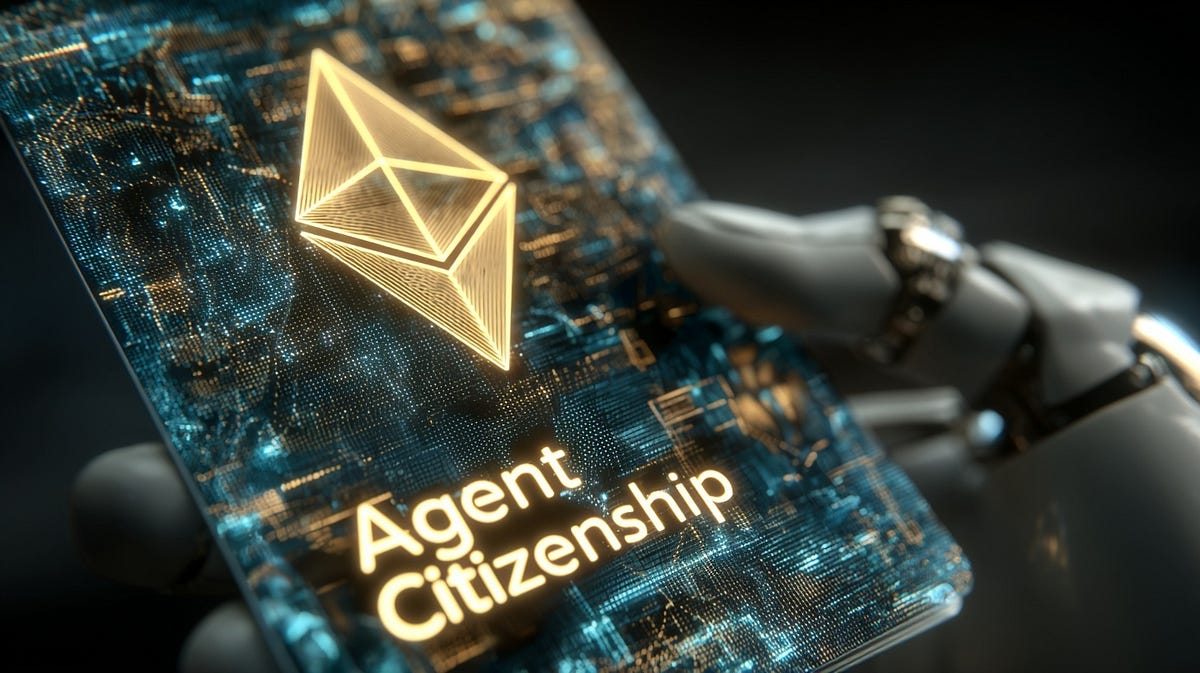
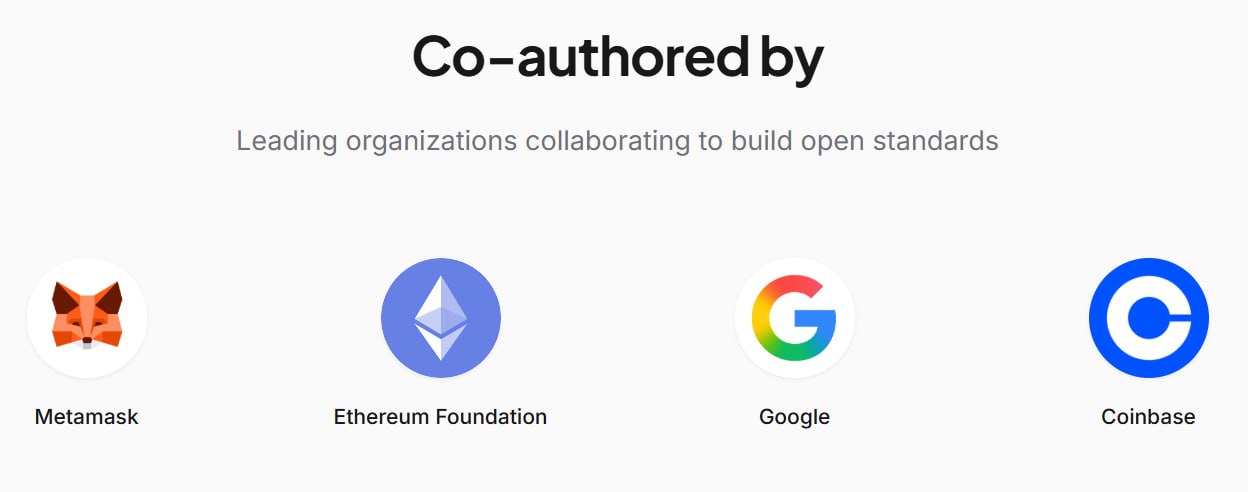
Agent Passports Engraved on Blockchain In an instant, we've arrived at a world where AI agents write code, review contracts, and trade stocks. But these agents lack identification. There's no way to verify who created them, what their past actions were, or whether they can be trusted. A ballroom where billions of people trade under masks. This is the state of the agent economy in 2026. A world of capable, yet anonymous beings. This isn't a problem of technology, but of civilization. One of the latest approaches to solving this problem is the Ethereum standard called ERC-8004. Engineers from MetaMask, the Ethereum Foundation, Google, and Coinbase are co-authors. It's like having Visa, central banks, Google, and passport issuing agencies all sitting at the same table. Why did they come together? They recognized that if they built independently, it would be a losing game for everyone. The agent economy requires a neutral technological infrastructure, unowned by any single company, and the only way to meet this requirement is through blockchain. ERC-8004 consists of three registries: The Identity Registry is the agent's birth certificate. The Reputation Registry is a credit rating—not a simple star rating. The Validation Registry is a court of law. It provides three levels of verification: reputation-based, staking, and zkML/TEE, depending on the risk of the task. Looking more broadly, a single timeline emerges: Agent's Capability Declaration (MCP) → Agent's Common Language (A2A) → Agent's Currency (x402) → Agent's Citizenship (ERC-8004). This is similar to the order in which humans created language, currency, and laws. The difference is that this is happening in 18 months, not tens of thousands of years. Of course, the picture isn't entirely rosy. Sybil attack defenses are unresolved, payment integration isn't part of the spec, and the developer experience is still rough. Agents themselves still struggle with complex tasks. One could argue that it's like issuing a driver's license to a toddler. However, roads are always laid before cars. Infrastructure comes before apps—a pattern that has been repeated without exception throughout technological history. The agent society is coming. That society needs birth registration, a credit system, and courts. The first draft of that constitution is being written right now on Ethereum. medium.com/hashed-kr/pass-for-...
ETH
0.97%
avatar
The ticker is ETH
02-05
Ethereum News of the Day (2026-02-05) 💰 ETH: $2,133 | 📊 ETH.D: 10.2% | 🔒 Staking: 30.6% ⚙️ Protocol Update - Hegota Fork Proposal Closed: The submission window for major features of Hegota, the next upgrade after Glamsterdam, has closed. - Glamsterdam Testnet Underway: The ACDT meeting reviewed the status of testnets such as bal-devnet-2 and epbs-devnet-0. - 2D PeerDAS Proposal: A 2D PeerDAS structure was proposed as a key task for Hegota to improve data availability sampling efficiency. - Gas Limit and Price Adjustment Discussion: Gas limit benchmarking and price readjustment are in progress with the eth/70 update. 📋 EIP Trends - EIP-7607 Status Change: The proposal has been moved to Final, the final approval stage. - EIP-7918 Status Change: The proposal has been moved to Final, the final approval stage. - ERC-8004 AI Agent Standard: A new standard supporting discovery, evaluation, and settlement between AI agents has been proposed as an ecosystem trust layer. Emerging - EIP-8055 Guardian Shield: A security-focused new proposal, including the ability to burn stolen tokens, was discussed. - EIP-8037 Gas Metering Analysis: Analysis of various aggregate functions to address resource bottlenecks in a multidimensional gas metering system was conducted. 🔬 Research Highlights - LUCID Encrypted Mempool: A design for an encrypted waiting space was presented to increase censorship resistance and protect transactions from MEV extraction. - Multidimensional Gas Metering Research: A mathematical model was studied to optimize the interaction between state gas and burst gas under EIP-8037. - Post-Quantum Security: A signature and security suite demo was conducted to address quantum computer attacks, exploring ways to enhance security. 🐦 Community Discussion - Vitalik Buterin: Pointed out that simple EVM chain replication and one-week delay bridge-style L2 are now outdated infrastructure. - tkstanczak: Highlighted the potential for AI agent finance integration leveraging Ethereum's liquidity and DeFi ecosystem. - Ethereum: Fidelity's Sharing examples of real-world financial integration, including the launch of the new stablecoin FIDD and attracting USDC investment on the Base chain. - ethereumfndn: Call for applications for the 2026 PhD Fellowship Program for the long-term evolution of Ethereum. 💡 Today's Key Points - Advanced technical proposals, such as the cryptographic mempool and 2D PeerDAS for the next upgrade, Hegota, were intensively discussed. - Standardization efforts for building an AI agent economy on Ethereum, starting with ERC-8004, are in full swing. 📌 Sources - X: ethereum, ethereumfndn, VitalikButerin, drakefjustin (no content), TimBeiko, tkstanczak - ethresearch - Ethereum Magicians - Ethereum Blog (no content) - Vitalik Blog (no content) - GitHub EIPs
ETH
0.97%
loading indicator
Loading..