Qubic is controlling 26.96% of Monero's hashrate and plans to conduct a 51% Attack from August 2 to August 31.
The top privacy cryptocurrency Monero (XMR) is facing its most serious challenge in history as the Qubic blockchain project announces a plan to take control of over 51% of mining hashrate. This intentional attack is expected to start from August 2 and last until August 31, raising deep concerns about the security and trust in the Monero network.
Sergey Ivancheglo, the founder of Qubic known by the alias CFB, has hinted at this plan on social media. According to the statement, the goal is not to destroy Monero but to demonstrate the effectiveness of the new "Useful Proof of Work" (uPoW) technology. However, the Monero community still expresses concerns about potential impacts such as double spending, transaction censorship, and orphan block creation.
Qubic's uPoW system allows "AI miners" to simultaneously secure the Qubic network and mine Monero during idle time. The XMR rewards will be converted to USDT, then used to buy and burn QUBIC tokens, creating a profitable deflationary model. This integrated mechanism has been operating since May 2025 and is attracting a large portion of the Monero mining community.
Monero Community Divided by the Threat
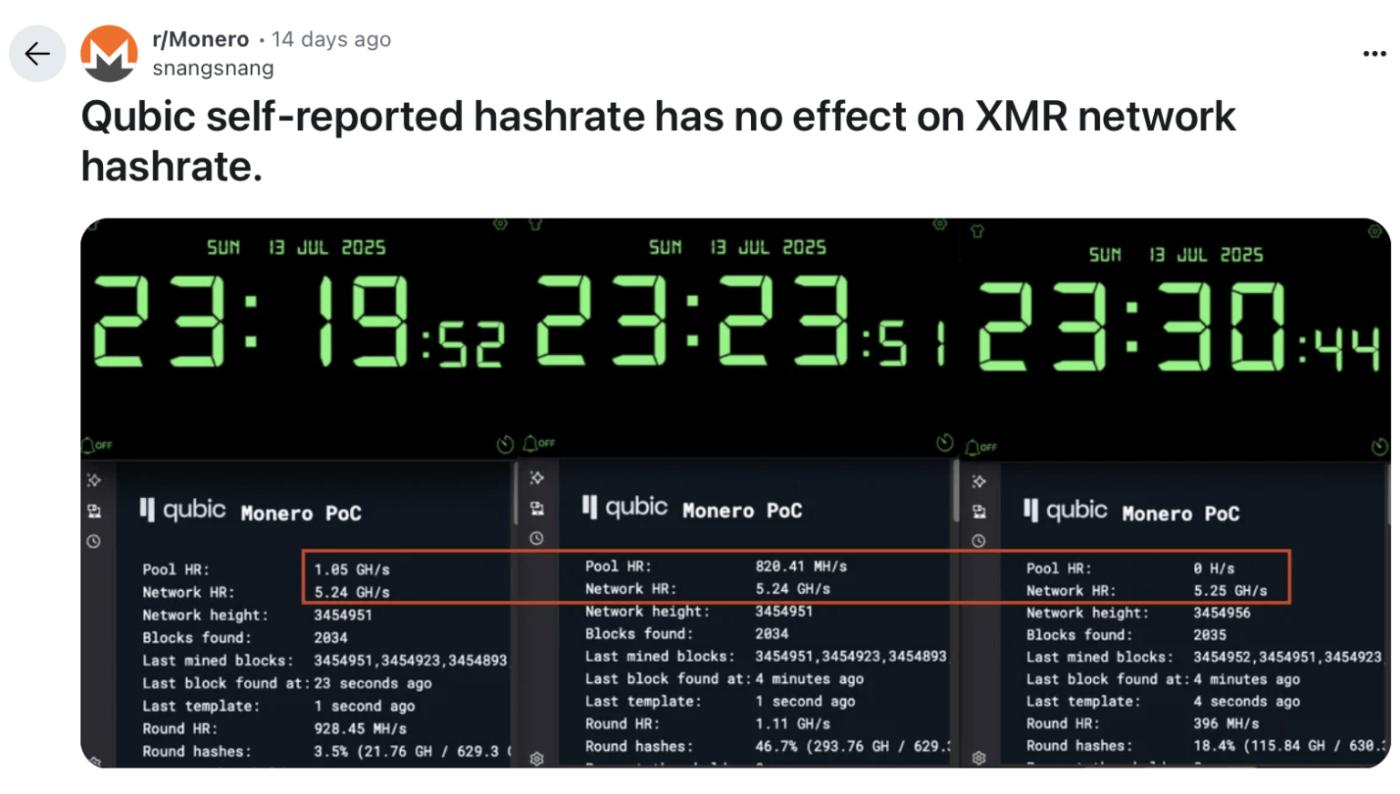
Data shows that in July, Qubic's global hashrate for Monero fluctuated between 20% and 40%. As of July 27, 2025, Qubic controls 26.96% of Monero's total 6.12 gigahash/second, approaching a concerning threshold.
The reaction from the Monero community has been quite harsh. Many supporters accuse Qubic of manipulating self-reported hashrate and parasitizing the Monero network. They warn that if the 51% Attack succeeds, trust in Monero could collapse, which is particularly serious given its reputation as the leading private transaction medium.
A member on the r/monero subreddit warned: "We need to be serious and not wait until it's too late to act". This threat recalls the MineXMR incident in 2022, which was mitigated through decentralization and pool migration.
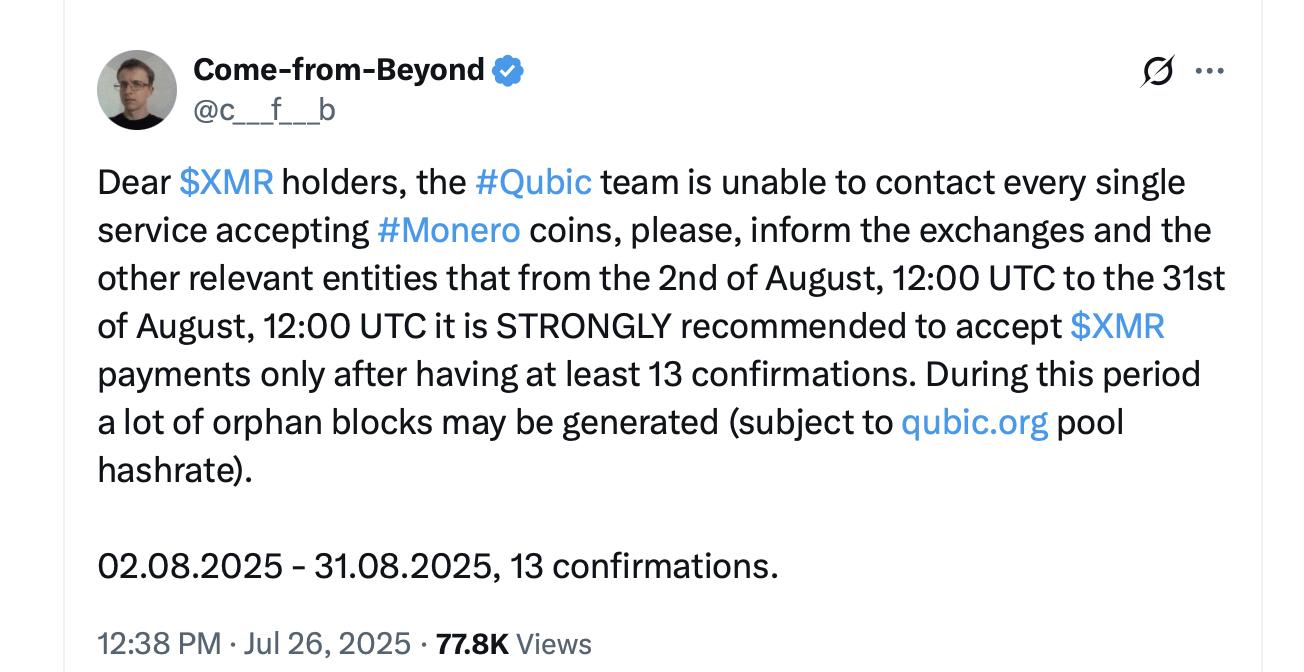
CFB has advised exchanges on X to increase confirmation requirements from 10 to 13 blocks for XMR transactions during the testing period, indicating the seriousness of the plan.
Qubic maintains that they do not intend to cause harm but simply create a new economic incentive, and argue that Monero's privacy features will protect XMR's value from any fluctuations. Qubic supporters view the test as proof of uPoW's capabilities.
Within the Monero community, opinions are divided. Some propose moving to decentralized mining pools like P2Pool, while others call for protocol changes. Neutral observers note this as an important stress test for both projects, exposing potential weaknesses in the proof-of-work model.
If Qubic achieves 51% without causing damage, it could bolster uPoW's reputation. Conversely, if the system becomes chaotic, Monero can still prove its resilience despite short-term price risks.