
This article is machine translated
Show original
Micron's soaring profits have dispelled doubts about an "AI bubble." Is it a good time to buy in on Micron's ($MU) surge?
Micron is also a chip manufacturer. Micron Technology is a chip manufacturer, but Nvidia/AMD are GPU chip manufacturers, while Micron is a memory chip manufacturer.
Core products include DRAM memory chips and NAND flash memory (SSD) chips.
Micron ranks third in global DRAM market share. SK Hynix and Samsung, both South Korean companies, rank first and second respectively. Therefore, Micron is the only DRAM manufacturer in the United States.
Micron ranks fourth globally in NAND flash memory, with the top three being Samsung (South Korea), SK Hynix (South Korea), and Kioxia (formerly Toshiba) (Japan).
Micron's latest quarterly financial report is very impressive. Micron's latest quarterly financial report shows:
Sales revenue was 13,643 million, with 11,315 million, 9,301 million and 8,053 million for the first three quarters, respectively.
However, costs did not increase proportionally; the increase in costs was less than the increase in revenue, resulting in a significant increase in gross profit margin.
The gross profit margin was 56.04%, compared to 44.61%, 37.72%, and 36.79% in the first three quarters, respectively.
This directly led to a greater increase in Micron's net profit and earnings per share.
Diluted earnings per share were $4.60, compared to $2.83, $1.68 and $1.41 for the first three quarters, respectively.
Micron's profits are not only rising, but have seen a rapid increase in the latest quarter.
The surge is attributed to demand for AI, according to Micron's latest quarterly financial report:
DRAM sales increased by 20%, mainly due to a 20% increase in average selling price.
NAND sales increased by 22%, mainly due to a rise in average selling price of more than ten percentage points and increased sales volume.
In other words, the sales volume of DRAM memory chips remained almost unchanged, and the increase in sales revenue came almost entirely from price increases.
Meanwhile, both the price and sales volume of SSD chips are increasing.
Therefore, the price increase is the main reason for Micron's soaring gross margin and earnings per share, especially the price of DRAM.
However, despite the rise in DRAM prices, sales volume has not increased significantly. There are two possibilities:
The first possibility is that Micron's production capacity was limited, and it was unable to produce more DRAM.
The second possibility is that the market prioritized purchasing chips from the two brands with larger market share, and only the price was passed on to Micron, while the demand had not yet been passed on to Micron.
In either case, it reveals a situation where the DRAM market is experiencing a supply shortage.
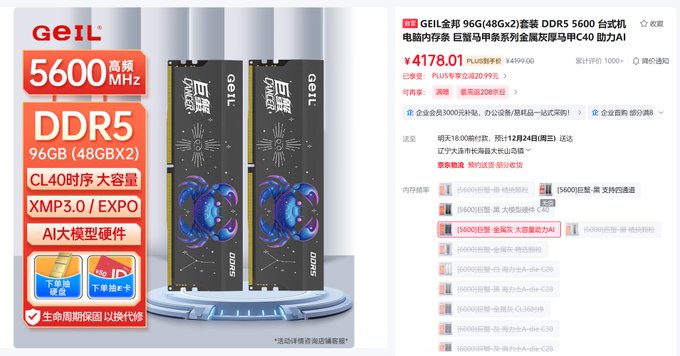
In June of this year, the customer purchased two memory modules at a price of 1680 yuan per module. According to customer service, the modules were shipped randomly with Hynix chips and other brands of chips.
Currently, the price of this memory module has risen to 4,100 yuan, an increase of approximately 148%, which is 2.48 times the original price.
The reason why memory prices have risen so dramatically cannot be due to a surge in demand for PCs.
The surge in demand is clearly driven by AI. With a large number of GPUs sold and deployed in AI applications, memory has become a bottleneck. Existing memory is insufficient to match the performance of GPUs, necessitating more memory.
It's like you've built a computer with a high-end CPU and powerful computing capabilities, but the RAM you've added is too small. As a result, the CPU can't fully utilize its processing power, and the computer can't meet your daily usage needs. Therefore, you must buy new RAM.
This is the current situation in the AI industry: memory is not matching the computing power of GPUs. Therefore, there is a greater demand for memory.
Of course, judging from Micron's SSD chip sales, AI also has a significant demand for SSDs. However, the demand for SSDs is relatively weaker than that for memory. Furthermore, memory production is less flexible than SSD production, making it impossible to quickly produce more memory to meet market demand. Therefore, memory prices have risen significantly, while SSD prices have risen relatively less.
This phenomenon precisely illustrates that the GPUs previously sold have been invested in AI computing, and the AI industry is currently performing a large amount of computational work. The claim of an AI bubble seems unfounded.
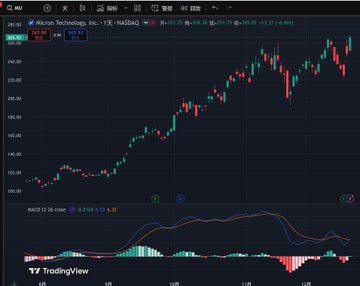
Next, let's look at Micron's stock price.
▌A brief look at the technical aspects
The MACD line is about to golden cross, and the MACD histogram has just turned from negative to positive.
The RSI value is 61.95, which is slightly strong but not overbought. The RSI line crossing above the moving average is also a bullish signal.
▌Growth and Narrative Furthermore, judging from the increase in memory module purchases by BeeBee, Micron's memory chip prices may continue to rise after the reporting period. The reporting period ends on November 27th.
Furthermore, Micron is the only DRAM manufacturer listed on the US stock market.
▌Valuation Finally, let's look at the valuation. Micron's market capitalization is 299.295 billion, and its TTM P/E ratio is 25.25.
Compared to AMD: its market capitalization is 347.473 billion, and its TTM P/E ratio is 112.
MU's market capitalization isn't large, and its price-to-earnings ratio doesn't indicate a price bubble in the current environment. The S&P 500's TTM price-to-earnings ratio is still 30.83.
However, the market is closed today, which is Saturday.
US stock trading will have to wait a while longer; next year, US stocks may launch 5*23 hours, or even 7*24 hours of trading.
$MU closed around 265 on Friday, then rose to 270 in after-hours trading. Now I can only place buy orders on MSX, one at 265 and one at 270, and see if I can get them through pre-market trading on Monday. The great thing about MSX is that you can use leverage:
msx.com/?code=6aTv37

麦通MSX
@MSX_CN
12-18
上一秒:AI 全是泡沫,要完了🥹
下一秒:美光财报炸了,直拉 8%😌
与其焦虑泡沫何时破,不如看清谁在真正向前跑。
MU 财报分析:https://msx.com/news-details/32
#麦通 #MSX #MU #bubble #麦点投研


666
This is actually a stock market commentary?
Yes, and the analysis was correct; the price rose significantly afterward.
You should watch more cows.
😚😚 Thank you for your recognition, University A!
Sector:

From Twitter
Disclaimer: The content above is only the author's opinion which does not represent any position of Followin, and is not intended as, and shall not be understood or construed as, investment advice from Followin.
Like
Add to Favorites
Comments
Share
Relevant content