This article is machine translated
Show original
Nvidia has acquired a potential competitor, announcing last night a $20 billion cash deal with AI chip startup Groq. However, the official statement clarified that it's not an acquisition of Groq as a company, but rather a technology license to integrate Groq's products into future offerings. Founded in 2016 by a group of former Google engineers, Groq is the core team behind TPUs and focuses on designing high-performance AI accelerator chips. Nvidia's move can be seen as following in Google's footsteps, accelerating its efforts in inference.
Technologically, 1) this represents Nvidia shifting from a single GPU (Graphics Processing Unit) approach to a dual-track model of "GPU + LPU," moving from "general-purpose parallel computing" to "dedicated deterministic inference."
2) Particularly in the storage path, from HBM (High Bandwidth Memory) to SRAM, HBM, while offering large capacity, suffers from bandwidth limitations. Groq's LPU relies almost entirely on on-chip SRAM (Static Random Access Memory), with bandwidth reaching 80 TB/s (approximately 10 times that of HBM). There's a view that the stronger the Groq narrative becomes, the weaker the storage narrative may become. This is something to watch for regarding the future trend of storage copyright.

qinbafrank
@qinbafrank
12-24
昨晚英伟达成了大科技里走势最强的那个,明显走出了震荡调整区间。最直接消息应该是,继之前川普取消了芯片出口管制后媒体披露了英伟达已经告知中国客户,计划2026年2月中旬交付H200芯片,2月中这一次发货总量预计在预计发货总量为5000—10000套模组,约4万至8万颗 H200芯片。 x.com/qinbafrank/sta…
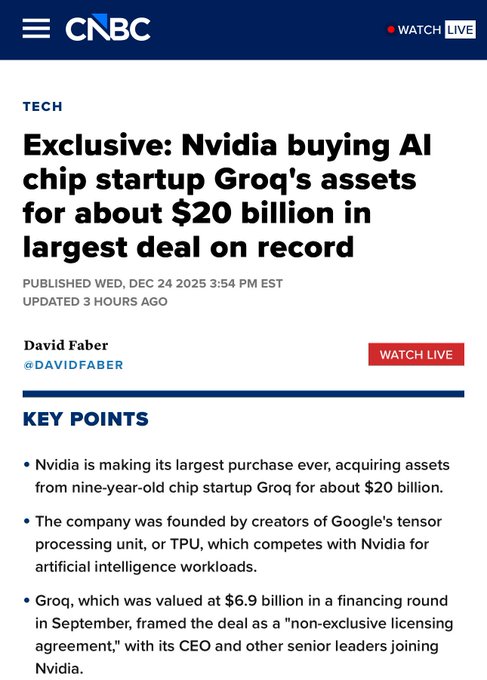
This seems like a positive development. This merger appears to be more than just a resource consolidation; it also seems to involve technological innovation. NVDA should be in a period of rest. After that rest, it's time to get back on track.

From Twitter
Disclaimer: The content above is only the author's opinion which does not represent any position of Followin, and is not intended as, and shall not be understood or construed as, investment advice from Followin.
Like
Add to Favorites
Comments
Share
Relevant content